
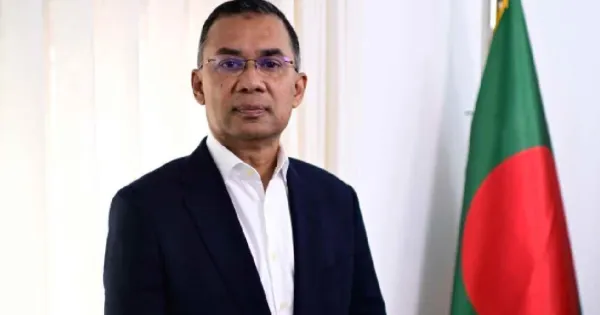
Bangladesh Oath Ceremony: Tariq Rahman became the 11th Prime Minister of Bangladesh, newly elected BNP MPs took oath, know how the cabinet will be.

Dhaka. Bangladesh Nationalist Party (BNP) President Tariq Rahman, who returned home after 17 years of exile, was sworn in as the new Prime Minister of Bangladesh on Tuesday. President Mohammad Shahabuddin administered him the oath at 4.15 pm. Mr. Rahman is the 11th Prime Minister of Bangladesh. After the fall of Prime Minister Sheikh Hasina’s government in July 2025, Mohammad Yunus was managing the country as an advisor to the Bangladesh government. Bangladesh’s general elections were held on 12 February 2026 after nearly eight months of governance under the supervision of Mr. Yunus. BNP made history by winning 209 out of 299 seats in these elections.
Tariq Rehman and his cabinet will take oath
Later, President Mohammad Shahabuddin will administer the oath of office and secrecy to Tariq Rahman and his cabinet. BNP has won 209 out of total 297 elected seats in the first general elections held after the departure of former Prime Minister Sheikh Hasina from power in August 2024. Tariq Rehman will be the first male leader to hold this position in decades. Tariq Rahman (60) is the eldest son of former Prime Minister Khaleda Zia and former Bangladesh President and BNP founder Ziaur Rahman.
Ziaur Rehman was assassinated during a military coup in 1981, after which Khaleda Zia entered politics and became Prime Minister for the first time in 1991. Rehman had been serving as the party’s working president since his mother’s arrest in 2018. Meanwhile, 297 newly-elected MPs will be administered oath by Chief Election Commissioner AMM Nasir Uddin in the oath taking chamber of Parliament.
However, the situation regarding the proposed ‘Constitutional Reform Council’ is not clear. BNP leaders say that the current Constitution provides only for the swearing-in of MPs and not for any Constitutional Reform Council. According to the Election Commission, the process of constituting a ‘Constitution Reform Commission’ is also going on. After getting a majority ‘yes’ vote in the referendum held on February 12, 2026, the Parliament is likely to function as a commission for 180 days.
The BNP has not formally endorsed the referendum, refusing to take a second oath as a member of the commission, while the Jamaat Party has accepted it. According to the Election Commission, more than 60 percent of voters supported the referendum.
Heads of these countries will be included
About 1,200 Indian and foreign special guests are expected to attend the swearing-in ceremony. These include Bhutan’s Prime Minister Tshering Tobgay, India’s Lok Sabha Speaker Om Birla, Pakistan’s Planning Minister Ahsan Iqbal, Nepal’s Bala Nand Sharma and Sri Lanka’s Nalinda Jayatissa. The ceremony will mark the end of the tenure of the interim government led by Chief Advisor Mohammad Yunus. In his farewell address, Yunus underlined the government’s focus on institutional reforms and the draft ‘July Charter’, which received support from various political parties and was approved in the recent referendum. The purpose of the Charter is to prevent the recurrence of authoritarianism in Bangladesh and to ensure the stability of democratic institutions.
Newly elected MPs took oath
Newly elected MPs of Bangladesh Nationalist Party (BNP) took oath on Tuesday, six days after the general elections held in the country. BNP won a clear majority by winning 209 out of 297 seats in the 13th parliamentary elections held after ousted former Prime Minister Sheikh Hasina’s party Awami League was barred from contesting the elections. The right-wing Jamaat-e-Islami won 68 seats and emerged as the main opposition party. Chief Election Commissioner AMM Naseeruddin administered the oath of office to the MPs at Sansad Bhavan (Jati Sansad Bhavan).
Due to the resignation of outgoing Speaker Shirin Sharmin Chaudhary, this oath was administered under the constitutional option. In the changed political scenario, Deputy Speaker Shamsul Haq had to fulfill the responsibility of administering oath to the MPs in the absence of the Speaker. But Haq was sent to jail after the violent student-led movement ‘July Uprising’. It was due to this movement that the Awami League government fell.
According to the official programme, President Mohammad Shahabuddin will swear in the Council of Ministers after the majority party elects its leader and the BNP will formally assume power. Under the Constitution, the President invites the leader of the majority party to form the government and administers the oath to the Cabinet. BNP has said that party president Tariq Rehman will be the next Prime Minister of the country and will lead the cabinet. The party has already made it clear that Rahman will be made the Prime Minister.
However, the BNP has refused to take a second oath as a member of the ‘Constitution Reform Council’ under the referendum conducted along with the general elections. This second oath is linked to a commitment to implement the so-called ‘July Charter’, which proposes comprehensive amendments to the Constitution. According to the Election Commission, more than 60 percent of voters voted ‘yes’ in the referendum.
BNP’s policy-making standing committee member and newly elected MP Salahuddin Ahmed told party MPs before taking oath that he has not been elected as a member of the Constitutional Reform Council and no provision related to the council has been included in the Constitution yet. In the presence of party president Tariq Rehman, he said, “None of us will take another oath.

Comments are closed.