
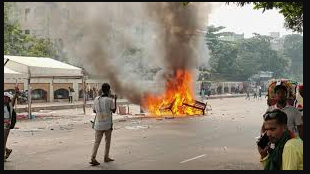
Bangladesh Turmoil: BNP Leader’s Daughter Burnt Alive, India Suspended Chittagong Visa Center

Rohit Kumar
NEW DELHI, Dec 21: Amidst the on-going unrest in Bangladesh caused due to the death of student leader Sharif Osman Hadi forcing India to indefinitely suspend visa operations at Chittagong, a 7-year-old daughter of Bangladesh Nationalist Party (BNP) leader Belal Hossain was burnt to death after an angry mob attacked his house and set it afire on Sunday.
As per the local media reports, the Lakshmipur house of the BNP leader was set on fire in the wee hours of Sunday. Media reported that the event took place at 1 AM when protesters outside the leader’s house set his home on fire with the family still inside.
Belal’s daughter, 7-year-old Ayesha Akter was burnt to death in fire, Officer-in-Charge (OC) of Lakshmipur Sadar Model Police Station Md Wahid Parvez said.
“One child was found dead, and three people were rescued with burn injuries,” Lakshmipur fire service’s Rajint Kumar told Dhaka Tribune. Belal and his two other daughters, 16-year-old Salma Akter and 14-year-old Samia Akter suffered critical burn injuries. Reports said the girls were later transferred to the burn unit of Dhaka Medical College Hospital, where doctors described their condition as critical.
Speaking to the media, Belal’s mother confirmed the attack and claimed the miscreants had locked the doors of the house and set it on fire after dousing it in petrol.
India on Sunday suspended visa operations at the Indian Visa Application Center in Bangladesh’s second-largest city, Chittagong, until further notice in the wake of heightened tensions following the death of prominent youth leader Sharif Osman Hadi, local media reported.
Hadi, a prominent leader of the student-led protests last year that led to the ouster of the prime minister Sheikh Hasina-led Awami League government, was a candidate for the scheduled February 12 general elections. He was shot in the head on December 12 by masked gunmen at an election campaign in central Dhaka’s Bijoynagar area. He died while undergoing treatment in Singapore on Thursday.
His death triggered attacks and vandalism across Bangladesh, including stone-hurling at the Assistant Indian High Commissioner’s residence in Chittagong on Thursday. “Indian visa applications in Chittagong have been suspended indefinitely with immediate effect,” the Indian Visa Application Center (IVAC) said on Sunday.
The statement added that a further announcement will be made regarding the reopening of the visa application center after a review of the security situation. On December 20, security was strengthened at the Indian Assistant High Commission office and the visa application center in Bangladesh’s Sylhet city.
Bangladesh on Sunday “entirely” rejected India’s comments over “Hindu extremists” demonstration in front of its high commission in New Delhi, questioning how the protesters were allowed to come so close to the installation in a secured diplomatic enclave.
Interim government’s foreign affairs adviser M. Touhid Hossain’s comments came hours after India trashed as “misleading propaganda” reports in Bangladesh media that a demonstration outside its mission in New Delhi against the killing of a Hindu man in Mymensingh attempted to create a security situation.
The Ministry of External Affairs (MEA) said about 20-25 youths gathered in front of the Bangladesh High Commission in New Delhi on Saturday, raised slogans protesting the “horrendous killing” of Dipu Chandra Das, 25, who was lynched to death by a mob in Mymensingh on Thursday. The protesters also called for the protection of all minorities in Bangladesh, the MEA said.
“Regarding the Indian press note, we completely reject it, entirely reject it. The issue has been presented as if it were very simple, whereas in reality it is not,” Mr Hossain said. He questioned how a group of 25 to 30 people, “described as belonging to a Hindu extremist organization, could reach such a sensitive zone,” adding under normal circumstances this should not have been possible “unless they were allowed the access.”
Mr Hossain also called the MEA statement “oversimplified” saying “they (India) say it may have been 20–25 people, but that is not the point.” He also said the protesters also did not merely raise slogans over the killing of a Bangladeshi Hindu citizen but made “other statements as well,” and claimed that reports published in Bangladeshi newspapers were largely accurate and not misleading.
Asked if he had any concrete proof about death threats to the Bangladesh envoy in Delhi as speculated, the adviser said no. Mr Hossain said Bangladesh was “compelled” to respond openly following the Indian press note but added that both sides remain in contact through diplomatic channels and convey their positions accordingly. Dhaka still trusted India to take appropriate security measures, but would consider scaling back its presence if the situation deteriorates, he added.
On December 20, security was strengthened at the Indian Assistant High Commission office and the visa application center in Bangladesh’s Sylhet city. The enhanced security measures were put in place to ensure that “no third party can exploit the situation,” Additional Deputy Commissioner (Media) of the Sylhet Metropolitan Police Saiful Islam said.
Hadi, 32, was laid to rest on Saturday amid extra-tight security beside the grave of National Poet Kazi Nazrul Islam near the Dhaka University mosque. Tens of thousands of people attended the funeral prayers, and ahead of the ritual, they chanted anti-India slogans like “Delhi or Dhaka – Dhaka, Dhaka” and “brother Hadi’s blood will not be allowed to go in vain.”

Comments are closed.