
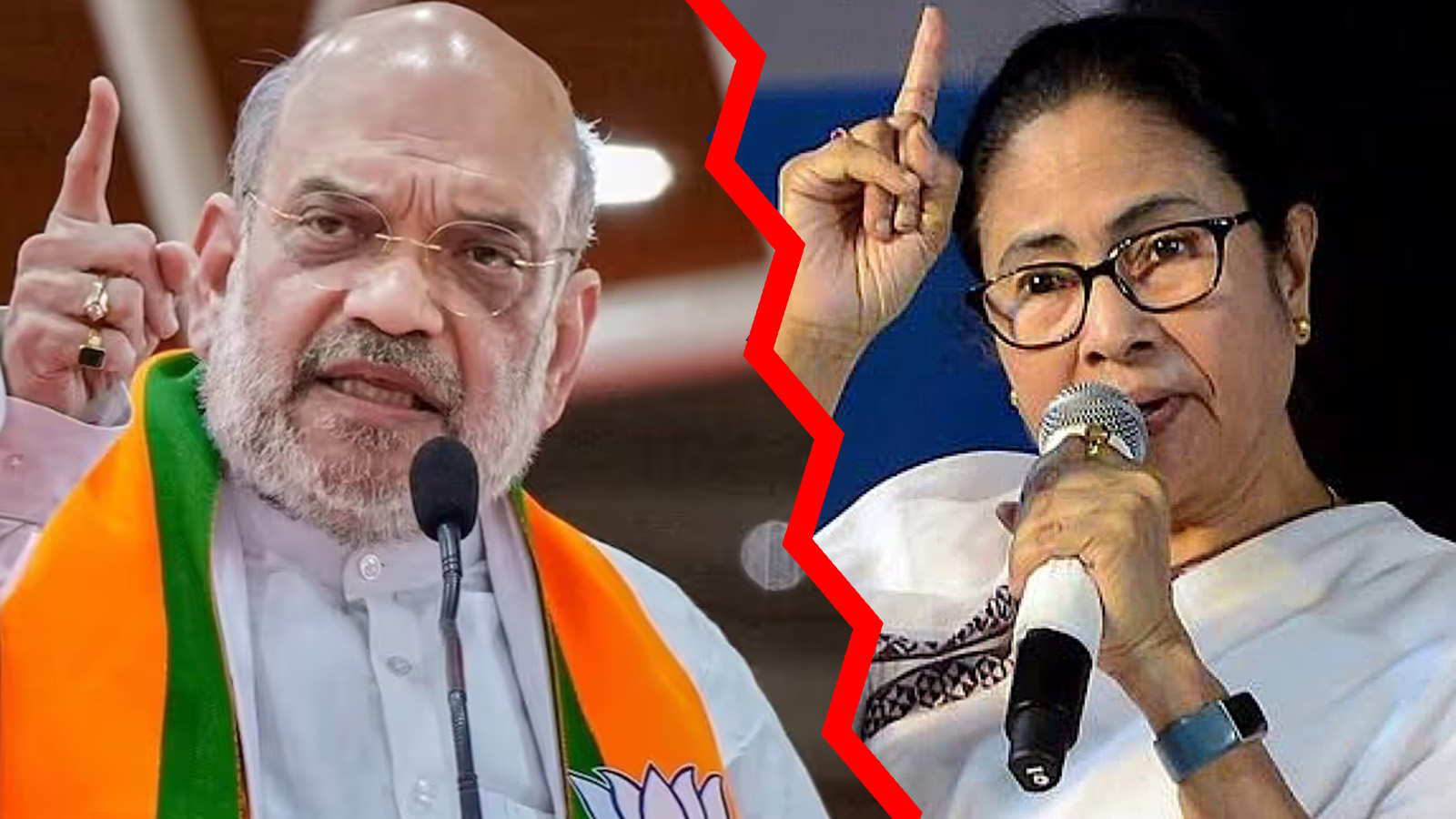

The 2026 West Bengal assembly election arrives with more moving parts than most of the previous contests in living memory.
The incumbent is a political institution defending a welfare architecture. The opposition carries national momentum but organisational gaps. The Left and Congress, once the state’s dominant forces, are competing for a consolation prize.
And above all, 91 lakh voters have been removed from the electoral rolls in circumstances that remain contested.
Also read: Bengal elections: Peace came to Jangalmahal, but prosperity didn’t follow | Ground Report
It is an election where the drama before a single vote is cast already rivals anything that will happen on the counting day, May 4.
The weight of 15 years
Trinamool Congress (TMC) supremo Mamata Banerjee enters this election as something more, and perhaps less, than a chief minister. She is the state’s dominant political fact, a figure whose persona has become so interwoven with Bengal’s self-image that voting against the TMC has, for many, felt like voting against the idea of Bengal itself.
Her appeal rests on two pillars: the welfare state she has built and the identity she has defended.
On welfare, the record is real. The Lakshmir Bhandar scheme, which delivers monthly cash transfers of Rs 1,500 to general category women and Rs 1,700 to SC/ST women, has restructured the economics of millions of households. It is not philanthropy; it is politics institutionalised into the household budget.
Also read: Bengal elections could be decided by 65-70 constituencies with razor-thin margins
Add to this housing schemes, health programmes, and the Kanyashree initiative, and the TMC has created a web of material dependency that no opposition party has yet figured out how to unpick.
No room for ‘outsider’ politics
On identity, Mamata has been equally consistent. Her positioning as Bengal’s defender against “outsider” politics, first against the Left’s ideological rigidity, now against what she characterises as Delhi’s Hindu majoritarian project, has given her a language that resonates across communities.
In a state with one of India’s most complex demographic compositions, that language has served as a political lingua franca.
The TMC’s cadre structure, despite recent defections and demoralisation, retains an edge that no quantity of national leaders’ rallies can substitute for.
And yet the vulnerabilities are accumulating at a pace that her organisation is struggling to absorb. The most explosive is also the most technical: the Election Commission’s Special Intensive Revision (SIR) of electoral rolls, which has resulted in over 91 lakh names being removed from the voter list, a contraction of nearly 12 per cent of the registered electorate.
The SIR battle
The EC has described the exercise as routine housekeeping, removing duplicate, deceased, and shifted voters. The TMC has called it targeted disenfranchisement of Muslims, Matuas, and Rajbongshis, the party’s core constituencies. Murshidabad, Malda, North and South 24 Parganas, and Nadia recorded the highest deletions.
These are not incidental districts. They are the geographical heart of the TMC’s electoral coalition.
Mamata has been unsparing in her response, alleging that the BJP orchestrated the deletions through its influence over central agencies, and promising legal challenges. But the damage may precede any remedy. In a margin-sensitive election and Bengal 2026 is shaping up to be precisely that, even a modest suppression of turnout in these districts could tip outcomes in ways that no amount of rally rhetoric can correct.
Topic of corruption
The second accumulating vulnerability is less administrative and more atmospheric. Women’s safety, law and order, and the ongoing fallout from corruption scandals, most prominently the 2022 School Service Commission recruitment scam, have provided the BJP with a narrative framework that goes beyond identity politics.
The arrest of the state’s education minister, Partha Chatterjee, in that case was not merely a legal event; it was a political wound that the TMC has not fully recovered from.
In urban constituencies in South Kolkata, Howrah, and Hooghly, voters who formed the core of the educated, secular TMC coalition in 2011, are signalling a fatigue that is distinct from ideological opposition; it is the weariness of disappointed expectation.
BJP’s arithmetic problem
The BJP, the state’s main Opposition, enters this election with a claim that would have been considered fantasy a decade ago: it is competitive across roughly half the state’s constituencies. From three seats in 2016 to 77 in 2021, the trajectory is unmistakable.
The question, and it is the central question of the election, is whether 2026 represents a continuation of that trajectory or it hits a plateau.
Also read: In Bengal, TMC fiercely defends bastion as BJP tries to melt fish-loving Bengali heart
The BJP’s campaign has been muscular and national in character. Union Home Minister Amit Shah has committed to spending 15 days in the state. Prime Minister Narendra Modi has also addressed multiple rallies.
The party’s manifesto, released under the “Sonar Bangla” (Golden Bengal) rubric, leads with the Uniform Civil Code (UCC), promising implementation within six months of forming government, alongside Rs 3,000 monthly for women (outbidding the TMC’s Lakshmir Bhandar), the Seventh Pay Commission for state employees, and zero tolerance towards illegal immigration.
The UCC promise deserves particular attention as a strategic move. It is constructed as a political trap for Mamata: oppose it, and she validates the BJP’s narrative about minority appeasement; support it, and she risks fracturing her Muslim support base. It is clever politics, but whether it translates into votes depends on whether Hindu consolidation behind the BJP is sufficiently strong to overcome the party’s structural deficits.
Those deficits are real. Bengal elections are won at the booth level, through networks of local relationships that take years to build and maintain. The TMC’s cadre structure, despite recent defections and demoralisation, retains an edge that no quantity of national leaders’ rallies can substitute for.
The BJP enters this election with a claim that would have been considered fantasy a decade ago: it is competitive across roughly half the state’s constituencies. From three seats in 2016 to 77 in 2021, the trajectory is unmistakable.
The BJP’s own internal assessments reflected in its decision to focus on seats where it came close in the 2024 Lok Sabha elections rather than spreading thin suggest the party is aware that a wave cannot substitute for organisation in Bengal’s political terrain.
Congress, Left, and politics of irrelevance
The Congress is contesting alone for the first time since 2006, fielding 284 candidates with a symmetrical attack on both the TMC and BJP. It is a principled position with little electoral purchase. The Left, allied with Abbas Siddiqui’s Indian Secular Force, faces a Muslim vote increasingly contested by the AIMIM.
For months, the AIMIM-AJUP alliance built by expelled TMC MLA Humayun Kabir around a provocative Babri Masjid-replica mosque campaign posed the TMC’s dangerous threat: a flank attack on its Muslim base in Murshidabad, Malda, and Uttar Dinajpur.
Then, the TMC released a video purportedly showing Kabir negotiating a Rs 1,000 crore deal with BJP leaders to engineer that very defection. The footage remains unverified. The AIMIM walked out of the alliance anyway. Kabir called it AI-generated fabrication. Shah called it Mamata’s handiwork.
Also read: Why Tathagata Roy is confident BJP will oust Mamata Banerjee
Together, these formations are most likely to peel secular, urban voters who would otherwise consolidate against the BJP, tipping marginal seats saffron without winning a single one themselves. It is the classic spoiler’s dilemma, and neither party has a solution to it.
What Bengal is actually deciding
Bengal’s deeper question in 2026 is not who wins, it is whether single-party dominance is the state’s natural condition or whether it can sustain a competitive equilibrium.
The polling says the latter is now possible. A TMC win at the lower end of projections, 140-odd seats against a BJP pushing 130-plus, would be a chastened victory, not a mandate. A BJP win would be the end of an era, and the UCC promise alone would trigger social change not seen since the Left’s land reforms.
On May 4, Bengal won’t just pick a government. It will signal which theory of governance it prefers: welfare as entitlement or accountability through competition. That answer will matter well beyond this state.
(The Federal seeks to present views and opinions from all sides of the spectrum. The information, ideas or opinions in the articles are of the author and do not necessarily reflect the views of The Federal.)

Comments are closed.