
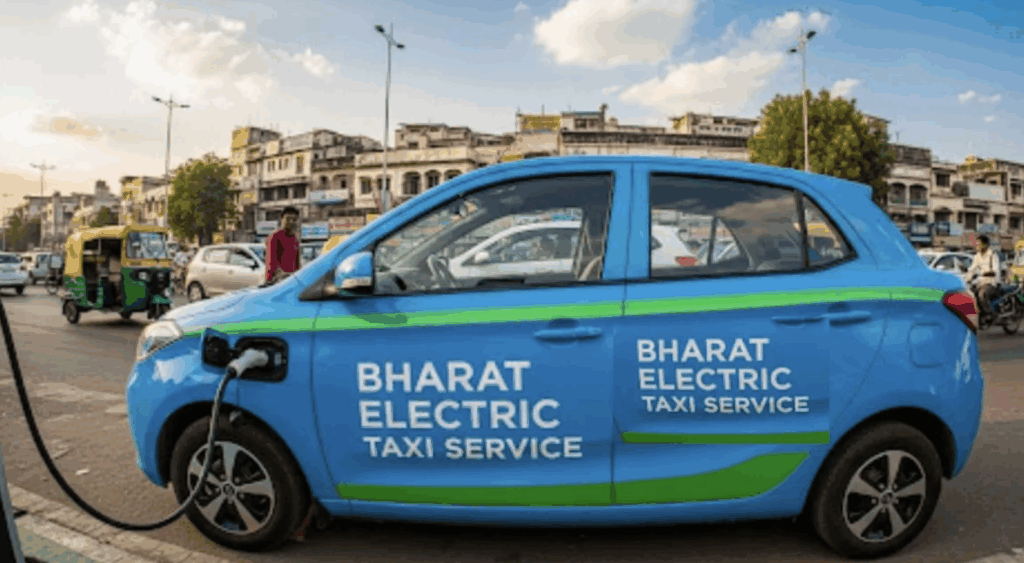

Passengers traveling through Indian airports may soon have a more predictable and cheaper experience because of a new public-sector initiative aimed at removing the unexpected price hike that has long plagued airport taxi service. The Airports Authority of India (AAI) has signed a partnership agreement with Bharat Taxi, a government-backed driver-owned cooperative ride-hailing service, to implement surge-free, transparent-fare taxi rides at several regional and tier-II city airports across the country.
The collaboration, which was established by a Memorandum of Understanding (MoU) signed on February 5, promises to launch fixed-fare airport taxi services initially at 11 AAI-operated airports, including popular destinations such as Pune, Surat, Rajkot, Vadodara, Varanasi, Patna, Bhuj, Kanpur, Prayagraj, Agra, and Chhatrapati Sambhajinagar (Aurangabad). Unlike existing app-based taxi services, which routinely increase fees during peak hours, bad weather, or late nights, the Bharat Taxi model aims to eliminate unpredictable charges and assure transparent pricing without surge rises.
Fixed Fares and Better Connectivity for Flyers:
For many air travelers, particularly at regional and smaller airports, ordering a cab service has often resulted in uncertainty, long wait periods, and unexpected price increases. Private ride-hailing companies such as Uber, Ola, and others use dynamic pricing algorithms that can raise fares by two to three times the standard rate during peak periods, frequently frustrating passengers and leaving them with no alternative but to pay expensive fees. The Bharat Taxi-AAI collaboration aims to solve these concerns by implementing a regulated taxi service that prioritizes fair, predictable pricing and simple booking processes.
Under this initiative, passengers will be charged a fixed per-kilometre fare for airport pickups and drop-offs, with all charges clearly disclosed in advance. Since the pricing will not change in response to demand peaks, long queues, or adverse weather, travellers can plan their budgets better and avoid unpleasant surprises at the ground transportation stage of their journey. The service also aims to reduce waiting times, as drivers under the Bharat Taxi framework will be accessible and regulated through a dedicated mobile app tailored for airport taxi bookings.
A Cooperative Model with Wider Benefits:
What sets Bharat Taxi apart from traditional ride-hailing apps is its driver-owned cooperative model, operated by Sahakar Taxi Cooperative Ltd. and promoted by the National Cooperative Development Corporation (NCDC), with support from other cooperative institutions. In this structure, drivers are stakeholders in the business rather than gig workers dependent on platform incentives. After deducting operational costs, drivers retain a larger share of earnings, and they also benefit from ownership stakes in the cooperative, contributing to enhanced income security and long-term welfare.
By placing drivers at the heart of the business model, Bharat Taxi aims to foster an ecosystem where income is fairer and service delivery is more reliable. This cooperative foundation aligns with broader national objectives such as Atmanirbhar Bharat and Sahakar se Samriddhi, which focus on self-reliance and shared prosperity. Drivers under the cooperative scheme are expected to benefit from improved pay structures, greater autonomy, and a business model that rewards participation and ownership rather than commission-based systems common in private ride-hailing platforms.
The Bharat Taxi smartphone app, designed for both passengers and drivers, will act as the primary booking interface. Riders will be able to order airport rides, view fixed fare estimates, follow their cab in real time, and receive transparent billing with no hidden additional fees. For many fliers, this suggests a more predictable commute from the airport to their destination, especially in the late evenings or when traditional platforms’ rates rise abruptly.
Passenger Response and Expectations:
Frequent flyers and commuters in cities like as Pune, one of the first to be targeted for implementation, have overwhelmingly good reactions. Many airline passengers have expressed delight at the prospect of no surge pricing and predictable costs, which could greatly reduce the burden of coordinating ground transportation, especially for outstation travelers or those traveling with family. Transparent invoicing and controlled terms are expected to boost trust and help fliers avoid conflicts over unexpected fare increases, which have grown routine with dynamic pricing platforms.
The collaboration between the Airports Authority of India and Bharat Taxi marks a significant step toward fairer, more transparent, and driver-empowering airport taxi services. With fixed fares, cooperative ownership, and a commitment to eliminating surge pricing, this new model could redefine airport mobility in India and offer a more predictable and equitable experience for millions of passengers each year.

Comments are closed.