


We all are aware about the E20 program and how India has achieved its 2030 target before time. Well, now there is a new problem for Indian oil manufacturing companies. And that problem is producing more ethanol than it can use and mix with petrol. So, in order to increase the demand, recently Indian OMCs offered the neighbouring Bhutan E20 petrol. However, it has now been reported that Bhutan has politely declined to accept E20 petrol.
According to reports, Bhutan has declined offers from Indian fuel suppliers. These include Indian Oil Corporation (IOCL), Bharat Petroleum (BPCL), and Hindustan Petroleum (HPCL), which recently offered to supply E20 petrol. The country’s Department of Trade has confirmed that Bhutan will continue to import only conventional petrol.
Bhutan has requested Indian OMCs to continue supplying regular petrol for as long as it remains available. The decision has not been taken because Bhutan opposes cleaner fuels. Instead, officials have stated that the country’s existing fuel storage infrastructure is not capable of safely handling ethanol-blended petrol.
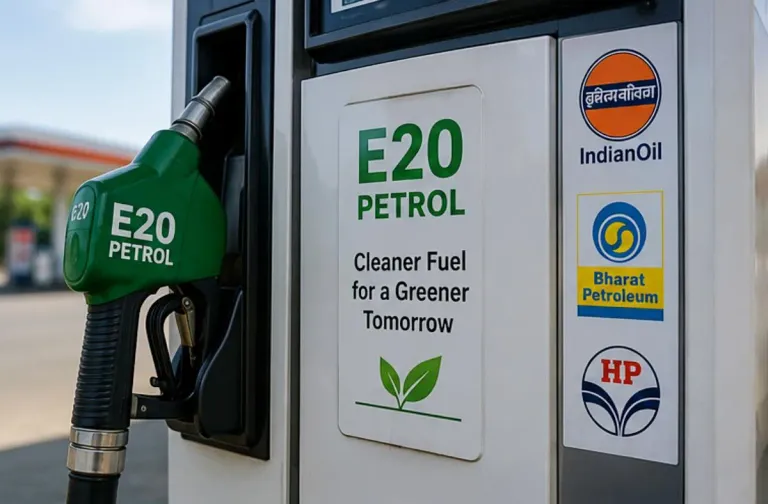
The biggest reason behind Bhutan’s decision to say no to E20 petrol is ethanol’s hygroscopic nature. As we all are aware, unlike conventional petrol, ethanol absorbs moisture from the atmosphere very easily. So, once water mixes with ethanol-blended fuel, it cannot be separated easily. This then affects fuel quality and changes its chemical composition.
According to Bhutanese officials, this is a major concern because many of their country’s underground fuel storage tanks are old. Also, they are located in mountainous regions where slight water seepage is common. So, if E20 petrol is stored in such tanks, the ethanol would absorb the moisture. And this will contaminate the fuel before it even reaches consumers.
Officials of Bhutan also fear that this could lead to poor engine performance, serious engine damage, or even vehicles failing to run altogether. Additionally, officials have also explained that contaminated E20 fuel would quickly turn milky if water entered the storage tanks. This will make the issue immediately visible.
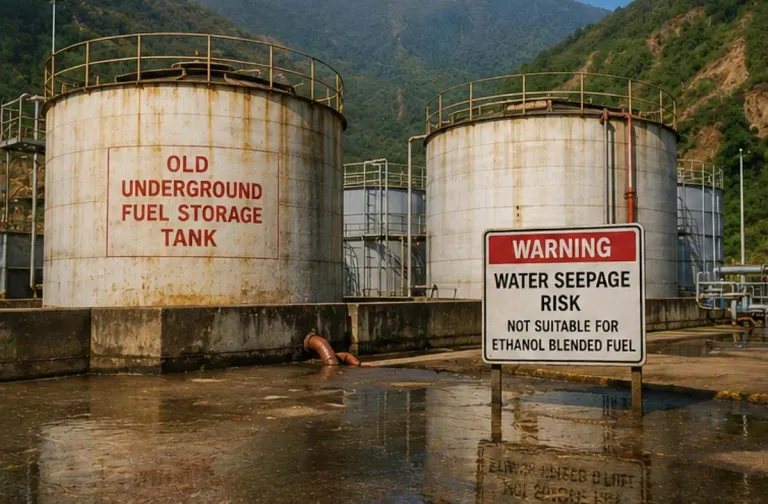
Bhutan has made it clear that it is not permanently rejecting ethanol-blended fuel. Instead, the country has requested India to provide advance notice before higher ethanol blends become mandatory. This request is to make sure that their country has enough time to upgrade its infrastructure.
According to officials, Bhutan would need to replace underground storage tanks, modernise fuel depots, improve transportation systems, and install leak-proof storage facilities. It added that all of this has to be done before it can safely handle ethanol-blended fuels.
They have also requested Indian OMCs to help provide leak-proof fuel storage systems whenever such transition will take place. Officials from Tashi BOD, Bhutan’s largest fuel distributor, have highlighted the same concerns. The company has stated that the country’s current fuel stations simply cannot safely store ethanol-blended petrol because of moisture seepage.
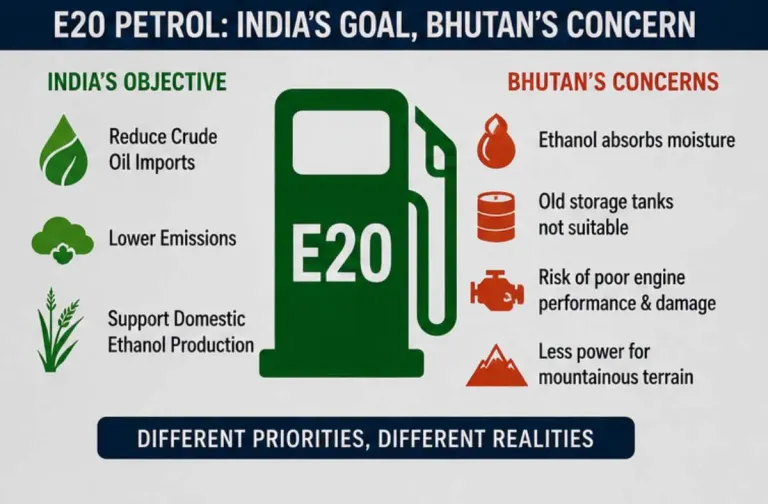
While explaining their stance, Bhutan has stated that it believes that its geography makes E20 even less suitable under current conditions. The country’s hilly terrain and high moisture levels increase the chances of groundwater entering underground storage tanks.
Apart from storage concerns, officials have also pointed out that vehicles operating in mountainous regions generally require more power while climbing steep roads. And since ethanol contains less energy than conventional petrol, Bhutan believes that E20 may not deliver the required performance in such conditions.
What’s interesting is that Bhutan currently imports higher export-quality petrol and diesel from India. This is why it is priced above the fuel sold at Indian retail fuel stations.
The government in India introduced E20 petrol to reduce crude oil imports, lower emissions, and support domestic ethanol production from crops such as sugarcane and maize. The Ministry of Petroleum and Natural Gas has stated that the Ethanol Blending Programme has been scientifically validated and that there are no verified reports of widespread engine failures because of E20.
However, the Bhutanese reports have now highlighted the concerns raised through consumer surveys, automotive forums, and workshop data. According to the report, many owners of petrol vehicles manufactured before 2023 have reported noticeable drops in real-world fuel efficiency and increased maintenance costs.
The report also claims that long-term use of E20 in incompatible vehicles could lead to premature wear of components such as fuel pumps, injectors, and fuel tanks. And as we all are well aware by now, these claims mentioned in the reports differ from the Indian government’s official stance on ethanol-blended petrol.
Source
Comments are closed.