
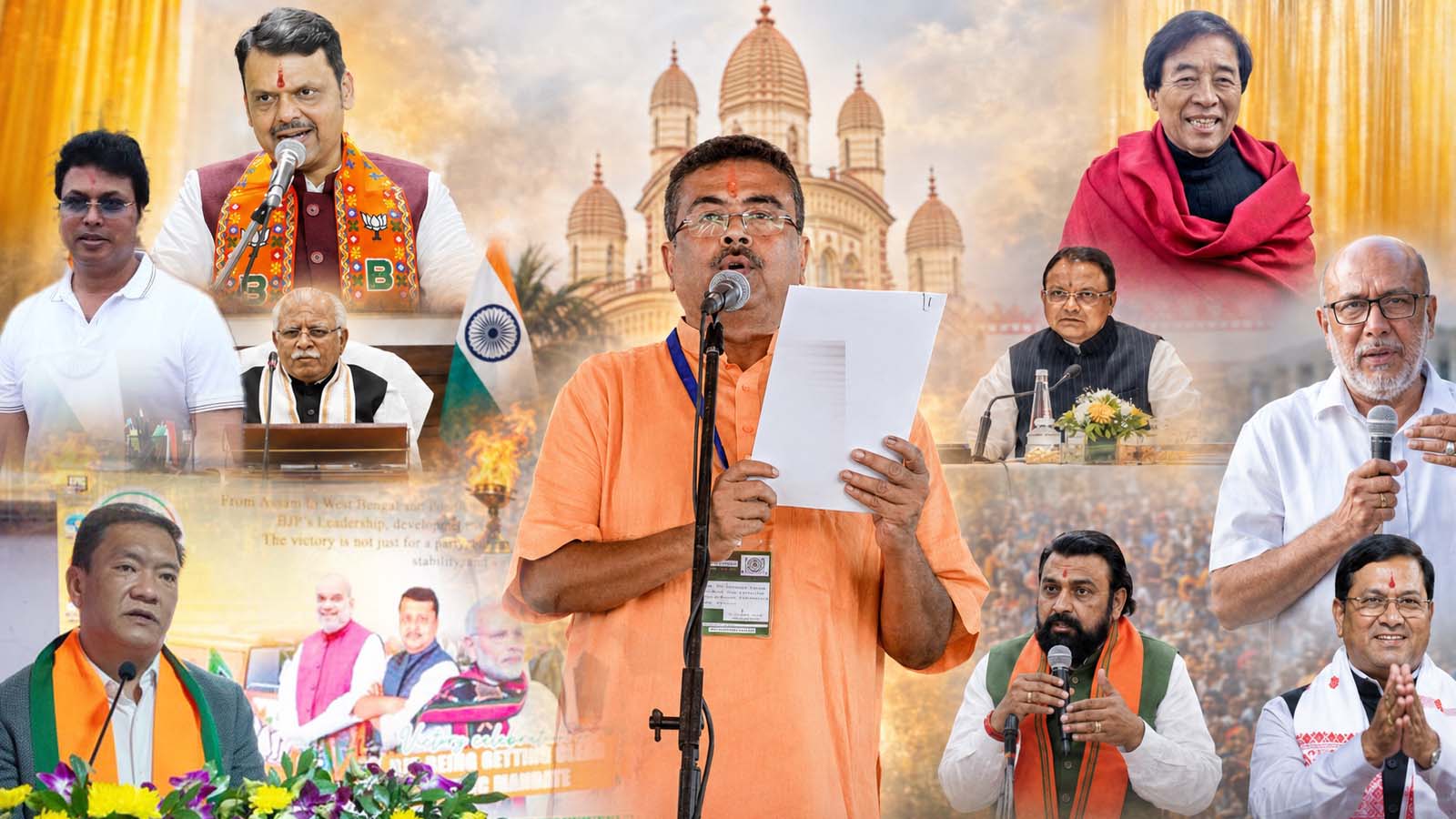

With Suvendhu Adhikari being sworn in as the first BJP chief minister of West Bengal on Saturday (May 9), ending the 15-year rule of the Mamata Banerjee-led Trinamool Congress (TMC) government, the party has secured the chief minister’s post for the first time in nine states since Narendra Modi became prime minister in 2014.
Also read: Suvendu Adhikari to become first BJP CM of Bengal, elected as BJP Legislature Party Leader
The journey began in 2014, starting with Haryana and Maharashtra, followed by Assam (2016), Arunachal Pradesh (2016), Manipur (2017), Tripura (2018), Odisha (2024), Bihar (2026), and now West Bengal.
Journey begins in Haryana
In Haryana, the party formed a government on its own for the first time and appointed Manohar Lal Khattar as chief minister.
Khattar is no longer the chief minister of Haryana, though the BJP is still in power. Nayab Singh Saini has been the chief minister since 2024.
In Maharashtra, after emerging as the single-largest party in the Assembly elections, the BJP formed the government with its Mahayuti partners, paving the way for Devendra Fadnavis to become the state’s first BJP chief minister in 2014.
After serving as the deputy to Shiv Sena’s Eknath Shinde from 2022 to 2024, Fadnavis is again serving as the chief minister now.
Northeast expansion
Sarbananda Sonowal became the party’s first chief minister in Assam when the BJP expanded its footprint in the Northeast by winning the state in 2016. Since then, the BJP has retained power in Assam and won two more consecutive Assembly elections, including the one held in April.
Currently, Himanta Biswa is the CM-elect in Assam after the 2026 Assembly elections.
Also read: Symbolism, social arithmetic define Bengal’s first BJP ministry as Suvendu takes oath as CM
The same year, 2016, the BJP formed its first full-fledged government in Arunachal Pradesh after a major political realignment in the state.
Rejig in Arunachal Pradesh
In July 2016, Congress leader Pema Khandu took over as chief minister amid a prolonged political crisis, but in September, he and a majority of Congress MLAs joined the People’s Party of Arunachal (PPA), an ally of the BJP.
A few months later, in December 2016, Khandu, along with 33 MLAs, joined the BJP, giving the party a clear majority and its first stable government in the state.
The BJP had briefly headed a government in Arunachal Pradesh in 2003 under former chief minister Gegong Apang. Apang, who had left the Congress and joined the BJP at the time, headed the government for only 44 days before returning to the Congress.
BJP captures Manipur, Tripura
In 2017, the BJP stitched together a post-poll alliance with the National People’s Party (NPP), Naga People’s Front (NPF), and other regional parties in Manipur and installed N Biren Singh as chief minister, marking the party’s first government in the border state.
After a period of President’s Rule following the resignation of Biren Singh following the ethnic unrest in the state, the state got another BJP chief minister in the form of Yumnam Khemchand Singh this year.
Also read: Bihar gets first BJP CM in Samrat Chaudhary, but will his govt be stable? | Capital Beat
In 2018, the BJP ended the Left Front’s decades-long rule in Tripura and formed its maiden government under Biplab Kumar Deb.
Biplab Deb is no longer the Tripura chief minister, though the BJP is still in power. Manik Saha became the CM in 2023.
BJP’s footprint in eastern India
The party achieved another breakthrough in eastern India in June 2024 by defeating the Biju Janata Dal (BJD) in Odisha, where Mohan Charan Majhi took oath as the BJP’s first chief minister in the state, ending Naveen Patnaik’s uninterrupted 24-year run.
In Bihar, where the BJP has long been part of coalition governments led by Nitish Kumar, it did not have a chief minister from the party until 2026.
Kumar, who served multiple terms as chief minister for more than two decades with brief interruptions, stepped down earlier this year and moved to the Rajya Sabha.
After his departure, the BJP appointed Samrat Choudhary as the state’s first chief minister from the party.
West Bengal victory
With its victory in West Bengal in the latest polls, the BJP has now formed a government in a state long considered politically elusive for the party. It won 207 of the 294 Assembly seats.
BJP national spokesperson Shehzad Poonawalla said the party’s political expansion under Modi reflects its governance model and growing acceptance across the country.
Also read: PM Modi says he will return to Bengal for BJP CM swearing-in, attacks TMC rule
“Under Prime Minister Modi’s leadership, the BJP and NDA have continuously expanded their political footprint across India based on governance, performance and delivery. States that never had a BJP government or BJP chief minister earlier have elected BJP governments after Modi became prime minister,” he said.
“Prime Minister Modi has now become synonymous with pro-incumbency. In the last few elections, BJP-NDA governments in states like Assam and Puducherry have been voted back to power, while governments in several opposition-ruled states have faced anti-incumbency,” he said.
He described the BJP’s rise in eastern India as “historic” and a corrective to an imbalance.
“This will help correct the historical imbalance and neglect faced by eastern India under Congress rule and ensure balanced development and infrastructure growth,” he said.
Congress under attack
Poonawalla also attacked the Congress, alleging that its political footprint is shrinking while the BJP-NDA continue to expand.
Also read: Assembly poll results: How BJP-Modi domination impacts INDIA bloc nationally
“Today, the BJP-NDA has around 21-22 governments across the country. The alliance’s governance footprint extends to nearly 78 per cent of India’s population and around 72 per cent of its landmass,” he said.
“The BJP under Modi’s leadership has become the central pole of Indian politics, while Congress is increasingly losing political space. Even its allies in the INDIA bloc are unhappy because Congress is competing with them for the same vote bank,” he alleged.
BJP national spokesperson Tuhin A Sinha described the party’s expansion as a “golden phase” in the party’s political journey.
BJP’s promise fulfilment claim
“This has been a golden phase in the BJP’s journey because we have entered geographical regions that were once considered impregnable or extremely difficult for the party,” he said.
Sinha credited the BJP’s rise to its governance decisions and fulfilment of poll promises.
Also read: Opposition deficit, rather than BJP triumph, is the message
“Whether it is the abrogation of Article 370, implementation of the CAA or the construction of the Ram Mandir, the BJP has demonstrated that it fulfils its promises. That is one of the reasons why states that were once immune to the BJP’s influence are now embracing the party,” he said.
He claimed the BJP now has a strong presence across most parts of the country.
“Barring two southern states – Tamil Nadu and Kerala – the BJP has established a strong presence across the country, and these states are also part of the party’s future expansion plans,” Sinha said.
(With agency inputs)

Comments are closed.