


BMW Motorrad is gearing up to launch the all-new F450 GS in India on April 23, 2026. With days left for the same, NothingToProve, a German YouTube channel has now shared a video showing a quick comparison between the F450 GS and the G 310 GS, which it replaces. The two motorcycles are shown side by side, as the host details the changes.
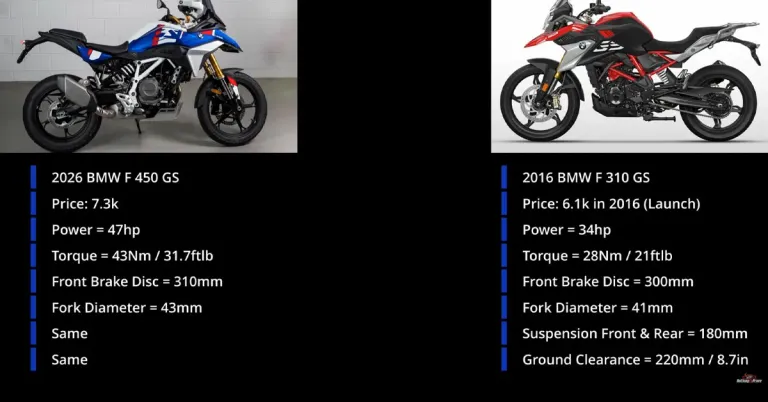
The host starts by explaining the prices of the two models. The G 310 GS that’s on sale in Germany costs €6,199. The F450 GS is slightly more expensive at €7.3K. The biggest upgrade has come in the powertrain outputs- the 310 GS used to offer 34hp and 28Nm while the F450 GS delivers 47hp and 43Nm. The F450 GS comes with a 450cc parallel-twin, which is essentially a downsized version of the Norton 540cc twin, with a different firing order and a couple of other internal changes.
Even the braking hardware is better on the 450. It comes with a 310mm front disc brake while the G310 GS has a 300mm unit. The fork diameter is 41mm on the 310 and 43mm on the 450. The front and rear offers suspension travels of 180mm each, on both bikes. The ground clearance is also same- 220mm.
When it comes to weight, the F459 GS is slightly heavier at 178kilos. The 310 GS weighs just 170 kilos. Fuel tank capacity has increased from 11 litres on the G310 GS to 14L on the new bike.
The F450 GS gets a host of electronics that the previous motorcycle misses out on. One example is the six-axis IMU. The previous motorcycle used to come with an LCD instrument cluster. The new model, on the other hand, has a large 6.5-inch TFT unit. You’ll also find heated grips and a number of other features.
On the design front, the two motorcycles have several cues in common. There are also multiple unique styling cues, like the X-shaped LED lighting signature. The F450 GS sits on a new frame. Its design also has ergonomic improvements and features a two-piece seat It is easier to stand up on the foot pegs and ride the F450 GS and it offers better grip as well. .
BMW has also given the F450 GS Easy Ride Clutch (ERC) technology. It takes the mid-ground between fully manual and fully automatic transmission systems. It automates the clutch operation while still keeping gearshifts manual. The video shows this setup in action. It shows exactly how the clutch in this system engages and disengages.
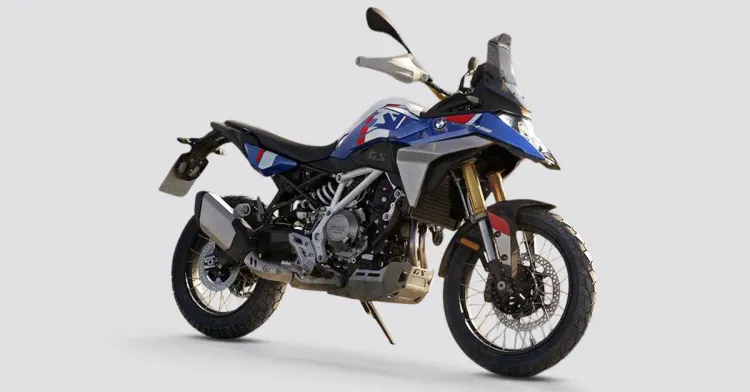
Unlike fully automated setups such as BMW’s own Automated Shift Assistant (ASA), Honda’s E-Clutch, Yamaha’s Y-AMT, or Honda’s Dual Clutch Transmission, the ERC keeps things simpler, lightweight, and cost-effective. The ERC is a mechanical unit. Instead of relying on electronic control units and actuators, it uses a centrifugal clutch mechanism. It may thus be more reliable in the long run.
The ERC combines a traditional multi-plate clutch with an additional centrifugal clutch unit. At the heart of the system is a specially designed friction plate that features small weights arranged radially.
As engine speed increases, centrifugal force pushes these weights outward. They move along ramped channels, which in turn separate the clutch plates and engage the drive. This allows the motorcycle to move forward automatically.
When engine speed drops, springs pull the weights back inward. This disengages the clutch, preventing the engine from stalling. To ensure smooth operation, the weights include metal ball inserts. These reduce friction as they move within the channels. The YouTuber rides the motorcycle within BMW’s plant premises. The company will conduct official media rides shortly after the bikes launch on 23rd.
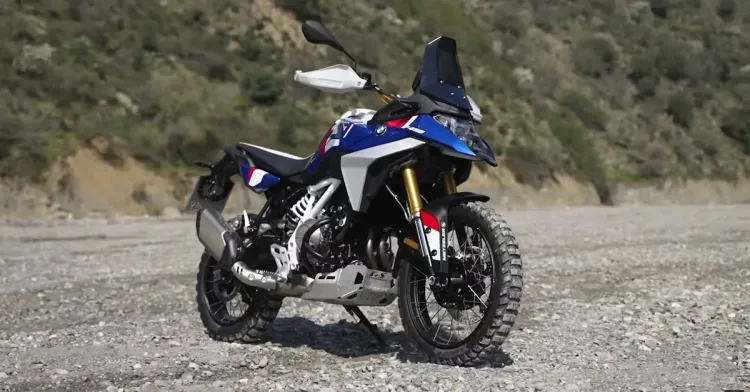
The F450 GS will be manufactured at the TVS manufacturing facility in Hosur. Increased localisation and local manufacturing could help BMW to price this motorcycle well. Whether they would do it remains a different question altogether.
When the G 310 GS was first launched in India, it was priced from Rs 3.49 lakh, ex-showroom. It was significantly higher than expectations, and the same affected sales of the motorcycle. Royal Enfield Himalayan, the GS’ primary rival, sat much lower with its ex-showroom prices. The high cost was mainly due to high CKD assembly costs and the brand’s own premium.
During the BS6 transition in 2020, the GS price was brought down to Rs 2.85 lakh- a big drop from previous figures. This was a major turning point. It pumped appeal into this motorcycle, and led to increased acceptance.
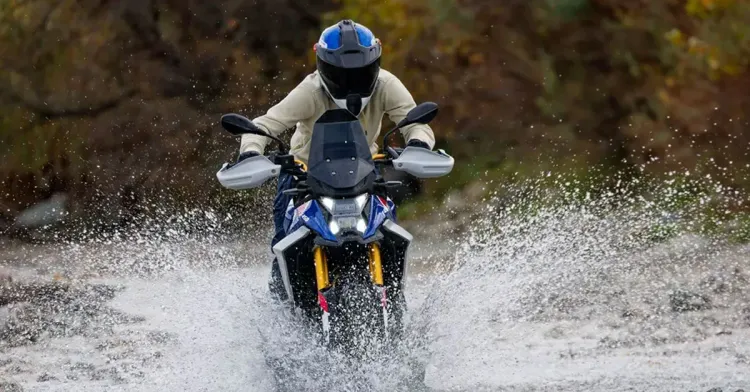
Today, with the new Himalayan 450 having its ex-showroom prices in the range of Rs 3.05-3.37 lakh, getting the price right will be very important in shaping the success of the F450 here. An ex-showroom price of under Rs 5 lakh would make a lot of sense. If the company manages to price it at around Rs 4.80 lakh, it would be competitive enough. Considering how BMW hasn’t been aggressive with its pricing in the past, the same seems just a distant possibility.
Pricing will also be key as there is a wave of twin-cylinder ADVs expected to arrive in the coming years. From twin-cylinder KTM Adventures to the new Himalayan 750, Norton Atlas 650 and Aprilia Tuareg 457, there’s a bunch of them.
Comments are closed.