
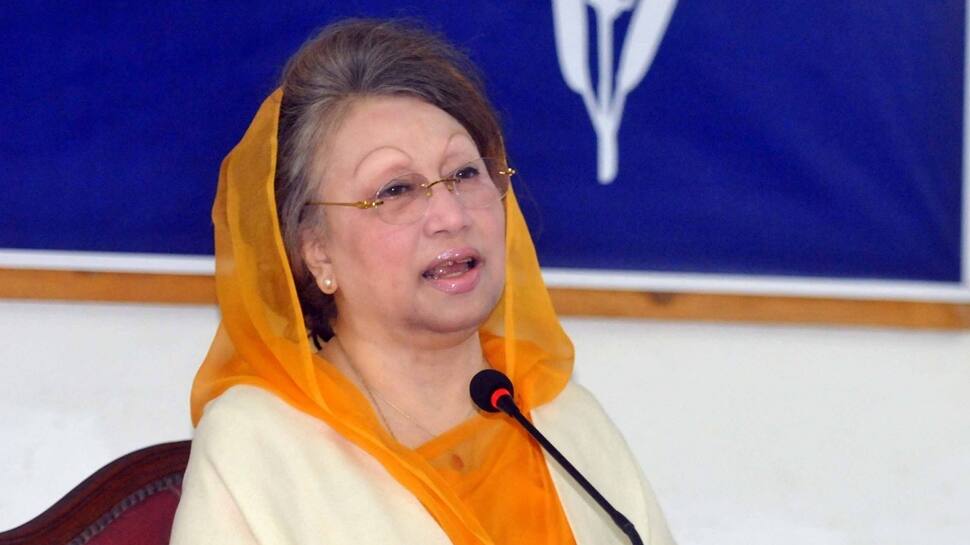

On Tuesday, December 30th, Bangladesh lost one of its most powerful political figures. Khaleda Zia, the country’s first woman Prime Minister, passed away at 80 after battling multiple health problems including liver disease, diabetes, and heart complications. Her death marks the end of an era in Bangladeshi politics, but her influence will echo for generations.
Who was Khaleda Zia? To understand her, we must first understand the family she married into—the Zia family, which shaped Bangladesh’s destiny after independence.
Khaleda was born as Khaleda Khanam “Putul” in 1945 in Feni, to a tea trader’s family. At just 15, she married Ziaur Rahman, a young army officer who would later become one of Bangladesh’s most important leaders. For nearly two decades, she stayed away from politics, quietly raising their two sons—Tarique and Arafat Rahman—while her husband rose to power.
Add Zee News as a Preferred Source
Her husband, Ziaur Rahman, was a war hero who fought for Bangladesh’s independence in 1971. After leading rebel forces against Pakistan, he eventually became the country’s leader from 1975 to 1981. He founded the Bangladesh Nationalist Party (BNP) and introduced policies that emphasized Islamic identity alongside economic development. But his rule ended abruptly on March 30, 1981, when disgruntled army officers assassinated him.
Everything changed for Khaleda overnight. She never wanted to enter politics, as she later admitted. But party leaders and public pressure pushed her forward. The BNP had no strong leader left—Zia had built such a dominant image that nobody could fill his shoes. With military ruler Hussain Muhammad Ershad cracking down on opposition, the party desperately needed someone who could rally support.
Khaleda officially took charge of the BNP in 1984. Around the same time, Sheikh Hasina—daughter of Bangladesh’s founding father Sheikh Mujibur Rahman—had taken over the Awami League. These two women, both thrust into politics by family tragedies, would define Bangladesh’s political landscape for decades. People called them the “battling Begums.”
Throughout the 1980s, Khaleda and Hasina led massive street movements against Ershad’s authoritarian rule. Despite their differences, they occasionally united against their common enemy. In 1990, months of protests finally forced Ershad out—much like the 2024 uprising that removed Hasina from power.
In 1991, Bangladesh held elections under a neutral caretaker government. The BNP won, and Khaleda became Prime Minister for the first time. She was making history as Bangladesh’s first woman PM.
Her first term (1991–96) brought real achievements. Education reforms dramatically improved literacy rates, which stood at just 35% when she took office. Her economic policies attracted foreign investment. She strengthened local governance, continuing her husband’s vision of empowering village-level institutions.
But her second term (2001–06) revealed her true political ideology—one that positioned India as Bangladesh’s primary adversary. This wasn’t just political posturing; it was a calculated strategy that fundamentally shaped regional relations.
Also Read: Bangladesh Nationalist Party Chairperson Khaleda Zia Dies At 80 In Dhaka After Prolonged Illness
To win a strong parliamentary majority, Khaleda allied with hardline Islamist groups, including Jamaat-e-Islami—the very party that had opposed Bangladesh’s independence in 1971 and supported Pakistan. This alliance came with a price: a sharply anti-India foreign policy that served Pakistan’s interests.
Under Khaleda’s government, Bangladesh became a safe haven for anti-India militant and separatist groups. These organizations used Bangladeshi territory as launching pads for violent attacks in India’s Northeast states, creating a serious security crisis. India repeatedly protested, but Khaleda’s government turned a blind eye.
The BNP actively promoted anti-India sentiment as a core part of its identity. Khaleda deliberately presented the BNP as the protector of “Islamic Bengal,” contrasting it with India’s West Bengal, which she described as Hindu-dominated. This wasn’t just rhetoric—it was policy. Her government encouraged closer ties with Pakistan, calling it an “Islamic brother nation,” while painting India as the enemy.
Water-sharing disputes escalated dramatically during her tenure. The Teesta River issue and other cross-border water conflicts remained unresolved as her government refused meaningful negotiation with New Delhi. Every disagreement was framed as Indian aggression against Bangladesh’s sovereignty.
Jamaat leaders, now mainstream politicians in her coalition, openly advocated strengthening bonds with Pakistan while opposing cooperation with India. This represented a stunning reversal—the country born from Pakistan’s oppression was now embracing its former oppressor while antagonizing the neighbor that had helped liberate it in 1971.
Political analysts note that anti-India messaging had long been part of BNP ideology, but Khaleda weaponized it to distinguish her party from the Awami League, which she accused of being “India’s puppet.” This polarized Bangladesh’s foreign policy into a false choice: either you stood with Islamic Pakistan or you were India’s agent.
In 2006–07, Khaleda tried manipulating the caretaker government system before elections. The strategy backfired. In 2008, Sheikh Hasina defeated her decisively and spent the next 15 years systematically weakening the BNP through corruption charges, arrests, and legal cases.
Khaleda’s health deteriorated from 2010 onwards. When protests erupted against Hasina in August 2024, Khaleda—though she welcomed the “revolution”—was too ill to return to politics. Her son Tarique Rahman, who returned from exile just five days before her death on December 25th, now carries the family’s political torch.
As Bangladesh mourns Khaleda Zia today, her legacy remains deeply controversial. She broke barriers as the first woman Prime Minister in a conservative society and stood firm against military dictatorship. But she also legitimized those who opposed Bangladesh’s independence, turned anti-India sentiment into state policy, and allowed militants to operate freely from Bangladeshi soil.
Her political choices remind us that leadership isn’t just about breaking glass ceilings—it’s about what you build afterward. Khaleda built a politics of religious identity and regional antagonism that still shapes Bangladesh today. Whether that’s a legacy to honor or overcome remains Bangladesh’s question to answer.
(Girish Linganna is a Defence, Aerospace & Geopolitical Analyst. He is the Managing Director of ADD Engineering Components India Pvt. Ltd., a subsidiary of ADD Engineering GmbH, Germany.)

Comments are closed.