
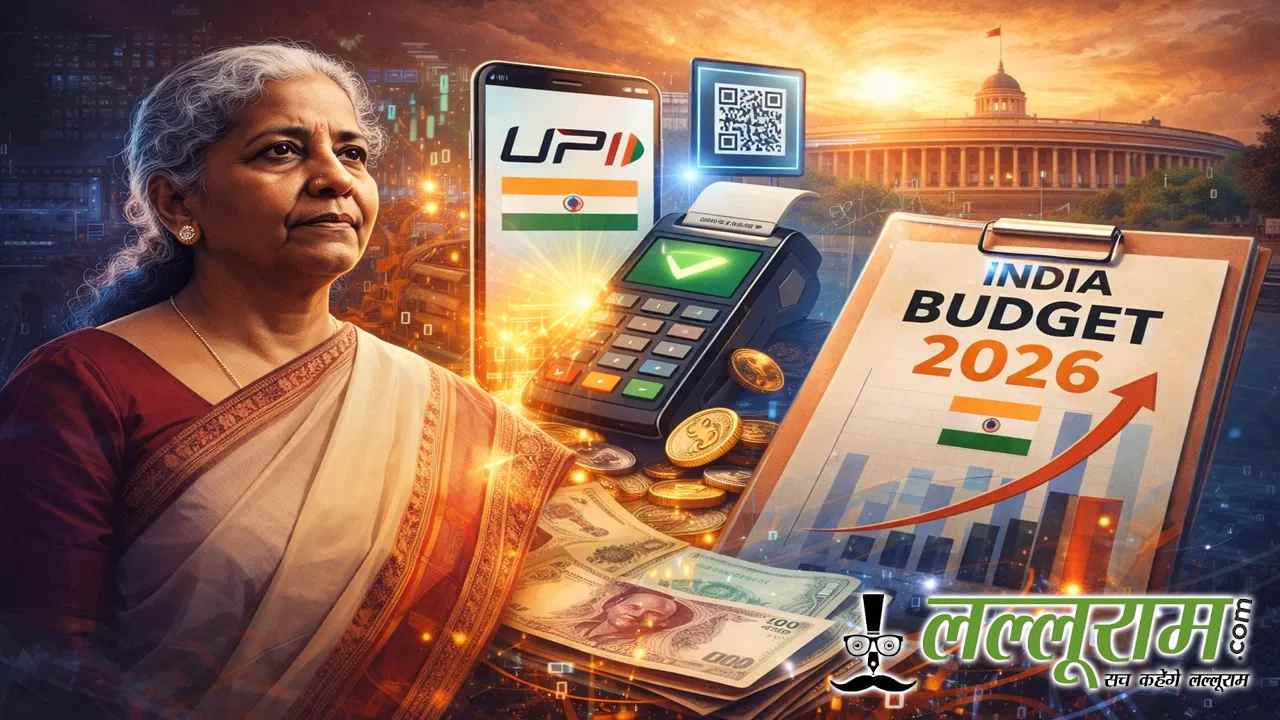
Digital India in danger: Free payment model may change in Budget 2026, what is Nirmala Tai’s plan?

Budget 2026 UPI Policy: The budget will be presented on 1 February. In this budget, a big question has arisen in front of the country’s government and the Finance Minister. This question is about the shortcomings of the UPI payment system. Removing these could be the biggest challenge of this budget.
Despite record transactions, the losses being incurred by payment aggregators have now become a matter of concern. The question is whether the government will be able to maintain the pace of Digital India in this budget. Does the government have any such plan so that the digital revolution continues and no one gets harmed?
Also Read This: Cow’s ghee is considered beneficial in Ayurveda, know here what are the benefits of eating it.
In fact, from a Rs 10 tea to a Rs 50,000 smartphone, to paying electricity bills or rent, plastic cards and paper currency are gradually becoming obsolete. Google Pay, PhonePe and other UPI based platforms have become an important part of everyday life. After demonetization and Corona epidemic, the country has rapidly moved towards contactless transactions.
But behind this success lies a growing concern, which policy makers can no longer ignore.
Also Read This: Vijay Kedia’s entry, bulk deals stir these stocks
Despite rapid growth, UPI’s trader network is showing signs of fatigue. According to analysts, the growth of active merchant QR networks has been only about 5 percent CAGR in the last three years. Even today, only about 45 percent of the merchants in the country accept UPI payments every month.
The geographical situation is even more shocking. About one-third of the pincodes in the country have less than 100 active UPI traders and about 70 percent of the pincodes have less than 500, while on an average each pincode has more than 2,500 merchants. This difference clearly shows the increasing pressure on the system.
Also Read This: Union Budget 2026: Stock market is going to create history, this time the market will open on Sunday also, know the timing and reason for opening on Sunday.
What is the solution to hidden costs?
Payment companies, banks and fintech firms have warned that the current model of UPI growth is becoming unsustainable. Financial inclusion has increased with the central government implementing zero MDR on UPI and RuPay debit card transactions, but its economic burden is now becoming unbearable.
According to RBI, it costs about Rs 2 to process each transaction. This cost has to be borne entirely by banks and fintech companies. MDR is the fee that merchants pay to payment processing companies.
Also Read This: Reliance Q3 Results: Strong performance in every sector, Jio again takes command
continuously decreasing incentives
PhonePe has acknowledged that the current zero MDR model is not economically sustainable. The company says that to maintain the ecosystem, either MDR will have to be implemented or adequate government subsidy will have to be given.
An incentive of Rs 3,900 crore was given in the financial year 2023-24, but it came down to Rs 1,500 crore in 2024-25. According to the company, this amount is not enough for technology, security, fraud prevention and user education.
Also Read This: Impact of US Visa Rules: Big blow to education loan sector, decline of up to 30–50%; Know the reason
RBI Governor’s signals
RBI Governor Sanjay Malhotra has said that UPI cannot remain free forever. There are some expenses involved and someone will have to bear these expenses. For the stability of the system it is necessary that there be someone to pay.
Lack of long term revenue model
Payments Council of India (PCI) has also said that there is no long term revenue model in the current structure. This may create a future crisis for the companies creating and managing payment systems.
According to PhonePe, in the current financial year the government has allocated only Rs 427 crore for digital payment incentives, while the ecosystem will need an investment of Rs 8,000 to 10,000 crore in the next two years.
Also Read This: Big investment opportunity, 4 new companies will enter the market next week
Budget 2026 will be decisive
Fintech companies believe that by implementing controlled MDR framework the ecosystem can become self-reliant. This will reduce the burden on the government and strengthen the digital infrastructure.
The industry demands that limited MDR should be allowed to be implemented on big traders, so that the system can be kept stable. If there is no improvement, fintech companies may have to stop expansion, which will harm both digital payments and financial inclusion. The current MDR policy of digital payments is continuously increasing pressure on payment companies and banks.
Also Read This: Today the prices of gold and silver increased, know the latest rate of your city before shopping.


Comments are closed.