
Built For The Toughest Targets: Meet The Missile Russia Claims Can Take Down America’s Stealth Kings, F-22s And F-35s | world news

Moscow: Russia’s S-500 Prometheus is being presented as something far beyond another surface-to-air missile battery. Moscow describes it as an upper-tier shield designed to sit above the well-known S-400 network, a system built from the start to confront the most demanding threats in modern warfare. In Russian military messaging, the S-500 is even portrayed as being “custom built” to challenge elite US platforms such as the F-22 Raptor and F-35 Lightning II.
According to Russian claims, the S-500 offers a reach of roughly 500 kilometers and can engage targets at altitudes approaching 200 kilometers. Its interceptors are described as hit-to-kill weapons intended for ballistic missiles, hypersonic threats and potentially objects moving at the edge of low earth orbit.
The system relies on a multi-radar design meant to detect and follow complex targets in environments filled with electronic interference, including stealth aircraft. Russian officials emphasize that the system’s sensors are built to function under heavy jamming, although detection alone does not automatically translate into a confirmed kill against aircraft designed to remain elusive in combat.
Add Zee News as a Preferred Source
The limited number of S-500 units and the value of the targets assigned to it suggest a system reserved for critical moments rather than everyday air defense. In Russian planning, the S-500 appears positioned as a strategic shield first, rather than a routine hunter of tactical fighters.
A New System, Not An S-400 Upgrade
Known as the 55R6M Triumfator-M, the S-500 Prometheus is Russia’s most advanced air and missile defense platform to date. It is sometimes described as an evolution of the S-400, but Russian designers have repeatedly stressed that it is a completely new complex with a different mission set. The system was conceived to counter high-priority threats such as ballistic missiles, airborne early-warning aircraft and even satellites.
On paper, the S-500 is paired with Russia’s most advanced search and tracking radars, giving it the theoretical ability to detect fifth-generation stealth aircraft. Russian sources maintain that the system is capable of tracking such aircraft, at least in controlled conditions.
From Concept To Deployment
Work on the S-500 began around 2009, driven by the idea of creating a system that could operate along with the S-400 Triumf while covering an entirely higher layer of air and missile defense. Early timelines pointed to production by 2014, but the complexity of integrating multi-band radar systems, extremely fast hit-to-kill interceptors and rapid command-and-control networks led to repeated delays.
Signs of progress emerged gradually. A long-range test reported in May 2018 was said to have achieved a reach of about 482 kilometres. In July 2021, Russia’s Ministry of Defense released footage from a live-fire test at Kapustin Yar, presenting the system as ready to take on upper-tier duties within Russia’s integrated defense network.
By September 2021, Russian sources stated that the S-500 had entered limited service with the Aerospace branch. A more concrete milestone followed on December 18, 2024, when General Valery Gerasimov announced the formation of the first regiment equipped with the S-500. The announcement signaled that the system had moved into operational deployment, even if only in small numbers.
What Sets The S-500 Apart
The defining feature of the S-500 is the scale of its engagement envelope. With a claimed range of around 500 kilometers and the ability to strike targets at heights of roughly 200 kilometres, the system is presented as capable of engaging satellites operating at the edge of space.
Russian officials also assert that the S-500 can intercept hypersonic missiles. They say the system has demonstrated this capability during testing, though such claims are typically presented without independent verification.
To carry out these missions, the S-500 employs the 77N6-N and 77N6-N1 hit-to-kill anti-ballistic missile interceptors, paired with long-range 40N6M air-defense missiles. This mixed missile load allows commanders to tailor the system to the expected threat environment.
Radar, Sensors And Mobility
Supporting these interceptors is a layered radar and sensor network designed to detect, classify and track stealth aircraft as well as fast and high-altitude ballistic targets. The system incorporates the 91N6A(M) battle-management radar, the 96L6-TsP acquisition radar and the 77T6 engagement radar.
These components are distributed across mobile platforms and connected through a command post designed to fuse data and assign targets quickly.
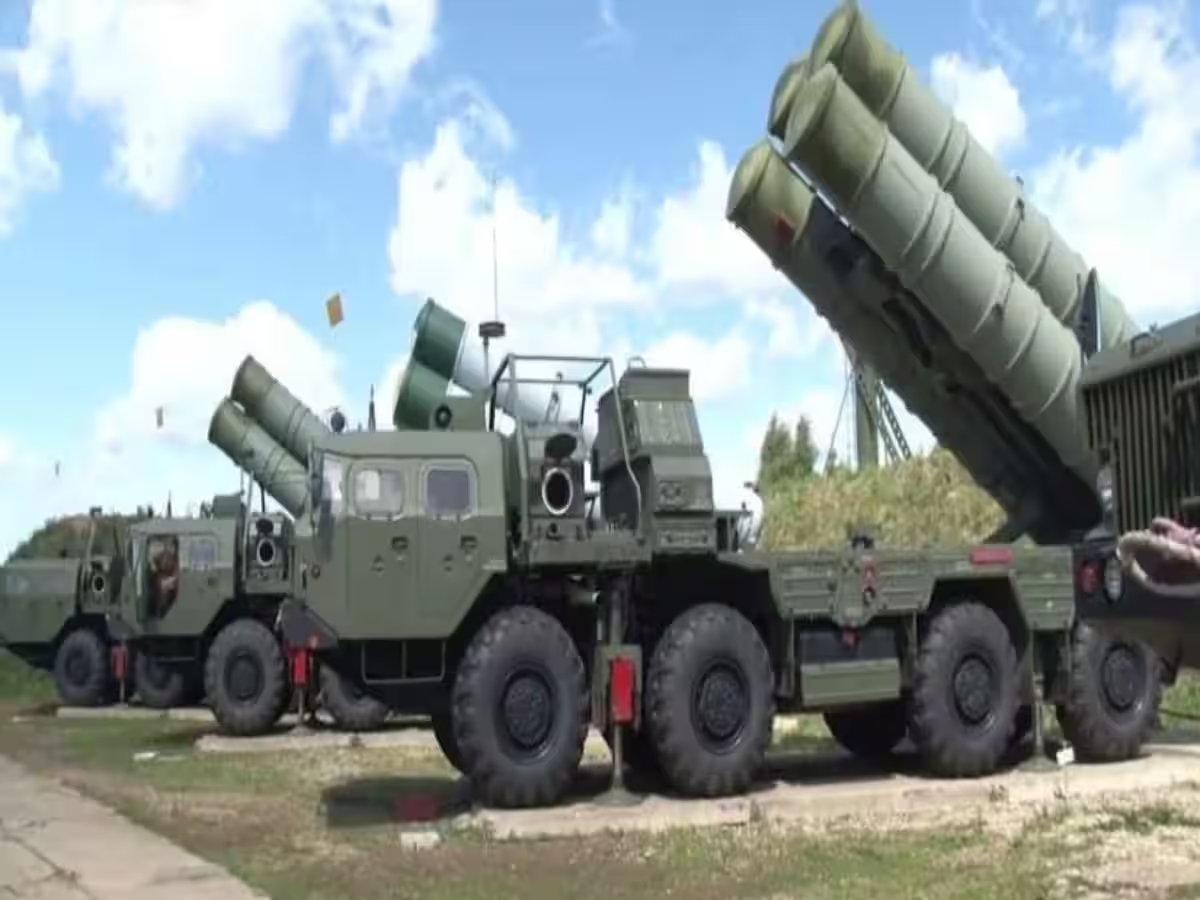
Mobility plays a central role in the S-500’s survivability. The launchers are mounted on BAZ-69096 10×10 trucks, each carrying two missiles. This setup allows the system to relocate rapidly and complicates efforts to target it.
The first publicly displayed transporter-erector-launcher, shown at the Army-2024 exhibition, offered observers a clear view of the system’s size and the scale of its anti-ballistic interceptors, which are significantly larger than traditional surface-to-air missiles and optimized for near-space engagements.
In Russian doctrine, the S-500 sits at the top of a layered defense structure. Short-range systems such as Pantsir-S1 protect important sites, S-300 and S-400 batteries provide medium- and long-range coverage and the S-500 forms the upper tier. Its role is to counter ballistic and hypersonic threats while also holding high-altitude intelligence aircraft and low-orbit targets at risk.
Reports from December 2024 and early 2025 linked the first S-500 regiment to the defense of the Kerch Strait and the Crimean Bridge, both of which have been repeatedly targeted during the Russia-Ukraine war.
Ukrainian intelligence assessments from mid-2024 also pointed to experimental deployments of S-500 components in the region, highlighting the Kremlin’s intent to use the system as a deterrent around critical infrastructure.
Can S-500 Really Take Down An F-22 Or F-35?
Although the S-500 is primarily designed for ballistic missile defense, it also carries an anti-aircraft role. Russian sources insist that the system can engage stealth aircraft, including fifth-generation fighters. The debate centers on whether its sensors can do more than simply detect them.
At the center of the system is the Yenisei 77T6 ABM engagement radar, which is developed specifically for the S-500. Unlike earlier systems such as the S-400, which operate for limited periods, the 77T6 is designed for prolonged automatic operation. It is built to function against targets employing electronic warfare and jamming.
This radar works along with the 91N6A(M), 96L6-TsP and 76T6 radars, which together represent the most advanced air-defense detection network Russia has fielded.
Taken as a whole, the architecture suggests that the S-500 may be able to see a fifth-generation aircraft. Detection, though, is only the first step in a chain that requires tracking, locking on and successfully intercepting a highly manoeuvrable and stealth-optimized target.
Russian analysts suggest there is a strong possibility that the system could shoot down a fifth-generation aircraft, while stopping short of calling it a certainty. Even within Russian discussions, another question looms larger whether the S-500 would ever be tasked with such a mission.
According to Russian sources, the S-500 is reserved for the most valuable targets, including ballistic missiles, AWACS platforms and specialized jamming aircraft. Stealth fighters are expected to fall under the responsibility of systems such as the S-400. The S-500’s role against aircraft appears more focusedsed on large and high-value platforms such as stealth bombers.
Russian military thinking suggests that the appearance of a stealth bomber near Russian airspace would itself signal an extreme escalation, one associated with the prospect of strategic weapons entering the fight.
In that sense, the S-500 is less a day-to-day fighter killer and more a system designed for the most serious moments a state can face, when the targets in the sky carry consequences far beyond a single engagement.

Comments are closed.