
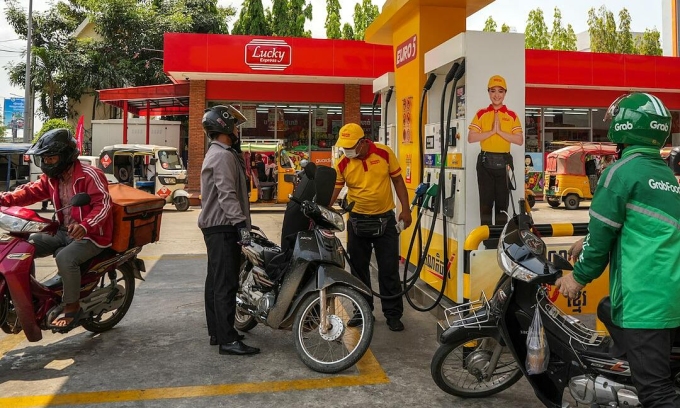

“The move is not to put further pressure on drivers who have been facing the significant rise in fuel prices,” Ministry of Interior spokesperson Touch Sokhak told Xinhua on March 26.
Since coordinated U.S.-Israeli strikes on Iran began on Feb. 28, the price of diesel in Cambodia has surged 84%, while gasoline has climbed 41.5% and liquefied petroleum gas 60%, according to the Ministry of Commerce.
The crisis forced nearly 2,000 of Cambodia’s 6,300 fuel stations to temporarily shut down in mid-March after running out of stock, the ministry said.
The Strait of Hormuz, a narrow waterway between Iran and Oman, normally carries about 20% of the world’s crude oil and natural gas. The conflict has brought shipping through the strait to a near standstill, with about 80% of the oil that transited it destined for Asian markets, according to the International Energy Agency. The IEA has called the disruption the largest in the history of the global oil market.
As of March 26, RON 92 gasoline costs 5,450 riel ($1.36) per liter, up 0.92% from the previous week, while diesel rose 5.97% to 7,100 riel ($1.77) per liter, Xinhua reported.
Despite the fine suspension, traffic police will remain on the roads to enforce drunk driving checks, promote road safety, and inspect for weapons and explosives during nighttime patrols.
The government has taken broader measures to cushion the blow. Last week, Prime Minister Hun Manet ordered the elimination of import duties and value-added tax on gasoline and diesel, zeroed out the special excise tax on diesel, and maintained a fuel subsidy of 6.5 U.S. cents per liter, effective on March 20.
All ministries and institutions are encouraged to limit in-person meetings and long-distance travel, and to promote the use of online platforms unless absolutely necessary.
Cambodia depends entirely on imported fuel, as its offshore oil reserves remain commercially unexploited. The country holds roughly 21 days of strategic reserves, the Ministry of Mines and Energy said, though supply disruptions have already forced hundreds of stations to suspend operations.
The rising cost of fuel is also expected to impact electricity production, as it remains a key input, the Khmer Times reported

Comments are closed.