

It took place on 25 February at Hughes Hall, a college of the University of Cambridge, next to Fenner’s, which was historically the university’s cricket ground. In 1846, Francis Fenner leased land from Gonville and Caius College. Two years later, he sub-let the newly built ground to the University Cricket Club, which, together with the Athletics Club, purchased the freehold in 1894.
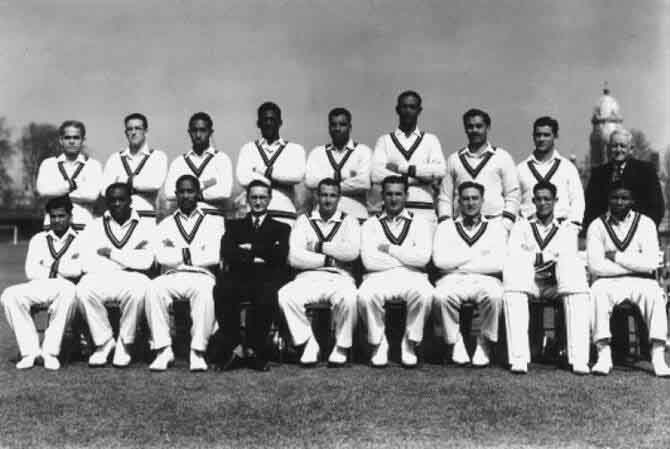
One of the presentations at the conference was on the topic “Town vs. Gown”, covering the history of cricket in Cambridge at both university and club level. I knew that Fenner had once been known as a batting pitch. When I told this to the presenter, he asked if I knew that in a first-class match in which both teams batted only once, the most runs were scored there. My interest increased. A quick search revealed that 1,324 runs were scored in a three-day match between May 17 and May 19, 1950, when Cambridge University hosted the touring West Indies team.
Winning the toss, the University chose to bat first, scored 507 runs losing just three wickets on the first day, and declared the innings after scoring 594 runs losing four wickets on the second day. By the end of the second day, West Indies had scored 379 runs for two wickets. They continued to bat on the third day, and scored 730 runs for three wickets, with Frank Worrell making 160 and Everton Weekes making 304 not out, at an average of four runs per over.
In today’s world of instant T20 cricket, in which an average of eight or more runs are scored per over, this frequency of runs scored by fencers would be considered normal. But, at the time, four runs per over was almost double the four runs scored in the four Test matches between England and the West Indies in 1950. There were five players in the Cambridge University team who would go on to represent England. One of them, Peter May, captained England on 41 occasions. Neither Weeks nor Worrell were impressed by the match, calling it “a joke’s game, just a boredom, a bit of match practice”, adding that “unless you have to work hard to score your runs, there’s no fun in making them.”
In addition to the local Cambridge topics, the conference had a wide variety of other themes. CRN is a group of researchers and writers who work on cricket-related issues with the aim of bringing change to the game through critical and empirical research.
Five main themes were covered. The first was gender, the second was history, both were inclined towards the women’s game, while the third was towards the 2026 Women’s T20 World Cup, which is to be held in England and Wales in June. Inclusion was the fourth theme, which included fandom and using AI to identify talent. After this, cricket was shown, which also included its special stories. The last session discussed governance and sustainability, which included illegal betting, climate justice and cricket being in the public interest.
As regular readers will know, the last subject area has been touched upon many times in this column, usually with a touch of frustration at the poor standards and methods of those charged with the governance of cricket. These have also been seen before and during the ongoing T20 World Cup, which was centered on Pakistan, India and Bangladesh. The day after my Cambridge visit, Pakistan failed to qualify for the semi-finals and rumors spread that the Pakistan Cricket Board, or PCB, was proposing to fine all team members the equivalent of $18,000. If this is true, it would be a huge example of mismanagement, in which players would actually be fined for losing the match.
These fines were said to have been imposed after Pakistan’s loss to India in a group-stage match, with the stipulation that the fine could be waived if semi-final qualification was achieved. Although this action of PCB is strange in professional cricket, but this is not the first time that PCB has taken punitive steps. Following the close defeat to India in the Asia Cup final on September 28, 2025, the board had briefly barred its players from playing in the T20 franchise league. Fines have been imposed earlier also for indiscipline and rebellion. This new action risks alienating players and further impacting their desire to perform. It is not known how the well performing players will react to this. Surprisingly, later there were rumors that not all players would be fined or different levels would be applied.
It would be wrong to fine Sahibzada Farhan, who broke the record of scoring most runs in the T20 World Cup, and also became the only player to score two centuries in the same tournament. Farhan and Fakhar Zaman, who played only two matches, made the team.

Comments are closed.