
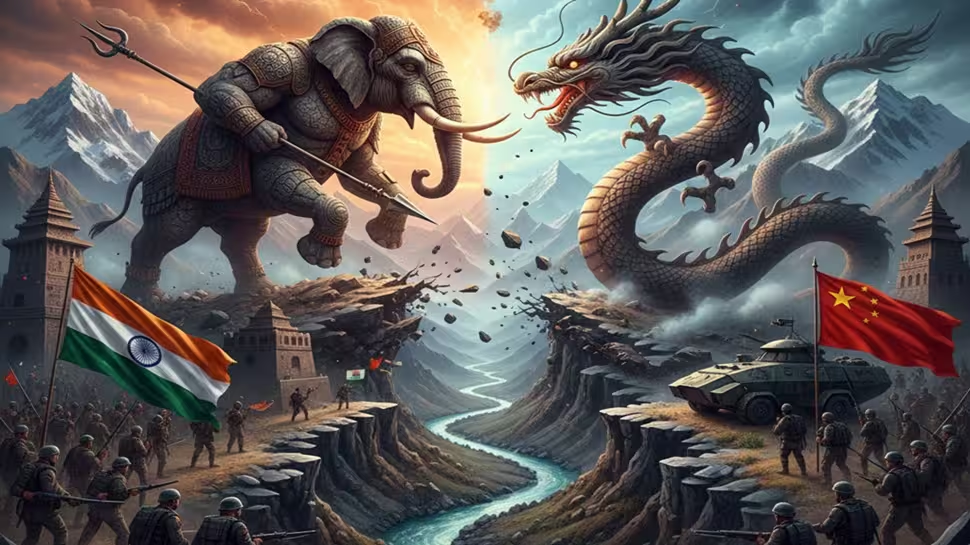
Can India Use Its Market Power To Gain Leverage In Border Talks With China? Check Expert’s Take | India News

India’s trade deficit with China has been growing with each passing year. While there has been a marginal increase in exports to China as well, but that’s not sufficient to bridge the gap. According to data released by Chinese customs, India’s exports to China rose by $5.5 billion in 2025, bucking the broader declining trend. Despite this increase, the overall trade gap remained elevated. Chinese exports to India also grew 12.8% to $135.87 billion last year. Overall bilateral trade surged to an all-time high of $155.62 billion in 2025, even as both countries faced tariff hikes imposed by US President Donald Trump.
In FY 2024–25, India’s trade deficit with China widened sharply to a record $99.2 billion, driven by rising imports and falling exports. Imports from China climbed 11.5% to $113.5 billion, up from $101.7 billion the previous year, led by electronics, electric batteries, and solar cells.
This comes at a time when both India and China have issued diplomatic remarks on the Shaksgam Valley. While Pakistan ceded the occupied territory to China long ago, India has maintained its rights over the area. The Shaksgam Valley is not the only flash point between the two neighbours. India and China share the world’s largest disputed border, called the Line of Actual Control (LAC). Due to this, China – following its expansionist policy – often claims Indian territories, from Arunachal Pradesh to Ladakh and PoK. In response, India has only been issuing diplomatic tough talk, which fails to deter Beijing.
Add Zee News as a Preferred Source
At this juncture, critics often question why, despite being one of the largest markets for China, India fails to use its purchasing power at the negotiation table.
Defense and strategic analyst Captain (Retd.) Shyam Kumar of the Indian Navy, said that India views China’s claims on Indian territories as illegal and doesn’t recognize the 1963 Shaksgam Valley pact. He also noted that a large part of Ladakh has been under illegal occupation by China. Captain Kumar added that an absence of a clearly defined border has been a cause of various incursions from the Chinese side in the past.
Talking about the trade deficit, the defense expert said, “India has a large trade deficit with China. Over 60% of India’s total imports are from China. In the present context, any move to use purchasing power as a tool to trade off land disputes by reducing imports will create a shortage of daily products and reduce the trade volume. The Indian market’s dependence on China will lead to a rise in unemployment, and businesses will be adversely affected, if the status quo is deliberate.”
While China will be able to absorb the loss in a short time, the reputation of the Indian economy in the international market will be hurt badly, he said.
“India sees border territories as non-negotiable for national security and identity. However, at present, the trade imbalance in volume favors China and does not provide India with the required negotiation power for land/ border dispute settlements. However, with India’s economy growing, thrust on self-reliance by boosting domestic manufacturing and its large, young, and growing workforce compared to China’s aging population are positive indicators,” he said.
He said that India’s higher GDP growth rates compared to China’s slowing pace, relocation pattern of manufacturing companies out of China, India becoming a preferred destination as an alternative manufacturing hub, and increasing exports are sure to empower India at the negotiating table, albeit in the long run.
Also, India is heavily dependent on Chinese imports for goods like electronics, pharma ingredients, and machinery. This weakens India’s ability to apply pressure without hurting itself. For China, Indian market is important, but not irreplaceable. China can redirect exports to Southeast Asia, Africa, and Latin America. This reduces India’s bargaining power.

Comments are closed.