
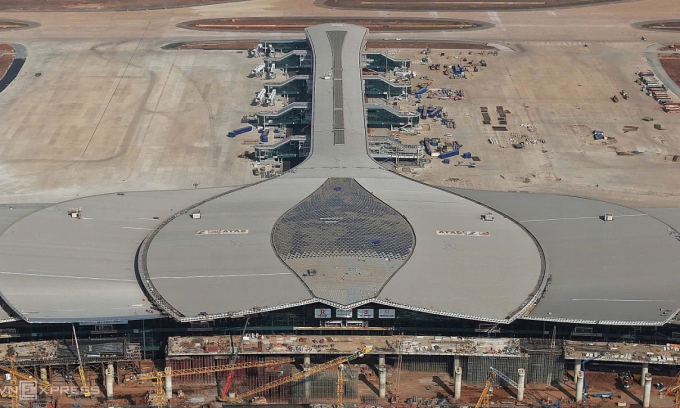

Long Thanh International Airport in Dong Nai Province welcomed its first flights by the end of 2025 and is scheduled to begin commercial operations in June 2026.
Designed to become the country’s biggest aviation hub, it is projected to handle around 80% of international passenger traffic in southern Vietnam, serving Ho Chi Minh City and relieving pressure on Tan Son Nhat Airport.
But there is one major obstacle: the journey from HCMC.
Although Long Thanh sits about 50 kilometers from the city downtown, travel time currently ranges from two to three hours, especially when the Ho Chi Minh City – Long Thanh – Dau Giay Expressway becomes congested. National Highways 1 and 51, which also serve the route, are frequently overloaded.
During a working session in HCMC on Feb. 9, Party General Secretary To Lam warned that airport development must go hand in hand with synchronized transport infrastructure.
If it takes two hours and congestion can happen at any time, no one would go to Long Thanh, he said, calling for solutions to reduce travel time from central HCMC to the airport to about 30 minutes.
Several key road projects are underway to improve access.
The Ho Chi Minh City – Long Thanh – Dau Giay Expressway is being expanded, while major routes including the Ben Luc – Long Thanh Expressway, the Bien Hoa – Vung Tau Expressway and Ring Road 3 are under construction. These projects are scheduled for completion in 2026 and early 2027, creating additional access corridors and easing pressure on the city’s eastern gateway.
The 58-kilometer Ben Luc – Long Thanh Expressway is nearing completion of the Phuoc Khanh Bridge, expected to open in September, which will form a continuous high-speed corridor connecting southern HCMC and Mekong Delta provinces directly to the airport.
HCMC and Dong Nai have broken ground on three major river-crossing bridges: Phu My 2, Long Hung and Cat Lai, aimed at strengthening cross-provincial links before 2030.
These projects are expected to reduce congestion. But experts say road expansion alone will not guarantee a 30-minute commute.
Ngo Anh Vu, director of the HCMC Urban Planning Institute, said Long Thanh has been comprehensively planned with both road and rail connections. However, implementation has lagged due to funding and regulatory challenges.
In the short term, highways will play the main role in improving access. In the long term, mass transit is considered essential.
The proposed Thu Thiem – Long Thanh metro line, first planned more than a decade ago, is now listed as a priority project through 2030. The route is being studied at around 48 kilometers with total investment estimated at nearly US$3.5 billion. If built alongside the Ben Thanh – Thu Thiem metro line, it would create a direct rail corridor linking downtown HCMC with the new airport.
Future plans also include extending the Ben Thanh – Suoi Tien metro line into Dong Nai and developing rail links connecting Long Thanh and Tan Son Nhat airports, forming an integrated aviation network.
Beyond highways and metro lines, authorities are exploring additional bus routes and even waterway connections.
One proposed option would link Bach Dang Wharf in central Ho Chi Minh City to SwanBay Marina in Nhon Trach by boat, followed by road transfer to the airport. Upgrades to river ports in Nha Be are also under consideration to improve access from southern districts.
Pham Viet Thuan, head of the HCMC Institute of Economics Environmental and Resources, said congestion would become a “hidden cost” for passengers, reducing the airport’s competitiveness if not addressed.
To accelerate progress, he called for streamlined investment procedures, faster land clearance and clearer coordination between Ho Chi Minh City and Dong Nai to ensure synchronized development.

Comments are closed.