
Ceasefire Collapses: US Blasts 90 Targets in Iran; IRGC Retaliates With 10 Ballistic Missiles Against US Base in Jordan:

The fragile geopolitical stability in West Asia has been completely shattered. Following a breakdown of the existing maritime and regional truce agreements, the United States has launched a massive, high-intensity wave of precision airstrikes, hitting approximately 90 critical Iranian military targets deep inside the Islamic Republic.
The renewed outbreak of warfare coincided with the high-stakes burial of Iran’s former Supreme Leader, Ayatollah Ali Khamenei, in Mashhad, disrupting the state’s intended display of seamless political continuity.
Strategic Breakdown: CENTCOM Moves to Degrade Strait of Hormuz Threat
According to an official combat directive issued by U.S. Central Command (CENTCOM), the heavy bombardment was ordered directly by President Donald Trump as Commander-in-Chief. The extensive multi-week bombing blueprint is specifically engineered to dismantle Iran’s defensive infrastructure along vital international waterways systematically.
The 90 distinct targets struck during the blitz include:
Advanced surface-to-air defence missile batteries.
Deep-underground drone manufacturing facilities and storage depots.
Logistical nodes and railway bridges running between Tehran and southern provinces like Bushehr, where Iran’s sole civilian nuclear facility is located (with state media reporting strikes hitting the secure outer perimeter of the plant).
CENTCOM clarified that the direct military actions are meant to hold Tehran accountable for a recent string of aggressive, asymmetric strikes targeting commercial shipping vessels and civilian crews navigating the critical oil corridors of the Strait of Hormuz. Following the strikes, President Trump publicly declared that the previous Memorandum of Understanding (MoU) and ceasefire with Iran were officially “over,” describing negotiation efforts as a waste of time.
Retaliatory Strike: 10 Iranian Ballistic Missiles Target US Air Base in Jordan
Tehran’s response to the American offensive arrived almost instantly. The Aerospace Force of Iran’s Islamic Revolutionary Guard Corps (IRGC) announced that it executed the “second phase” of its strategic retaliation, launching 10 heavy ballistic missiles targeted directly at the Al Azraq Air Base in northern Jordan.
The IRGC statement claimed that their fighters destroyed an active “enemy command and control centre in West Asia” operating out of the Jordanian installation. Concurrently, the IRGC launched secondary drone swarms targeting a U.S. Patriot missile interceptor battery in Kuwait, early warning arrays in Qatar, and military fuel reserves in Bahrain.
The Jordan Interception Profile: Jordanian military authorities quickly counter-reported that their sovereign air defence networks successfully intercepted and downed eight of the incoming Iranian ballistic missiles over their airspace, confirming that the barrage resulted in no localised casualties or critical structural damage. The IRGC has warned that if American aggression continues, other U.S. regional outposts will not be spared from heavy fire.
Trump Updates Netanyahu on Secret ‘Moves in the Gulf’
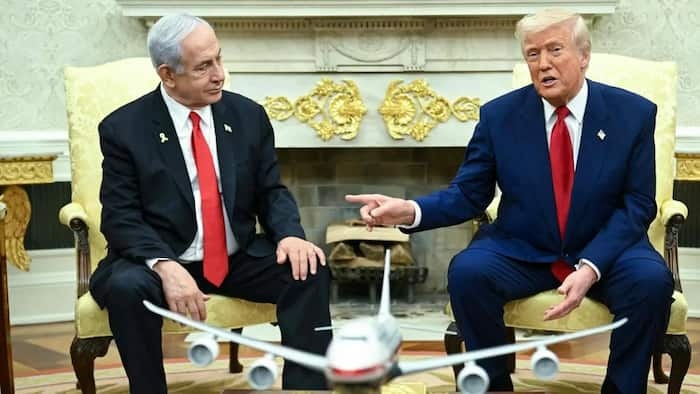
Against the backdrop of collapsing regional stability, President Trump held an urgent, high-level phone conversation with Israeli Prime Minister Benjamin Netanyahu to establish tight tactical coordination across shifting combat sectors.
During the sensitive briefing, Trump updated Netanyahu on classified American operational manoeuvres and ongoing troop redeployments sweeping across the Persian Gulf. In return, the Israeli Prime Minister raised deep security concerns regarding increasingly hostile public rhetoric emerging from Turkish President Recep Tayyip Erdogan against the sovereignty of Israel, while reinforcing the immediate operational necessity of establishing reinforced security buffer zones along Israel’s borders.
Despite rumours circulating about a prospective high-profile visit by Netanyahu to the White House, administration officials clarified that no official bilateral meetings have been added to the calendar yet, even as Trump noted to the press that the close relationship ensures total alignment on who steers global policy decisions in the region.

Comments are closed.