
Centre Removes Excise Duty on Higher Ethanol-Blended Petrol: What It Means for Consumers (explainer)

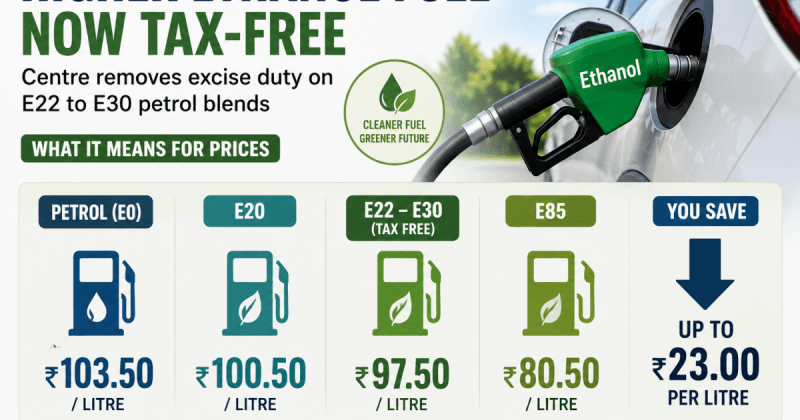
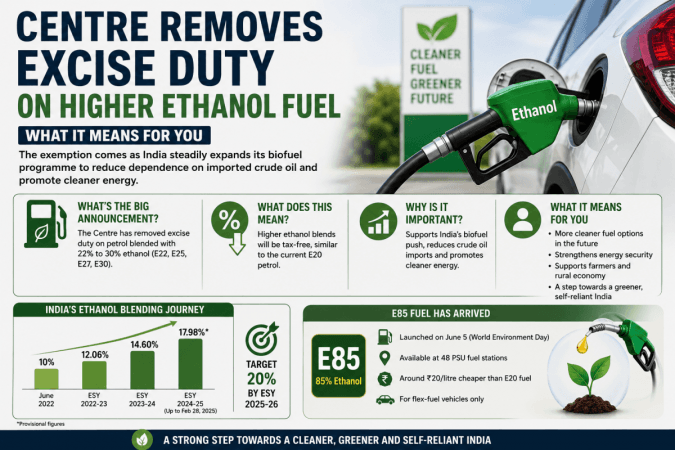
The Central government has exempted petrol blended with 22-30 per cent ethanol from excise duty, extending tax incentives beyond the current E20 standard. The move covers higher ethanol blends such as E22, E25, E27 and E30, marking the first major fiscal support for fuels containing more than 20 per cent ethanol.
While no decision has yet been taken on the nationwide rollout of these higher blends, officials from the Ministry of Petroleum and Natural Gas said the exemption aligns with recently updated fuel standards and remains subject to further testing and consultations.
Laying the Groundwork for the Next Phase
The decision comes as India nears its long-standing target of achieving 20 per cent ethanol blending in petrol. For years, the country’s ethanol programme focused on reaching the E20 benchmark. The latest tax exemption suggests policymakers are already preparing for the next phase of the transition.
The timing is notable because the Bureau of Indian Standards (BIS) recently notified fuel-quality standards for E22, E25, E27 and E30 under IS 19850:2026, which came into force on May 15, 2026. The standards define ethanol content, octane ratings, sulphur limits, testing protocols and safety requirements.
Together, the BIS standards and the excise-duty exemption provide both the technical and financial framework needed for wider adoption of higher ethanol blends in the future.
India’s Ethanol Journey
India’s ethanol blending programme has progressed faster than originally planned.
The National Policy on Biofuels, introduced in 2018 and amended in 2022, advanced the target of 20 per cent ethanol blending from 2030 to Ethanol Supply Year (ESY) 2025-26.
The progress has been substantial:
- 10% blending achieved in June 2022
- 12.06% in ESY 2022-23
- 14.60% in ESY 2023-24
- 17.98% in ESY 2024-25 (up to February 2025)
The rapid rise has helped reduce fossil fuel consumption while creating a larger market for domestic ethanol producers.
Why Ethanol Matters
India imports nearly 87 per cent of its crude oil requirements, making fuel imports a major burden on the economy. Ethanol blending is seen as a way to reduce dependence on imported oil, improve energy security and support domestic agriculture.
Union Minister Nitin Gadkari has repeatedly argued that ethanol offers multiple benefits, including lower emissions, reduced import bills and increased income opportunities for farmers and rural communities.
Every litre of ethanol blended into petrol potentially lowers crude oil imports while creating demand for agricultural feedstock such as sugarcane and grains.
Concerns Over Higher Blends
The transition to ethanol-blended fuel has not been without debate.
As E20 fuel became available nationwide, some vehicle owners expressed concerns about mileage, engine performance and compatibility. The issue even reached the Supreme Court of India, which in September 2025 dismissed a petition challenging the rollout of E20 fuel.
The government argued that the shift had been carefully evaluated and would also benefit sugarcane farmers. Industry bodies later clarified that while some older vehicles may experience a marginal reduction in fuel efficiency, E20 does not pose safety risks.
The Cost Challenge
One key concern for consumers is fuel pricing.
Many assume ethanol-blended petrol should be cheaper, but government data suggests otherwise. According to the Petroleum Ministry, the weighted average procurement cost of ethanol has exceeded the cost of refined petrol in recent years.
As of July 2025, the average procurement cost of ethanol stood at Rs 71.32 per litre, including transportation and GST. This has complicated demands for lower retail fuel prices despite higher blending levels.
E85 Signals Faster Biofuel Expansion
The tax exemption comes shortly after the launch of E85 fuel, which contains 85 per cent ethanol and is designed specifically for flex-fuel vehicles.
Launched on World Environment Day by Petroleum Minister Hardeep Singh Puri, E85 is currently being sold through 48 public-sector fuel stations across the country. State-run oil marketing companies are offering the fuel at around Rs 20 per litre cheaper than E20 petrol.
Although E85 can only be used in flex-fuel vehicles, its introduction highlights how rapidly India’s biofuel ecosystem is evolving.
What the Latest Move Means
The excise-duty exemption does not immediately mean E22-E30 fuels will be available nationwide. However, it clearly signals the government’s intention to move beyond E20 and continue increasing ethanol use in India’s transport sector.
With new BIS standards in place, fiscal incentives introduced and higher-blend fuels such as E85 already entering the market, India appears to be laying the foundation for a broader shift towards cleaner, domestically produced transportation fuels while reducing dependence on imported crude oil.

Comments are closed.