

Summary
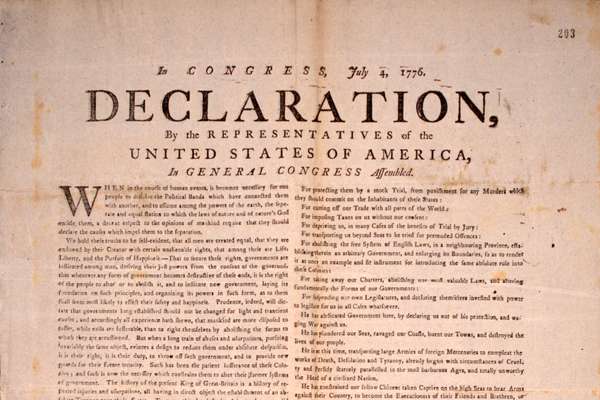
- Unlike most surviving early printings of the Declaration, which were preserved in private libraries or state archives, this copy has a direct connection to military conflict.bHistorians have identified the document as an Exeter Broadside, printed in Exeter, New Hampshire, between July 16 and July 19, 1776 just two weeks after the Continental Congress formally adopted the text in Philadelphia.
- Captain Eleazer Johnson of the American privateer ship *Dalton* acquired a copy of this New Hampshire printing in November 1776 before setting sail across the Atlantic.
- To see a closer look at the actual document and hear from the archivists involved in this discovery, you can view this report on the rare Declaration of Independence copy discovered in UK archives.
AI Generated Summary
In a historical irony that reads like the plot of a Hollywood film, a vanishingly rare early printing of the United States Declaration of Independence has been discovered in London. The artifact had spent nearly 250 years tucked away inside a bundle of administrative paperwork at the UK National Archives, entirely overlooked by generations of historians.
The timing of the discovery could not be more cinematic. The document was unveiled by archivists on the eve of America’s semiquincentennial the 250th anniversary of the 1776 signing of the Declaration. While millions of Americans prepare to mark the milestone with fireworks and celebrations, researchers in the United Kingdom are marveling at a piece of paper that was captured by the British military during the very war fought over those famous words. The extraordinary find was not made by a senior academic or an expensive scanning project, but by Michael Scurr, a retired insurance executive who has spent his Thursday mornings volunteering at the National Archives for the last 11 years. Scurr was methodically cataloging 18th-century naval records when he came across a letter written by a Royal Navy captain detailing the capture of an American ship. Attached to the letter was a bundle of miscellaneous items dismissively labeled in old bureaucratic script as simply another paper. When Scurr carefully unfolded the yellowed sheet, the bold typography at the top of the page immediately caught his attention. It was a pristine copy of America’s founding text, still retaining the clearly legible and revolutionary rally for life, liberty and the pursuit of happiness. What makes this specific artifact so historically valuable is its unique backstory. Unlike most surviving early printings of the Declaration, which were preserved in private libraries or state archives, this copy has a direct connection to military conflict.bHistorians have identified the document as an Exeter Broadside, printed in Exeter, New Hampshire, between July 16 and July 19, 1776 just two weeks after the Continental Congress formally adopted the text in Philadelphia. As revolutionary fervor swept through New England, local printers rushed to duplicate the text to spread the news. Captain Eleazer Johnson of the American privateer ship *Dalton* acquired a copy of this New Hampshire printing in November 1776 before setting sail across the Atlantic. Privateers were privately owned merchant ships authorized by the nascent U.S. government to attack and seize British commercial vessels. It is highly likely that Captain Johnson brought the text aboard to inspire his crew, anchoring their dangerous mission in the lofty ideals of the new nation.
However, the voyage was short-lived. On Christmas Eve 1776, off the coast of Portugal, the British Royal Navy vessel *HMS Raisonable* intercepted and captured the *Dalton*. The ship, its crew, and all its paperwork were seized and brought back to Plymouth in southwest England. Under the maritime laws of the 18th century, British captains were legally required to surrender all captured documents to the Admiralty Court to prove they had legitimately seized an enemy vessel and claim their financial prize money. Because the British military captured more than 3,600 ships during the Revolutionary War, the archives became a massive depository of intercepted American history. Unusually, instead of being sent directly to the courts, this copy of the Declaration was kept among the personal reports of the British capturing captain, Thomas Fitzherbert, who likely recognized it as a highly significant piece of political intelligence. It was filed away, forgotten under layers of imperial red tape, until it was unfolded nearly two and a half centuries later. The document represents the 11th known surviving copy of the Exeter printing and is the first of its kind ever discovered outside the United States. Following delicate preservation work, the National Archives plans to add the artifact to its current Revolution 250 exhibition, offering a rare look at a document that was intended to build a nation, but wound up as a trophy of war. To see a closer look at the actual document and hear from the archivists involved in this discovery, you can view this report on the rare Declaration of Independence copy discovered in UK archives. This video details how the 1776 Exeter printing managed to survive undiscovered for nearly two and a half centuries.
We welcome your contributions! Submit your blogs, opinion pieces, press releases, news story pitches, and news features to opinion@minutemirror.com.pk and minutemirrormail@gmail.com
Comments are closed.