
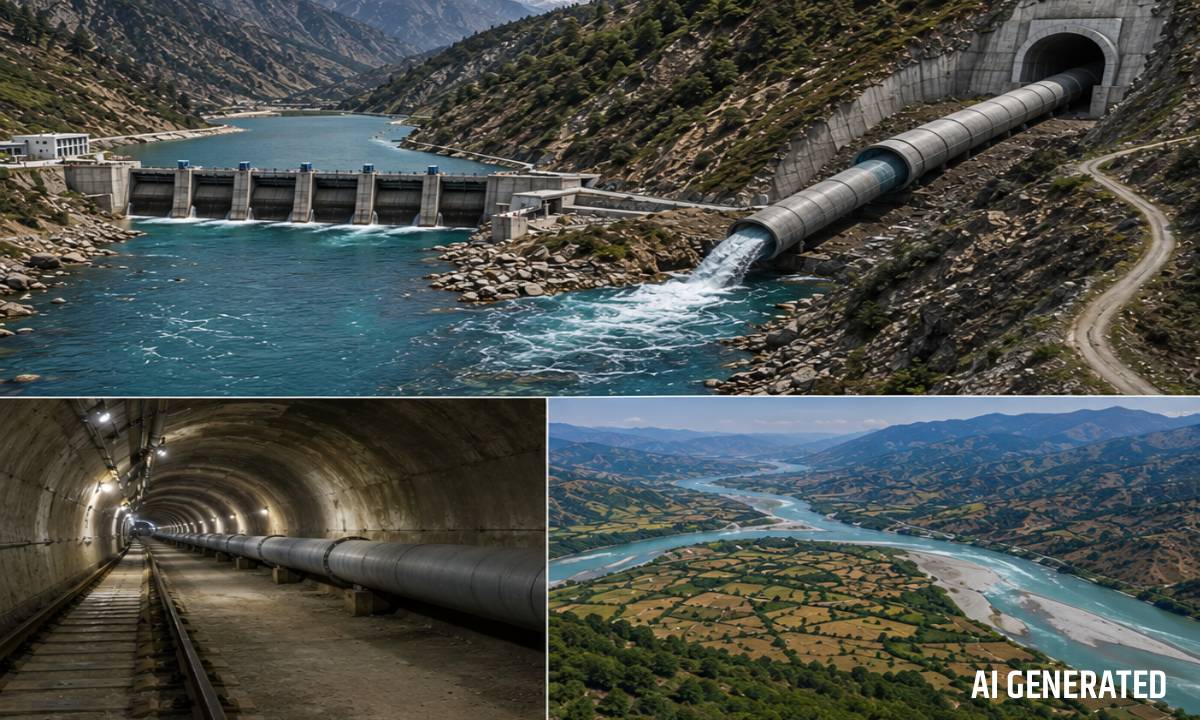

Water shortage becomes a big challenge every year during summer in many parts of the country. Especially in many areas of Delhi, Haryana, Punjab and Rajasthan, the problem of water crisis keeps coming to the fore. Meanwhile, the Central Government is going to start work on such an ambitious project, which can have a positive impact on the water availability of these states in the coming years.
The government is preparing to take forward the Chenab-Beas Link Tunnel Project. Under this project, a long tunnel will be constructed in the Lahaul-Spiti region of Himachal Pradesh, through which excess water from the Chenab river basin will be transported to the Beas river system.
When will the project start?
The construction work of this project costing about Rs 2,352 crore is expected to start from the month of August this year. This project will be developed under the Ministry of Jal Shakti.
When will the target be accomplished?
According to sources associated with the Jal Shakti Ministry, the detailed project report (DPR) of this project has been prepared. The government has set a target to complete this important project as soon as possible. Sources say that once the construction work starts, it is planned to be completed in about two years. However, the maximum deadline for complete completion of the project is considered to be the year 2029.
Where will the barrage be built?
In the first phase of the project, there is a plan to build a barrage on Chandra River in Koksar area of Lahaul Valley in Himachal Pradesh. Chandra River is among the major tributaries of the Chenab River Basin.
During the summer season, when the Himalayan glaciers melt, the water flow in the Chandra River increases significantly. During this time a large amount of water flows forward. The government plans to divert this excess water to the Beas river system through an underground tunnel.
In simple words, the excess water which currently goes unused, will be made available to those areas where the demand for water is high and the problem of water crisis comes up again and again.
How long will the tunnel be ready?
Under the project, about 8.7 km long tunnel will be built, through which the excess water of Chenab basin will be shifted to the Beas river system. This entire project is connected to the Indus river system. The Indus river system includes major rivers like Chenab, Jhelum, Ravi, Beas and Sutlej.
In the first phase of the project, it has been proposed to build an approximately 19 meter high barrage on Chandra river near Koksar village. This region is considered part of the Upper Chenab Basin located in the Western Himalayas.
Which states will benefit?
- Delhi
- Haryana
- Punjab
- Rajasthan
- Himachal
Who was given the responsibility?
The responsibility of construction and operation of this project has been entrusted to National Hydroelectric Power Corporation (NHPC). According to sources, this project will not only help in water management but will also contribute significantly in increasing the hydropower generation capacity in Himachal Pradesh. It is estimated that after the completion of the project, the potential of additional hydropower generation of about 4,000 MW can be developed in the state.
Why is the condition of Pakistan bad?
Chenab River is an important part of the Indus River system and its water further reaches Pakistan. Pakistan has been dependent on the water flow of this river for a long time. According to sources, India aims to make maximum use of its available water resources. The government says that the main goal of this project is to utilize the excess water within the country.
Through the Chenab-Beas Link Project, a part of that water can be used in India, which currently flows towards Pakistan without use. However, officials say that this project is being developed completely under the provisions of the Indus Water Treaty. Despite this, Pakistan is looking at it from a strategic perspective, because after the completion of the project, India will be able to make its water management capacity stronger than before.
The government believes that this project will not only strengthen water conservation and water management, but can also play an important role in meeting the increasing water demand in future. Besides, it is expected to provide benefits in both water availability and energy production sectors in the northern and western parts of the country.

Comments are closed.