
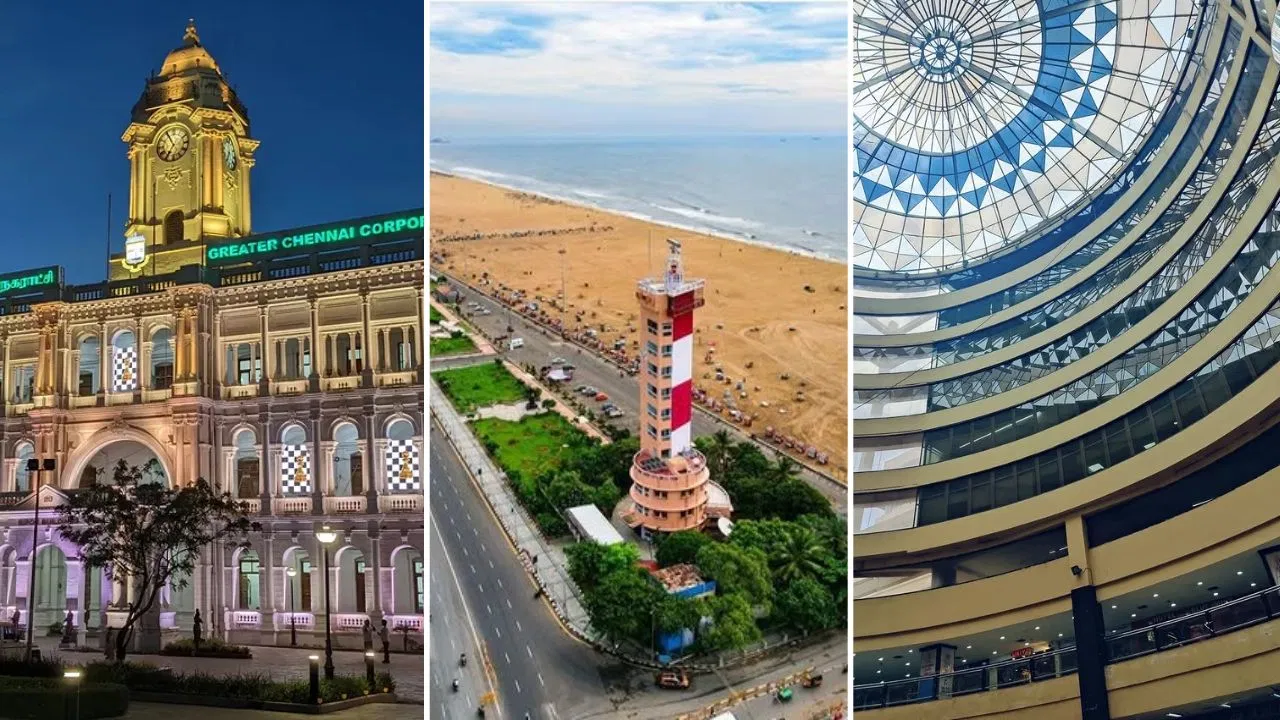
Chennai: Visit this city that boasts world’s second-longest urban beach, India’s first skyscraper and many more historic firsts

New Delhi: Chennai, the capital of Tamil Nadu on the Coromandel Coast, stands as one of South India’s most influential cultural, economic and educational centres. Formerly known as Madras, it earned the title “Detroit of India” for its formidable automobile industry, yet its character extends far beyond manufacturing strength. The city is equally rooted in classical Bharatanatyam, Carnatic music traditions, colonial-era architecture and long, windswept beaches such as Marina. It has also emerged as a major destination for medical tourism, drawing visitors from across the country and overseas.
Beneath this layered identity lies another defining feature. Chennai is a city shaped by historic firsts. Over centuries, it has introduced pioneering institutions, landmark infrastructure and architectural milestones that influenced India’s urban evolution. From governance and education to engineering and maritime trade, the city has repeatedly stood at the forefront of change. This combination of tradition, industry and record-setting achievements gives Chennai a legacy that continues to shape its modern profile. Here are the historic firsts of Chennai.
Chennai: City of firsts
1. World’s second-longest urban beach
Marina Beach stretches roughly 12 to 13 kilometres along the Bay of Bengal, making it the second-longest urban beach in the world. Beyond its scale, it serves as a social and cultural hub where morning walkers, families and fishermen share space against sweeping coastal views.
2. India’s OG shopping mall
Spencer Plaza traces its origins to 1863-64, when Charles Durant and JW Spencer established a departmental store that later evolved into one of India’s earliest shopping complexes. For over 160 years, it has remained a commercial landmark on Mount Road.
3. India’s first municipality
The Madras Municipal Corporation, founded in 1688, stands as the oldest municipal body in India. Its establishment laid the foundation for organised urban governance during the early colonial period.
4. India’s oldest school
St George’s Anglo-Indian Higher Secondary School began in 1715 at Fort St George under Rev William Stevenson. Initially created as the Military Male Orphan Asylum for children of British soldiers, it is regarded as India’s oldest school and among Asia’s earliest institutions of its kind.
5. Tamil got first classical crown
Chennai houses the Central Institute of Classical Tamil. In 2004, Tamil became the first Indian language to receive Classical Language status, reinforcing the city’s deep linguistic and cultural legacy.
6. South India’s first railway station
Royapuram Railway Station, inaugurated on June 28, 1856, marked the beginning of rail services in South India. It remains one of the oldest surviving railway stations in the country.
7. India’s oldest engineering college
The College of Engineering, Guindy, founded in 1794, is recognised as India’s oldest engineering institution, contributing generations of technical expertise.
8. Early Indian aviation roots
SV Setty, among India’s earliest aviators, conducted part of his pioneering aviation work in the Madras Presidency, linking Chennai to the country’s early flight history.
9. India’s second-largest artificial seaport
Chennai Port grew into one of India’s largest artificial seaports, second only to Jawaharlal Nehru Port in Mumbai, strengthening its maritime importance.
10. India’s first skyscraper
The LIC Building, completed in 1959, was once the tallest structure in India and is widely considered the country’s first skyscraper, signalling a new architectural era.
11. India’s oldest surviving bookstore
Higginbothams on Mount Road has operated since 1844. Established by Abel Joshua Higginbotham, it continues to serve readers nearly two centuries later.
12. Only Indian city bombed in World War I
On September 22, 1914, the German warship SMS Emden bombed Madras, making Chennai the only Indian city attacked during the First World War.
Chennai’s landmarks are not isolated trivia. Together, they map the journey of a city that has quietly influenced governance, education, trade and culture across centuries.

Comments are closed.