
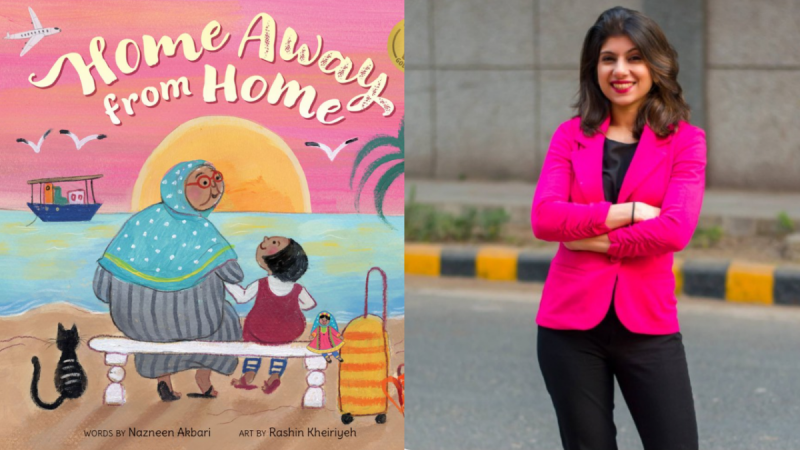
Children’s book by Nazneen Akbari strikes a chord with Indian families navigating migration

In a nation where the move between states (and countries) is not only becoming the norm, but where immigration between states and countries is becoming more frequent, the children of Nazneen Akbari with her book Home Away From Home are being received with a warm welcome by Indian parents and by small children. In a book with drawings made by Rashin Kheiriyeh, he discusses the meaning of home among children whose lives are in the in-between places, cultures and emotional worlds.
The story is at its base a learning of two children who know that belonging cannot be associated with an individual address but rather a relationship, memories, and familiarity. The sweet story, to which are added the sweet, suggesting pictures of travel and domestic life, furnish a language which many such children, who are not experiencing an easy transition, appear to understand unconsciously.
Parents are presented with a mirror image of their families
The book is discussed as an effective tool in discussing the issue of relocation in Indian parenting communities and from the perspective of reviews of readers. Many parents observe that it leaves them open to discussions on the changing schools, changing cities or adapting to life in a foreign country without overwhelming young readers.
Some of the reviewers indicate that their children re-explore certain images, airports, suitcases and left-behind grandparents and relate them to their experiences. To those families who move and settle elsewhere to work or receive an education, this tale replicates a situation where family values are divided among several households.
Writing out of lived experience

The writing of Akbari is subtle and it is about emotional multicoloured prism of the child. The story does not present migration as either the most exciting or the most challenging experience, but it tries to appreciate the authentic unpredictability that frequently comes with changes in life. The words are not complicated but they are not surface deep as children are allowed to know how they feel without an immediate solution.
Teachers believe that this can make the book especially useful to beginning readers who might still lack the vocabulary needed to express complicated feelings about separation or cultural transition.
Examples that have the personal charge
The cartoons created by Rashin Kheiriyeh are a focus of the narration. Symbolic bridges between the two worlds are created through recurrent motifs, e.g. boats, planes, silent communion with grandparents, etc. Visual fallacy changes slightly between warm and nostalgic, as the mood of the narrative is emotional.
In younger kids that use the visual means first before the verbal, the picture serves as a stabilising mechanism, allowing the narrative to be processed even before the text is read in its entirety.
Basinger (Junior Library Guild) recognition
Home Away From Home has been awarded the seal of the Junior Library Guild (JLG) Gold Standard a badge which is assigned to a small number of children’s books each year based upon the quality and relevance of the literature. To the parents and schools, this would act as a recommendation on its own as to the educational and emotional merit of the book.
Why the book resonates now
All year-round, India experiences mass internal and external migrations but children are usually silent subjects in such moves. The book provides a muted structure in how to comprehend change but framework brings about resilience not in a lesson form but in a kind of emotional experience.
Referring to the high-concept children literature in a saturated marketplace, Akbari is notable by being sensible and emotionally clear, which seemingly is resonating with the Indian families that walk the fine line between the multiple definitions of home.

Comments are closed.