
China got irritated by the teaser of ‘Battle of Galwan’, said- Indian Army had crossed the border earlier…

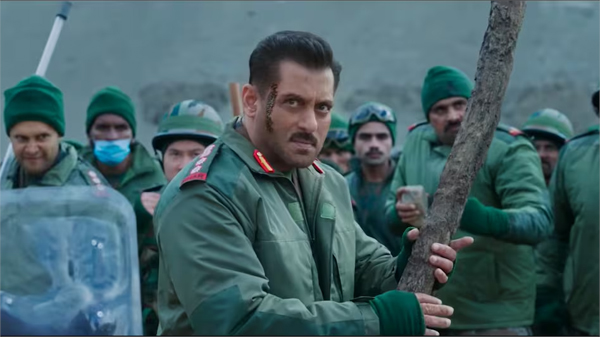
New Delhi. The teaser of actor Salman Khan’s film ‘Battle of Galwan’ is creating a stir not only in India but across the border in China. This film, depicting the character of Colonel Santosh Babu, who sacrificed his life while responding to the Chinese betrayal in Galwan, will be released in theaters on April 17, 2026. China is feeling hot after watching the teaser of this film.
China’s government siren The Global Times has published a long report on the teaser of this movie. The Global Times has boasted that no amount of cinematic creativity can rewrite history or shake the PLA’s resolve to defend China’s sovereign territory.
Global Times has written that Salman Khan, who is best known to the Chinese audience as the lead actor of Bajrangi Bhaijaan, is often teased by Chinese netizens for playing roles that seem too exaggerated, whose story is too simple and the visual effects are so exaggerated that the drama seems fake.
In this film, Salman Khan has played the role of Colonel Bikkumala Santosh Babu. Global Times has said about Colonel Santosh Babu that this is a role about which the Indian media had claimed that he had caught the media’s attention due to his so-called important role in the Galwan Valley conflict of 2020.
Global Times said that some netizens compared the teaser of this film to a scene from Game of Thrones and raised the question whether the film has copied that scene.
Quoting the Chinese social media platform Weibo, the newspaper has drawn the attention of readers to the reaction of Chinese users. A Weibo user with the handle “kingning ryu v” commented that the Indian ‘over-the-top’ film is completely at odds with the facts.
Another Weibo user, “situka98”, mocked the film and the media hype surrounding it, saying, “When history falls short, Bollywood steps in.”
The newspaper quoted the spokesperson of the Chinese Foreign Ministry as claiming that Galwan Valley is located on the Chinese side of the Line of Actual Control in the western part of the China-India border. Chinese border soldiers have been patrolling and on duty in this area for many years.
Global Times claims that since April this year, Indian soldiers have unilaterally and continuously built roads, bridges and other facilities along the LAC in Galwan Valley. China has expressed protest several times, but India has done even more provocative actions by crossing the LAC.
‘Use of films to incite nationalistic sentiments’
Chinese military expert Song Zhongping told the Global Times on Monday that India’s use of films, especially Bollywood films, to incite nationalistic sentiment is not surprising, it reflects a deep cultural and political tradition. He said that no matter how dramatic or exaggerated the events are, films cannot change the basic facts of the Galwan Valley incident.
According to Song, Indian soldiers had crossed the border first and the PLA protected China’s territory as per the law. The bravery shown by officers like Qi Fabao and Chen Hongjun has both symbolic and practical significance, showing that the new generation of Chinese soldiers will never retreat when faced with threats to national sovereignty and territorial integrity.
Song said, “Under extremely difficult mountain conditions, Chinese soldiers consistently perform their duties and meet challenges, which enhances public confidence. This incident has a great impact on Chinese society, highlighting the practical identity of national will and military spirit.”
When Indian and Chinese armies clashed in Galwan
In June 2020, there was a violent clash between Indian and Chinese soldiers in the Galwan Valley in eastern Ladakh. There was tension between India and China here since May 2020.
During the disengagement process at Patrolling Point 14 on the night of 15-16 June, Chinese soldiers treacherously attacked the Indian team. Iron rods, stones and spiked sticks were used in the fight. 20 Indian soldiers were sacrificed in this attack. Colonel Santosh Babu was also among them.
India accepted the loss of its soldiers but China kept covering it up for many days. Later, China officially accepted the death of 4 soldiers, but in some reports, more than 40 Chinese soldiers are estimated to have been killed. The incident was part of a long standoff on the Line of Actual Control, which strained relations between the two countries.
Comments are closed.