
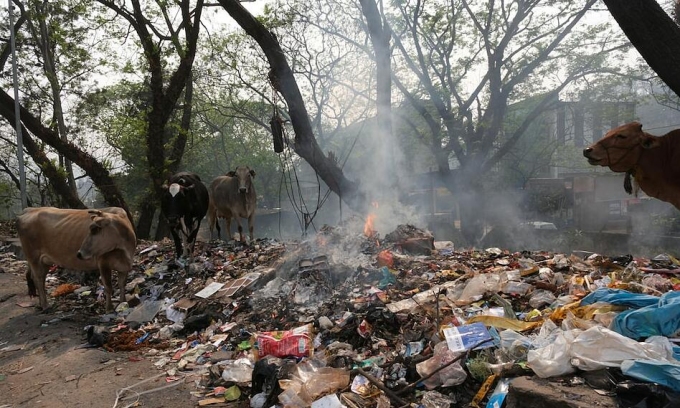

The IQAir 2025 World Air Quality Report released last week shows that a significant share of Asia’s worst-affected cities are located in the two countries, driven by a mix of industrial emissions, traffic congestion, coal-based energy use and seasonal factors such as crop burning.
India, in particular, has dozens of cities among the world’s most polluted. In 2025, 64 Indian cities were listed in the global top 100, underscoring the scale of the problem.
Chinese cities also remain prominent, with several urban centers recording high concentrations of PM2.5, fine particulate matter that can penetrate deep into the lungs and bloodstream, posing serious health risks.
Across Asia, pollution levels in many cities far exceed the World Health Organization’s recommended annual guideline of 5 micrograms per cubic meter. In some cases, levels are several times higher, placing millions of residents at risk of respiratory and cardiovascular diseases.
Topping the list of Asia’s most polluted cities is Loni in India, with an average annual PM2.5 level of 112.5 μg per cubic meter, followed by Hotan in China at 109.6 μg per cubic meter.
India’s Byrnihat (101.1) and Delhi (99.6), and Faisalabad in Pakistan round out the top five with an annual average of 98.8 μg per cubic meter.
These cities also rank as the most polluted globally, in the same order.
The IQAir report analyzes PM2.5 data from 9,446 cities across 143 countries, regions and territories, offering a comprehensive snapshot of global air quality in 2025.
Across Asia, only three cities met the WHO’s air quality guideline last year.
All are located in Central Asia: Zhezqazghan in Kazakhstan, with an annual average PM2.5 concentration of 2.8 μg per cubic meter, topped the list, followed by Kokshetau, also in Kazakhstan, at 3 μg per cubic meter, and Kuyulusebil in Turkey at 4.2 μg per cubic meter.
Experts say rapid urbanization, industrial growth and continued reliance on fossil fuels are driving pollution across the region. Although some governments have introduced measures to curb emissions, progress remains uneven.
The findings underscore the urgent need for stronger environmental policies and regional cooperation to tackle air pollution, which remains one of the leading public health threats worldwide.
Comments are closed.