

In the 2026 rankings by Nature Index, a global database that tracks institutions and countries/territories and their scientific output, all but one of the world’s top 10 research institutions are based in China. Harvard University is the sole U.S. representative, placing second.
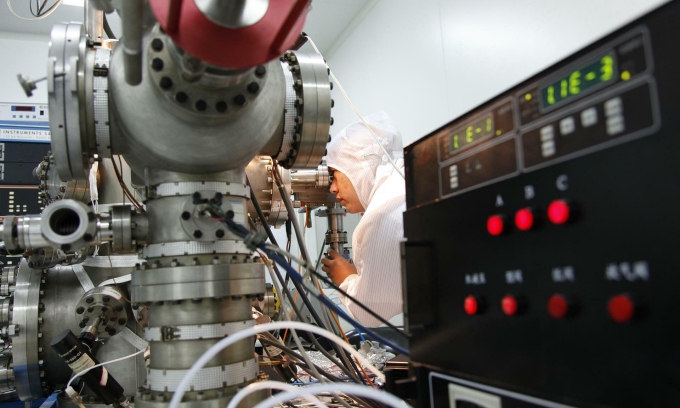
A researcher is seen at a laboratory of the University of Electronic Science and Technology of China in 2019. Photo courtesy of the university |
The index tracks scientific output by institutions and countries based on publications in 145 leading journals across the natural and health sciences. It evaluates performance using two core metrics: Count (total number of papers) and Share (authors’ fractional contribution), capturing both the volume and quality of research output.
By both measures, Chinese institutions dominate the rankings.
Among the top 20 institutions, 14 are Chinese universities or research bodies. The United States has only two more entries besides Harvard — Stanford University (15th) and Massachusetts Institute of Technology (18th).
The remaining positions are held by European institutions, including the Max Planck Society (12th) and the French National Center for Scientific Research (14th).
Topping the list is the Chinese Academy of Sciences (CAS), which significantly outperforms all competitors in both Share and Count. Since the Nature Index was launched in 2014, CAS has held the number one position without interruption.
 |
World’s top institutions by research capacity in 2026. Graphic by Nature Index |
The gap between CAS and Harvard, the leading U.S. institution, continues to widen. In 2025, CAS produced roughly 2.4 times as many publications as Harvard; in 2026, the ratio rose to about 2.9. A similar pattern appears in the Share metric, where CAS exceeded Harvard by around 2.4 times in 2025 and nearly 2.8 times in the latest rankings.
The divergence reflects broader structural shifts in research funding and policy.
In the United States, instability in science governance and fluctuations in funding have created a more challenging environment for researchers and institutions. Reductions in public spending, particularly in basic research, are weighing on long-term scientific capacity.
According to a January report by the Nature Index, the U.S. research landscape has entered a period of disruption, driven largely by administrative changes and budget proposals affecting federal science agencies. In 2025, the federal government froze or terminated thousands of previously approved research grants.
More than 7,800 grants were affected across the National Institutes of Health and the National Science Foundation. For fiscal year 2026, a 35% cut has been proposed for non-defense research and development spending.
By contrast, China is rapidly expanding its scientific investment. A March report by the Organization for Economic Co-operation and Development shows that China has surpassed the United States in total R&D spending when adjusted for purchasing power parity.
In 2024, China invested approximately $1.03 trillion in research and development, slightly exceeding the $1.01 trillion spent by the U.S.
Chinese R&D expenditure has grown at an average annual rate of more than 14% since 2004. Government spending on R&D rose by 90% between 2013 and 2023, compared with just 12% growth in U.S. public spending over the same period.
Comments are closed.