

Duan, 65, increased his holdings in the Hong Kong-listed company on July 6 through his wholly owned firm, H&H International Investment, according to the South China Morning Post.
A filing with Hong Kong Exchanges and Clearing released on Friday showed his stake rose from 6.85% to 7.65%, representing 102 million shares.
Duan’s latest purchase came as the company’s newly launched Labubu Hair Salon series received a weaker-than-expected market response following its late-June debut.
Unlike previous launches that sparked buying frenzies, several variants of the new collection traded below their official retail prices immediately after release, an uncommon occurrence in the designer toy market.
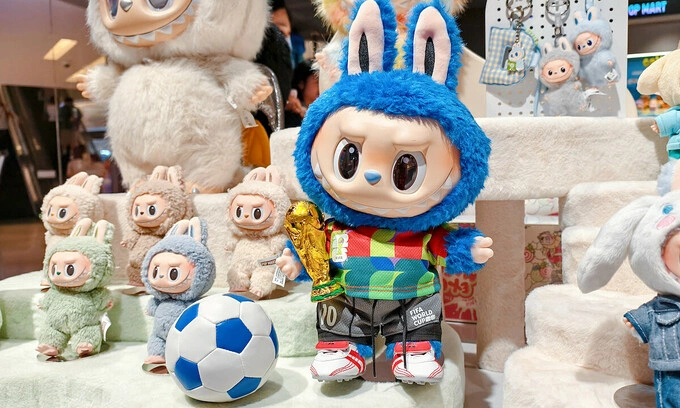
POP MART Labubu x World Cup co-branded Designer Toys authorized by FIFA for the first time in the Pop Mart store in Shanghai, China on July 13, 2026. Photo by CFOTO via AFP |
Analysts remain divided over Pop Mart’s growth outlook. Despite strong expectations ahead of the launch, fueled by exposure tied to the FIFA World Cup and an endorsement from Blackpink’s Lisa, the resulting sales boost was much weaker than anticipated.
Pop Mart has pushed back on the negative outlook. Sales of products outside the Labubu franchise accounted for about 50% of Pop Mart’s total revenue in the U.S. in 2025, chief operating officer Si De said in an interview with Bloomberg, providing the first breakdown of sales in the company’s largest overseas market.
In markets including Japan, South Korea, and Southeast Asia, non-Labubu characters generate the majority of the company’s sales, he said.
“There was an overemphasis on how important Labubu is last year,” said Si, who joined Pop Mart in 2015, shortly before the company shifted its focus from a lifestyle retail chain to art toys.
“Pop Mart’s other intellectual properties also achieved strong growth and gained a significant number of users and fans, but they were simply overshadowed by Labubu,” he added, citing Twinkle Twinkle, a line of star-themed figurines and toys, as one of the company’s fastest-growing character franchises in Asia.
Pop Mart is likely to experience a meaningful slowdown in the second quarter, reflecting slower growth in China and weaker overseas performance, Deutsche Bank said in a research report released last week.
A separate report by Guolian Minsheng Securities last week said the company was in a multi-track verification phase, including testing the performance of mature IP, expanding new consumption scenarios, and exploring new IP incubation pathways, while continuing to broaden the commercialization of its IP portfolio.
Over the longer term, the brokerage said, expansion across multiple business formats would support steady revenue growth.
“Pop Mart has a sustainable business model and strong corporate culture. Its average annual profit over the next 10 to 20 years will not likely fall below current levels,” Duan said on Friday in a post on Xueqiua Beijing-based social investing platform.
“This view rests on the assumption of sustained demand for emotional value (I know I do myself). My investment thesis works if this holds true, yet the premise could prove incorrect,” he said.
Duan, a long-term investor, is best known as the founder of consumer-electronics group BBK Electronics. After building the Subor learning-machine brand in the 1990s, he established BBK and became an influential figure in the Chinese smartphone industry through the wider business ecosystem linked to brands such as Oppo and Vivo.
Duan is also known for long-term investments in companies including NetEase, Apple, Tencent, Kweichow Moutai and PDD.
Comments are closed.