
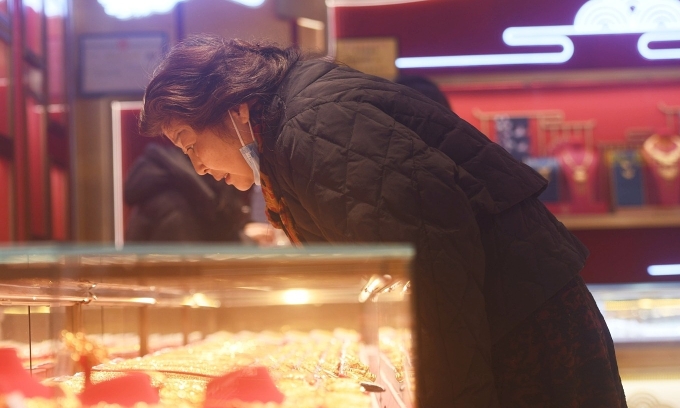

Rose Tian, 43, says worries about the economy and rising global instability have pushed her toward a familiar hedge: gold.
A customer looks at gold at a store in Zhejiang, China, February 2025. Photo by Reuters |
In the week leading up to the Lunar New Year, the high school teacher visited one of Beijing’s largest jewelry markets to buy gold bracelets, necklaces and rings, The Wall Street Journal reported.
Over the years, she has spent thousands of dollars buying gold for herself and family members.
China has emerged as a major engine of the global precious-metals surge that has drawn in traders worldwide. Small-scale Chinese investors like Tian helped drive gold and silver to record levels, before being jolted by sharp price swings in recent weeks.
Chinese buyers acquired about 444 metric tons of gold bars and coins in 2025, up 29% from a year earlier and accounting for nearly one-third of global purchases in that category, according to the World Gold Council.
Despite recent volatility, Tian considers gold the most reliable way to safeguard her savings. She said her salary has edged down in recent years and she is uneasy about escalating geopolitical tensions.
“I’m still bullish because I believe gold is a great safe-haven asset,” she said.
Even the Chinese government is hoarding gold. China increased its official gold holdings in January even as prices climbed, marking the 15th straight month of purchases.
This implies that authorities are continuing efforts to diversify and refine the country’s international reserves, according to official figures, according to China Daily.
Gold reserves reached 74.19 million ounces at the end of January, rising by 40,000 ounces from the previous month, according to the State Administration of Foreign Exchange.
The January addition came after a total net increase of 860,000 ounces in 2025, following the central bank’s decision to restart gold purchases in November 2024.
Chinese households face limited attractive options for storing wealth. The property sector remains weak, domestic equities are volatile, and bank interest rates are low.
As a result, groups ranging from experienced middle-aged female investors known as “aunties” to Gen Z buyers have poured into gold as a store of value.
Many investors purchase gold exchange-traded funds through mobile apps such as WeChat or Alipay, with the same ease as ordering coffee.
Chinese gold exchange-traded funds recorded record inflows last year, while gold futures trading volumes on the Shanghai Futures Exchange reached a new annual peak, the World Gold Council said.
Others prefer physical holdings. At jewelry centers and gold markets, shoppers queue to purchase gold bars and one-gram gold beans, which are often packaged in glass jars.
But prices have been swinging recently. On Jan. 30, gold and silver posted their steepest one-day drops in decades.
“It’s become more of a speculative frenzy,” said Hamad Hussain, climate and commodities economist at Capital Economics.
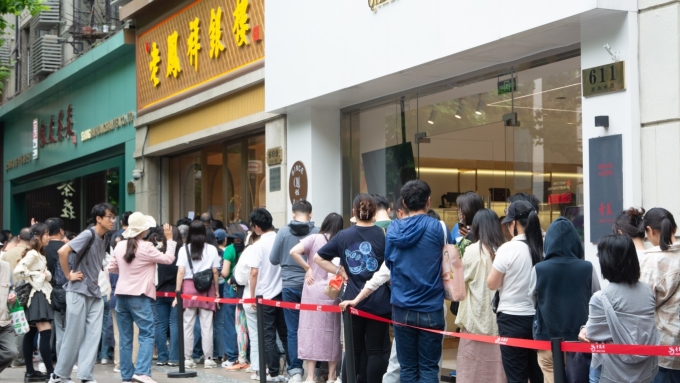 |
Customers line up outside a jewelry store in Shanghai, May 2025. Photo by Read/Reuters |
Golden opportunities
Some analysts, however, believe that recent fluctuations do not undermine the long-term value of gold.
Wang Qing, chief macroeconomic analyst at Orient Golden Credit Rating, said the steady and controlled pace of the central bank purchases despite record-high global gold prices points to an effort to optimize the structure of China’s official reserves.
Gold made up roughly 9.7% of China’s official reserves by the end of 2025, still lower than the global average of about 15%, Wang said.
He added that near-term fluctuations in gold prices are unlikely to significantly alter the central bank’s broader direction of increasing its gold holdings.
In a recent report, the World Gold Council said that although the central bank may have tactically slowed the pace of purchases during periods of sharp price gains, China’s ongoing buying underscores a strategic drive to further diversify its growing international reserves.
On Chinese social media platforms, retail investors who suffered losses said they were drawn into the rally near its peak and then “chopped up like chives.”
But many are buying more. According to Hong Miao, a sales associate at a shop in Beijing’s Tianya Jewelry Market, the recent price correction has increased store visits.
Demand for gold bars has improved during the dip, though overall sentiment remains cautious.
“A ‘wait-and-see’ attitude dominates,” she told The Wall Street Journal.
Jia Pei, a tourist in her 30s from Henan province, believes gold has become too expensive. She purchased about 50 grams of gold several years ago and sold it last summer for a profit after prices doubled.
She and her friends have now shifted their focus to silver, which they expect has greater upside potential than gold. “I’ve begun hoarding silver,” she said. “Even if prices fall, it’s bearable.”

Comments are closed.