
Chinese livestream sellers turn South Korean streets into online shops for ‘authentic’ goods

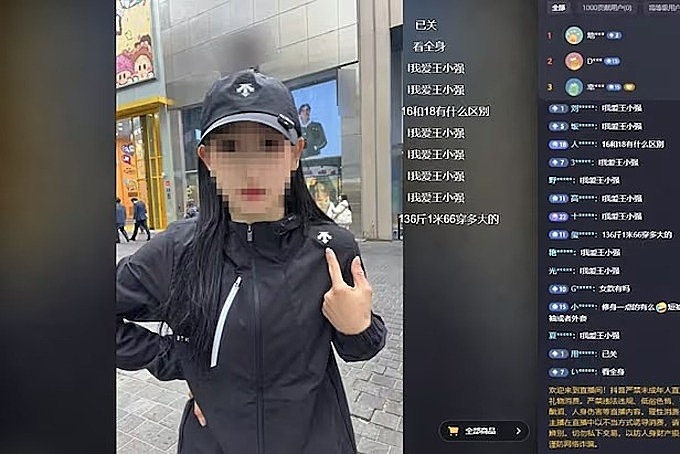
“These are authentic Korean products. The feel on your skin is different when you wear them,” a Chinese woman said as she livestreamed herself on a smartphone at 6 a.m. in Seoul’s Jung District, as reported by South Korean newspaper ChosunBiz.
A screenshot of a video on Douyin showing a Chinese national selling fashion products on a live broadcast on Myeong-dong Street in Jung District, Seoul. |
She was promoting a jacket from a sports brand, speaking in Chinese to her online audience. A male assistant sits beside her, monitoring comments and orders on a laptop screen.
Less than 10 minutes after the broadcast began, he shouted “sold out.”
Chinese street livestream sales have recently become more visible in major Seoul commercial districts.
Merchants in Myeong-dong, a busy shopping area in Seoul, say the number of Chinese street livestreams has risen three- to fourfold over the past six months.
Many believe that this type of sale is a new method invented by traders to sell the duty-free products they bought in South Korea in bulk to Chinese customers.
One of the vendors is a 27-year-old Chinese national, identified as A, who hosts livestream broadcasts on the streets of Myeong-dong from 9 a.m. to 1 p.m. on weekdays.
A sells clothing, shoes and hats to viewers through Douyin, the Chinese version of TikTok.
During a sale session, A introduces dozens of South Korean products, many were from outdoor brands popular among Chinese consumers. Each time a new item is shown, hundreds of viewers asked in the comments about the availability of their preferred sizes.
A later edits the livestream footage into short videos of under one minute and uploads them to the channel. Each clip attracts thousands of views, with some drawing larger audiences than the original broadcast.
Competitive pricing is another advantage. During one livestream, A sold a pair of branded sneakers for CNY699 yuan (US$101), roughly 20% cheaper than the CNY919 yuan price listed on Chinese online malls.
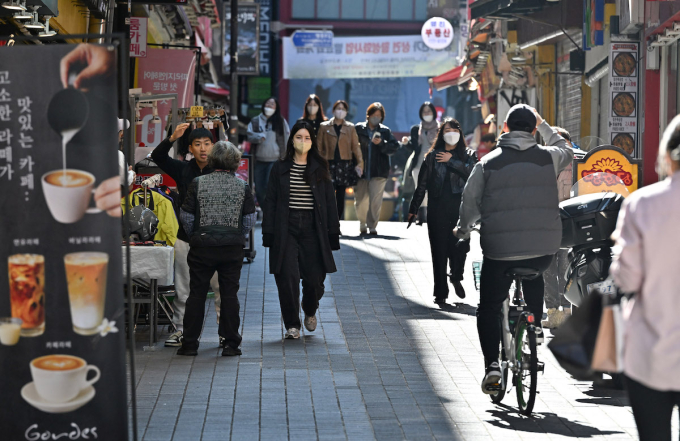 |
Pedestrians walk through the Myeongdong shopping district in Seoul on October 12, 2022. Photo by AFP |
Another Chinese seller, An Jing, 30, who runs a personal shopping mall, livestreams from Hongdae’s streets from 9 a.m. to 1 p.m. daily.
An said the strategy is to focus on cost-effective items sourced personally rather than well-known Korean brand products.
“My company is in Hongdae, so I broadcast from here,” An said, referring to a vibrant district in Seoul.
“I personally wear the items first, then show how they feel to wear and their designs.”
The biggest reason sellers take to street livestreaming is to give proof of their products’ authenticity. Broadcasting in front of well-known South Korean shopping districts helps convince viewers that the products were purchased directly in South Korea.
Analysts say the approach also has a marketing advantage. Lee Eun-hee, a professor of consumer studies at Inha University, said, “Just as there is demand to vicariously experience the local atmosphere by watching overseas street CCTV footage, the method of introducing products on busy streets can be seen as a strategy aimed at such an effect.”
Not all South Korean merchants in the area are supportive, however. Some complain that the broadcasts block pedestrian walkways and create noise in crowded areas.
An apparel store owner in Myeong-dong said, “When Chinese people doing live broadcasts shout right in front of the store, it is inevitably uncomfortable,” adding, “I’ve never seen any crackdowns or restrictions, even as their numbers keep increasing.”

Comments are closed.