
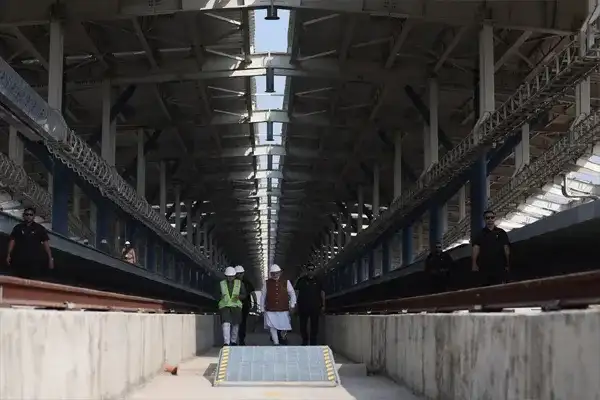

Cost increase in bullet train project
Ahmedabad: An important update has emerged for the country’s first and most ambitious bullet train project, which is underway under the Ahmedabad-Mumbai High Speed Rail Corridor. The project has been delayed for more than four years resulting in huge cost overruns. Earlier it was targeted to be completed for around Rs 1.1 lakh crore, but now its estimated cost has increased to Rs 1.98 lakh crore, which is about 83 percent more than the initially approved amount.
Railway Board confirms cost increase
At a briefing organized under the government’s ‘Pragati’ initiative, Railway Board Chairman and CEO Satish Kumar said that the final decision on the revised cost is still pending, but the new figure is around Rs 1.98 lakh crore. Revision of cost is in progress and is expected to be finalized in the next one-two months. Problems in land acquisition, time in legal approvals and delay in selection of trains are said to be the main reasons behind the delay in the project and increase in the budget.
project progress
According to Railways data, as of November 30, the physical work of this project has been completed at 55.6% and financial progress at 69.6%. Till now Rs 85,801 crore has been spent on this. According to sources, Prime Minister Narendra Modi had recently reviewed the work of the Railway Ministry and had given instructions to complete this ambitious project expeditiously.
Inspection of tunnel in Palghar
Amid reports of cost overruns, the project has also crossed an important milestone. Railway Minister Ashwini Vaishnav inspected the ‘breakthrough’ of the 1.5 km long mountain tunnel in Maharashtra’s Palghar district through video conferencing. This tunnel is located between Virar and Boisar stations and is named ‘Mountain Tunnel-5’. The ministry has described it as a great example of engineering. Earlier in September 2025, the work of 5 km long underground tunnel between Thane and BKC was also completed.
future plans
The bullet train is designed to run at a speed of 320 kilometers per hour. In future, Japan’s modern E10 series Shinkansen trains will also run on this track. From an environmental point of view, this project will help in reducing carbon emissions by 95% compared to road transport. As per the plan, the first phase between Surat to Bilimora is expected to be operational by August 2027, while the entire 508 km long corridor will be ready by December 2029.

Comments are closed.