
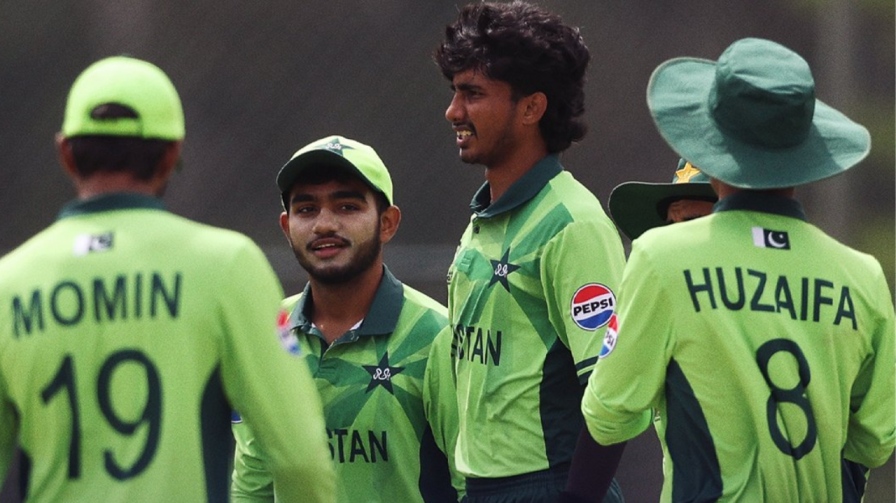
Cleverness or dishonesty… Why were questions raised on Pakistan’s victory in the Under-19 World Cup?

The 19th match of the Under-19 World Cup 2026 was played between Pakistan and Zimbabwe on Thursday (January 22). This was the last match of Group-C. In this match played at Takashinga Sports Club ground in Harare, Pakistan won the toss and decided to bowl first and bowled out Zimbabwe for 128 runs.
The Pakistani team, which came to chase this small target, had scored 66 runs at the loss of 1 wicket in 10 overs. She seemed to be winning easily till the 20th over but she deliberately batted slowly and won in the 26th over.
With this win, Pakistan made it to Super-6. Due to their slow run chase, Zimbabwe qualified for the Super-6 stage and Scotland were eliminated from the tournament. Zimbabwe and Scotland had 1 point each. Tournament co-host Zimbabwe reached the next round at the mercy of Pakistan on the basis of net run rate. Now questions are being raised on the approach of Pakistani team.
Also read: Will Adar Poonawala buy RCB? Said – I will make a big bid for the franchise
Why did Pakistan score slowly?
Pakistan suddenly slowed down the pace of scoring runs after the 14th over in the run chase. His batsmen scored only 36 runs in the next 12 overs at a run rate of 3 and did not hit any boundaries. As soon as Zimbabwe’s Super-6 ticket was confirmed, Pakistani opener Sameer Minhas hit two sixes in two balls and ended the match.
Pakistan achieved the target of 129 runs by losing 2 wickets in 26.2 overs. If the Pakistan team had completed this run chase in 25.2 overs, the Scotland team and not Zimbabwe would have reached the Super-6. In such a situation, questions are bound to arise that why did Pakistan do this?
Also read: Reshuffle in South Africa’s T20 World Cup squad, Stubbs-Rickleton’s entry
Pakistan got this benefit
Actually, the Pakistani team used this trick to take advantage of the rules of the tournament. As per the format of the Under-19 World Cup, both group stage points and net run rate are carried forward. The catch is that only the points and net run rate of the matches played between the teams that have qualified in Super-6 are carried forward.
Pakistan defeated Scotland with 6.5 overs to spare. Had they won against Zimbabwe before 25.2 overs, Scotland would have qualified and would have had to carry the net run rate of the Scotland match. It was more beneficial for Pakistan for Zimbabwe to reach the Super-6, because it had a chance to win by a big margin. That is why the Pakistan team chased the runs slowly. He first ensured Zimbabwe’s qualification and then improved his net run rate by registering a win.
Will ICC take action?
If the slow run chase of Pakistani team is considered a deliberate act then action can be taken against it. ICC Rule 2.11 states, ‘Any manipulation for improper strategic or tactical reasons in an international match is a Level 2 breach of the Code of Conduct.’ Although Pakistan deliberately batted slow in the run chase, it is difficult to prove this.

Comments are closed.