
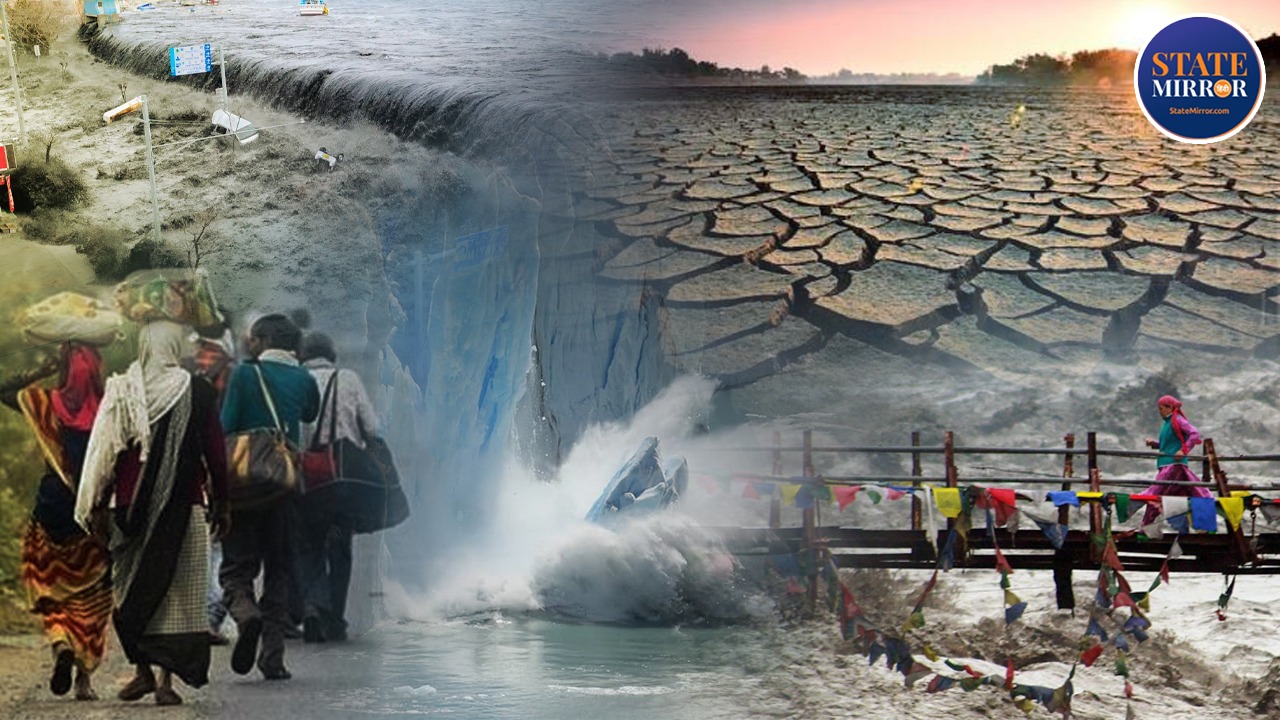
Has Climate Migration started in India, which states and cities are facing crisis? future question how

Has climate migration started in India? Due to climate change, increasing floods, heat waves, rising sea levels, drought and water crisis are becoming big challenges for many states and cities of the country. States like Assam, Bihar, Odisha, West Bengal, Rajasthan, Madhya Pradesh and Uttarakhand are considered to be the most affected, while cities like Mumbai, Chennai, Delhi and Kolkata are also facing serious climate risks. Know the real picture of Climate Migration in India and possible future challenges based on experts, IPCC, DST, World Bank and other reports.
There was a time when climate change was considered a concern only for environmental scientists, but today it is becoming the biggest crisis related to the livelihood, health and living space of crores of people. Heatwaves, irregular monsoons, rising sea levels, frequent floods, droughts and water crises are no longer just natural phenomena, but are forcing people to leave their homes. The process of climate migration has started in many countries of the world.
Clear signs of this have started appearing in India also. Although experts do not believe that entire cities will become empty in the near future, but if the pace of climate change and urban mismanagement continues at this pace, millions of people may have to change their homes or cities in search of a safer and better life in the coming decades.
What is Climate Migration?
Climate migration or climate-induced migration is a situation when people are forced to leave their homes and live somewhere else due to floods, drought, sea level rise, cyclone, extreme heat, water crisis or other climate disasters. This migration can be temporary as well as permanent.
According to the International Organization for Migration (IOM), climate migration has now become one of the main causes of internal displacement in the world. The Intergovernmental Panel on Climate Change (IPCC) has also warned that South Asia will remain among the regions at highest climate risk in the coming years.
At present, its biggest impact in India is visible in the form of internal migration from rural areas to cities, where people are moving to big cities in search of new opportunities after farming and traditional employment are affected.
Is India also under this threat?
India is among those countries in the world where the impact of climate change is increasing the fastest. Reports from organizations like Department of Science and Technology (DST), Ministry of Environment (MoEFCC), NITI Aayog, Council on Energy, Environment and Water (CEEW), IPCC, World Bank, FAO, UNDP and Climate Action Network South Asia show that all 28 states and 8 union territories of the country are worried about climate change in some form or the other.
India’s approximately 7,500 km long coastline, monsoon-dependent agriculture system, large rural population and rapidly growing cities make this risk more acute.
According to different research reports, if the pace of temperature rise is not stopped and measures to avoid it are not accelerated, then by 2050, crores of people in India may have to change their place of residence due to this crisis. Experts say that this change will not happen suddenly, but will gradually emerge in the form of internal migration in the coming years.
Which states are most at risk?
- The impact of climate change is visible across the country, but the challenge of every region is different. Among the eastern and north-eastern states like Assam, Bihar, West Bengal, Jharkhand and Mizoram, they are most at risk of floods, river erosion and landslides.
- Floods of the Brahmaputra in Assam and the Kosi and Ganga in Bihar displace thousands of families every year, while rising sea levels and salt water intrusion in the Sundarbans are posing a threat to both agriculture and drinking water.
- Rising sea levels, cyclones and coastal erosion are impacting people’s livelihood in coastal states like Odisha, Tamil Nadu, Andhra Pradesh, Kerala, Maharashtra, Goa and Gujarat.
- Increasing heatwave, irregular monsoon and decreasing agricultural productivity are increasing the concerns of farmers in the plain states of North India.
- Desertification and water scarcity are becoming serious challenges in western states like Rajasthan and Gujarat, while persistent drought and falling groundwater levels in Madhya Pradesh and Bundelkhand region are promoting rural migration.
- In the Himalayan states (Uttarakhand, Himachal Pradesh, Sikkim and Arunachal Pradesh), events such as rapid melting of glaciers, glacial lake outburst floods (GLOF), cloud bursts and flash floods are posing new risks to the local population.
- This is why experts see these areas as potential future climate migration hotspots.
Which cities will pay the biggest price?
- The impact of climate change is not limited only to villages or agricultural areas, but big cities of India are also falling prey to it. Rising sea level, high tide and urban floods that occur every year have become the biggest challenges facing Mumbai.
- Chennai has faced severe water crisis on one hand and sudden heavy rains and floods on the other. Recent studies have also warned of land subsidence in some parts of the city, which may further increase the risk of floods in future.
- Migration of people is already being recorded due to the increasing impact of sea erosion and salt water in the Sundarban region of West Bengal, which may put pressure on cities like Kolkata.
- The effect of increasing heatwave, water crisis, air pollution and urban heat island in Delhi is making life more difficult.
- Cities like Ahmedabad, Nagpur, Jaipur and Lucknow have also started being counted among urban areas at climate risk due to prolonged heatwaves.
- Experts believe that if cities are not planned keeping climate change in mind, the pressure of population and resources on these metros may increase manifold in the coming years.
Why would people be forced to leave their homes?
Potential migration due to climate change is not the result of a single disaster, but the combined effect of multiple crises. When an area starts getting flooded every year, cultivable land starts submerging into rivers, sea water makes fields and ground water salty, there is drought for several consecutive years or work becomes difficult due to extreme heat, then people face the crisis of saving their livelihood.
Farmers start leaving farming, fishermen’s income decreases and work opportunities for daily wage laborers start decreasing. In such circumstances, people first migrate to nearby cities and later to big metros.
According to experts, climate migration in India will not be a sudden event, but will be a gradually increasing social and economic process in the coming years.
What are experts warning about?
Experts working on climate change say that climate migration in India has become a challenge not of the future but of the present.
The IPCC estimates that the frequency of extreme heat, erratic rainfall, rising sea levels and extreme weather events will continue to increase in South Asia, with the greatest impact on poor, coastal and agriculture-dependent communities.
The World Bank’s Groundswell report also warns that if the pace of climate adaptation does not increase, millions of people around the world could be forced to migrate within their own countries by 2050, with South Asia being one of the key regions.
Zaheer Allam, an expert working on urbanization and climate policy, believes that India’s cities are expanding rapidly, but they are not adequately prepared for the increasing climate risks and the needs of the migrant population.
WRI India says that the climate crisis hits people living in slums, low-income groups and coastal areas the most, so just strengthening the infrastructure will not be enough, but also socially resilient cities will have to be developed.
What is the government doing to tackle this challenge?
In view of the increasing threat of climate change, central and state governments are working on adaptation and disaster management strategies at many levels.
Many missions related to water, agriculture, energy, forests and ecology are being run under the National Action Plan on Climate Change (NAPCC).
Most states and union territories have prepared State Action Plan on Climate Change (SAPCC), in which plans for water conservation, climate-resilient agriculture, forest conservation, urban development and disaster management have been made according to local geographical conditions.
Work is also being done on National Coastal Mission for coastal areas, Aravalli Green Wall Project to prevent desertification, Heat Action Plan for cities and various schemes related to water conservation.
Apart from this, the Government of India, in collaboration with various UN agencies, is also making efforts to strengthen the livelihoods of climate-risk communities and for safe internal migration.
What is the biggest challenge right now?
India has made rapid progress in the fields of renewable energy, disaster management and early warning systems, but there is still no comprehensive and separate legal system for the rehabilitation of people affected by climate change. Many states do not have sufficient financial resources for climate adaptation projects. Whereas due to rapid urbanization the pressure on cities is continuously increasing.
Large investments are still needed in areas such as water security, climate-friendly urban development, local employment opportunities and social security. If these challenges are not addressed in time, the economic and social impacts of climate change could be much more serious in the future.
Can India avert this crisis?
Experts believe that it is not possible to stop climate migration completely, but its speed and impact can be reduced to a great extent. For this, rapid work will have to be done on climate-friendly urban planning, water conservation, coastal protection, expansion of green areas, climate-friendly agriculture, strong heat action plan and clear policy for rehabilitation of the affected people.
The most important thing is that climate change should be seen not just as an environmental challenge but as an economic, social and development issue. India still has an opportunity to reduce the future climate crisis by including climate resilience in the mainstream of development.
If this does not happen, climate-induced internal migration could become one of the biggest social and economic challenges facing the country in the coming decades.

Comments are closed.