
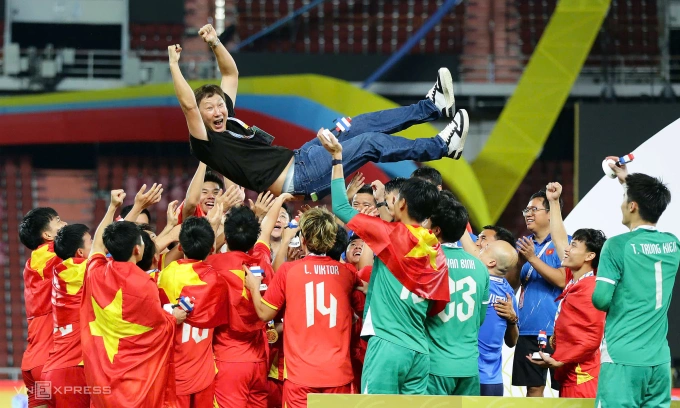

Vietnam football players throw coach Kim Sang-sik in the air to celebrate their 3-2 victory over Thailand to claim gold medal at the 33rd SEA Games at Rajamangala Stadium in Bangkok, Thailand, Dec. 18, 2025. Photo by Read/Duc Dong |
In an interview with Read, Kim said he believes several factors beyond the professional tactics have contributed to his success.
Before managing Vietnam’s national teams, what did you know about the country?
Vietnam is a young, dynamic nation with close ties to South Korea. Many South Koreans travel here, including my family. We once had a joyful and memorable trip to Da Nang, a place with beautiful scenery, great food, and friendly people.
In 2022, I traveled to Ho Chi Minh City with Jeonbuk Hyundai Motors for an AFC Champions League group stage match against hosts HAGL. My impression, shared by my team, was that Vietnamese clubs play with such passion and intensity, showing a serious competitive spirit. Feeling the heat from the fans’ enthusiasm in Ho Chi Minh City made me think I would come to Vietnam if given the chance.
After a year-long break following your departure from Jeonbuk, you received an offer from the Vietnam Football Federation (VFF) in April and were unveiled on May 6, 2024. What do you remember about that first call?
When I received the offer from VFF, I was both nervous and excited. I had never worked abroad before, but deep down, I had always wanted to. After careful consideration, I found VFF’s proposal serious and clear. They wanted to work with me to develop Vietnamese football.
I discussed it with my family. They supported me and agreed it was a good opportunity to challenge myself, which gave me more confidence to take on the new job.
Through YouTube, I learned about Vietnamese culture and history, trying to understand the country before officially arriving. I also studied how coach Park Hang-seo worked with Vietnamese players and received his advice.
I realized that while tactics are extremely important in football, it is equally crucial to connect with players emotionally. In different situations, a coach can be a family member, a parent, at times a brother, or even a close friend to players. We all aim to get closer to the players, understand their wishes and concerns, and work together to resolve them.
I believe one of my strengths is a relatively youthful mindset and approach, which helps me connect more easily with players. At times, I do raise my voice or scold them, but once we leave the training ground, I treat them like a brother would to better understand their thoughts.
Together, we find the best ways for them to develop individually and as a team. Fortunately, this approach suits the players. They train hard and give everything for the Vietnamese flag.
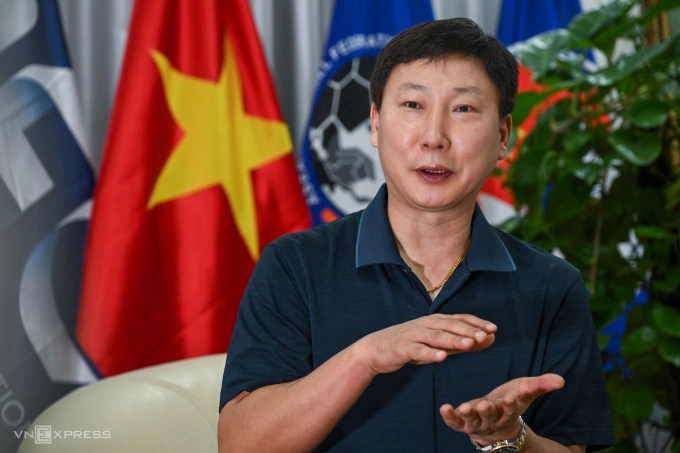 |
Coach Kim Sang-sik in an interview with VnExprses at the headquarters of Vietnam Football Federation in Hanoi, April 14, 2026. Photo by Read/Giang Huy |
Vietnam is only the second team you have managed. You once admitted that the early period was very stressful, even saying you “did not dare to unpack your luggage.” How do you feel now?
When I said I “did not unpack all my luggage,” I meant that the position of head coach is unique because it depends entirely on collective results. If the results are good, you continue. If not, you can be dismissed at any time and return to South Korea. That saying reflected the pressure I faced when I first arrived in Vietnam.
However, together with the team, I worked hard to overcome difficulties and manage pressure to earn the positive results we have now. I have received affection and trust from players, staff, and Vietnamese fans. I am very happy to repay that trust with good results over the past two years.
My luggage is now fully unpacked, but the pressure remains. How to further improve the national team is always on my mind.
How do you cope with accumulated stress?
It is inevitable for a national team coach to face great pressure. My ways of relieving stress in Vietnam are somewhat limited because I am recognized by many people. Usually, I meet friends or acquaintances to have a meal, share concerns, and talk things through, and I also play golf. I feel mentally relaxed when my family visits. Another way is eating pho, which is very delicious.
I try to focus on football only when working. In my free time, I deliberately switch off from it to clear my mind.
Your contract targets included reaching the semifinals of the 2024 ASEAN Cup, the 33rd SEA Games, and qualifying for the 2026 AFC U23 Championship. In the end, you won three Southeast Asian titles and finished third at the AFC U23 Championship. What do you think of the mentality of Vietnamese players after each milestone?
Over the past two years, I have clearly felt their passion and will to win, which is what I should learn from them. I always want to praise and encourage them. Their performances on the pitch bring them closer to the fans and contribute to their personal development.
We have had success in Southeast Asia and Asia because the players have done very well. However, if they can build confidence a bit faster, right from the first match, then the results could be even better.
What changes do you expect from the Vietnamese players?
The idea that “players need guidance” is not unique to Vietnam, but applies worldwide. Who the head coach is, what direction the team takes, what goals are set, and what philosophy to follow are all crucial.
The Vietnamese players are doing well, but they can do even better by cultivating a deeper professional mindset. They need to invest efforts and time to think about improving their performance and contributing to team victories, as well as enhancing their physique and fitness.
These are essential factors for players anywhere. Top players like Cristiano Ronaldo and Lionel Messi maintain elite performance beyond 35 thanks to their professionalism. In South Korea, many players over 35 or even 37 still maintain that mindset, and Vietnamese players should do the same to prolong their careers.
Some foreign coaches in Vietnam say players tend to follow instructions and rarely challenge coaches. What is your view?
It depends on the player. Some may voice their opinions, others may not. I believe feedback should not be a way to assert oneself, but rather to contribute to the team’s development. In the Vietnam national team, no player has opposed the coaching staff’s instructions, so I feel quite comfortable.
I understand football is unpredictable and has no single correct answer. It is normal for a player to feel that a coach’s instruction might not always be right. There is a big difference between being on and off the pitch, so reactions vary by situation. Ultimately, players need flexibility to handle different scenarios during matches.
What about your immediate goals: defending the ASEAN Cup title in 2026 and advancing far at the 2027 Asian Cup?
As head coach, I closely monitor club-level matches to scout promising talents and identify the best players for upcoming call-ups. While the team has achieved good results, there are still weaknesses and mistakes to address and tactics to refine to achieve greater success in future tournaments. I am always thinking about training programs, setting goals, and motivating players to perform as a cohesive unit.
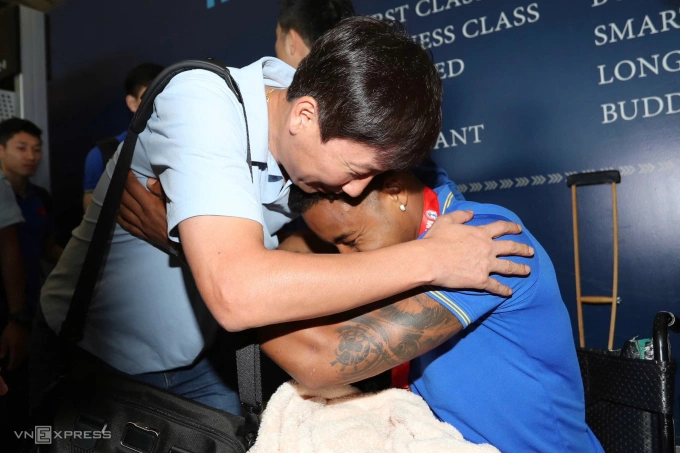 |
Coach Kim Sang-sik (L) hugs naturalized striker Nguyen Xuan Son, sitting in a wheel chair from breaking his leg during Vietnam’s 3-2 victory in the 2024 ASEAN Cup final with Thailand, at Suvarnabhumi airport in Bangkok, Thailand, on Jan. 6, 2025. Photo by Read/Dong Huy |
From Park Hang-seo to Kim Sang-sik, the South Korean influence has been significant in Vietnam’s international success. What is the core secret behind this partnership?
I think it largely stems from cultural similarities. The two countries share many values, such as respect for family, hierarchy, and mutual respect in cooperation. In particular, South Korea has the concept of “jeong,” while in Vietnam it is called “tinh” (affection) – an invisible emotional bond connecting people deeply. These similarities come together to create great success in our collaboration.
What are the similarities and differences between the football of the two countries?
The similarity lies in the players’ passion on the pitch. Both South Korean and Vietnamese players give everything when they step onto the field, fighting for victory and for their teammates, sacrificing for each other, and overcoming difficulties.
The difference is that South Korean players possess better professionalism, especially for the fans. They aim to deliver exciting, fast-paced matches. For example, after a collision, Korean players try to get up quickly and resume play without slowing the tempo, keeping fans engaged.
In Vietnam, players currently focus more on winning and place less emphasis on attracting more fans to the stadium. Vietnamese players need to develop a more professional mindset.
The “senior-junior” culture in South Korea and Vietnam shares many similarities. How does this manifest in football?
South Korean football used to have strict senior-junior rules during my playing and early coaching years. Today, we are moving toward a more equal culture to ensure fairness.
Vietnam seems to have a similar culture. I observed at team meals that younger players are sometimes less comfortable, not allowed to speak freely, and expected to serve food to senior players. I think Vietnam should also move toward equality, where seniority does not dictate to others, but everyone works equally for the team’s success.
What opportunities do you see in sports cooperation between Vietnam and South Korea?
Exchanges between our two countries are developing well, including in sports, but there is still much potential. We can strengthen connections in youth training systems across sports.
In football, we should increase exchanges between the U13 and U15 teams through regular friendly matches and tournaments in both countries. South Korean teams visiting Vietnam would gain unique experiences and new ideas for development. Broadcasting the K-League and V-League in both countries is another good idea.
My connections are mainly in football. If given the opportunity, I would leverage relationships with federations, experts, and individuals in South Korean football to promote Vietnamese football and encourage collaboration.
We all know that FIFA and the World Cup are models of successful sports business. I hope to contribute to improving Vietnam’s football system to generate more benefits and revenue, such as through sponsorships and increased fan attendance. South Korea’s sports economy could offer useful lessons.
South Korea also has many large companies and sponsors. One of my goals is to work with VFF to connect with these businesses and attract more funding for Vietnamese football.
What is needed to ensure a sustainable sports cooperation in the future, especially with South Korean President Lee Jae-myung set to visit Vietnam?
I am very happy about President Lee Jae-myung’s visit. Currently, the global spread of K-pop, Korean culture, and cuisine helps promote the country’s image. K-pop and sports play important roles in exchanges with Vietnam. I hope sports will further strengthen the ties between the two nations.
Beyond high-level visits, we should enhance youth exchanges, improve sports infrastructure, especially football, and expand cooperation in sports broadcasting.
During this visit, I hope the President can enjoy Vietnamese dishes. If needed, I can recommend good local restaurants and even act as his tour guide.
Coach Kim Sang-sik was born in 1976 in Jeonnam Province and grew up in Busan in southern South Korea. He graduated from Daegu University and holds a master’s degree in Physical Education from Yongin University. A former defensive midfielder capable of playing as a center-back, Kim spent his entire club career in South Korea, playing from 1999 for Seongnam FC, Gwangju Sangmu (now Gimcheon Sangmu), and Jeonbuk Hyundai Motors, winning five K-League 1 titles (2001, 2002, 2006, 2009, 2011). He retired at the end of the 2013 season. From 2014 to 2020, he worked as an assistant coach at Jeonbuk. In 2021, after obtaining the AFC Pro License, he led Jeonbuk to the K-League 1 title and the 2022 FA Cup. He resigned on May 4, 2023. On May 6, 2024, Kim was officially appointed head coach of Vietnam’s national team and U23 squad. He qualified for the 2027 Asian Cup, won the 2024 ASEAN Cup, the 2025 Southeast Asian U23 Championship, secured the SEA Games 33 gold medal, and finished third at the 2026 AFC U23 Championship. His initial contract with VFF ran from May 2024 to March 2026, with an automatic one-year extension triggered by strong results in competitions. |
Comments are closed.