
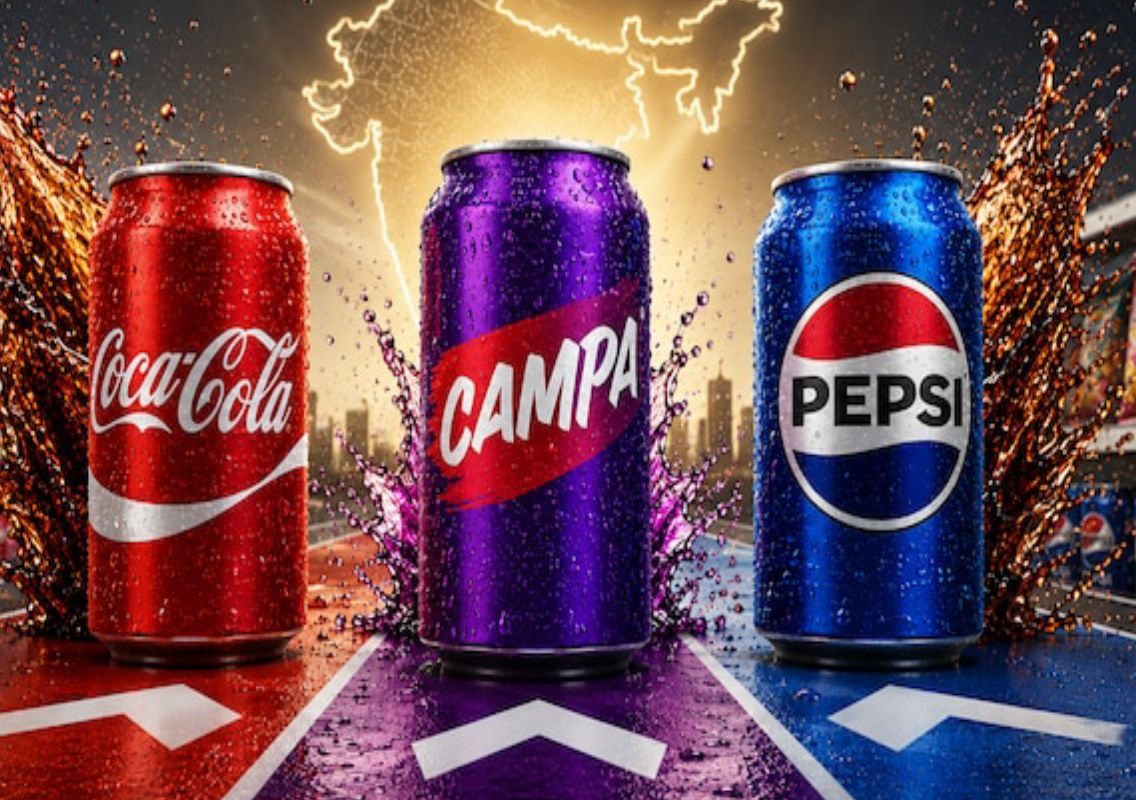

New Delhi: India’s carbonated soft drinks market is witnessing heightened competition as Coca-Cola continues to lead, while Reliance Consumer Products-backed Campa rapidly expands its footprint, challenging established players including PepsiCo.
According to industry estimates, Coca-Cola holds a dominant 40–42% share of India’s carbonated beverages market, followed by PepsiCo with 28–30%. Campa, relaunched in March 2023, has quickly scaled up to capture around 7–8% market share, marking one of the fastest expansions in the segment in recent years.
The intensifying competition highlights a shift in market dynamics, where pricing strategies, distribution strength and retailer incentives are becoming as critical as brand equity.
Campa’s rapid rise disrupts market dynamics
Campa’s resurgence under Reliance Consumer Products has significantly altered the competitive landscape. Positioned as a value-for-money alternative, the brand has adopted aggressive pricing strategies and is offering higher trade margins to distributors.
This dual approach has enabled Campa to penetrate both modern retail and general trade channels at a rapid pace. Its strong presence across Reliance Retail outlets has further accelerated nationwide distribution.
The brand’s portfolio includes Campa Cola, Campa Orange and Campa Lemon, which are gaining traction among price-sensitive consumers. Industry experts suggest that Campa has been steadily gaining market share from both Coca-Cola and PepsiCo, although the impact appears more significant on PepsiCo.
The financial momentum reflects this growth. Campa recorded approximately ₹2,900 crore in sales in the first quarter of FY27, contributing an estimated 20–22% of Reliance Consumer Products’ overall revenue. This makes it one of the fastest-growing segments within the company’s FMCG portfolio.
Coca-Cola relies on scale and brand strength
Despite rising competition, Coca-Cola continues to maintain its leadership through a strong brand portfolio and an extensive distribution network. Its beverage lineup includes well-established brands such as Coca-Cola, Thums Up, Sprite, Fanta and Limca.
The company operates through multiple bottling partners, including Hindustan Coca-Cola Beverages, ensuring deep penetration across urban and rural markets.
Coca-Cola’s scale, manufacturing capabilities and brand loyalty provide a strong competitive advantage, allowing it to defend its market share even as new challengers emerge.
PepsiCo leverages diversified portfolio
PepsiCo is adopting a broader strategy by leveraging its diversified snacks and beverages portfolio. Its beverage brands include Pepsi, Mountain Dew, 7UP and Mirinda, while its snacks division features popular products such as Lay’s, Kurkure, Doritos, Uncle Chipps and Cheetos.
This integrated portfolio allows PepsiCo to strengthen consumer engagement and cross-sell products across categories.
In India, a significant portion of PepsiCo’s bottling operations is managed by Varun Beverages, with Pepsi-branded products contributing more than 90% of the bottler’s revenue.
However, analysts note that PepsiCo may be facing relatively higher competitive pressure from Campa due to overlapping consumer segments and pricing strategies.
Distribution and pricing emerge as key battlegrounds
The competition in India’s carbonated drinks market is increasingly shifting beyond traditional brand loyalty. Distribution reach, retailer relationships and pricing strategies are becoming decisive factors.
Campa’s higher trade margins have incentivised retailers to stock and promote its products, helping it secure valuable shelf space. Combined with competitive pricing, this has made the brand particularly attractive in price-sensitive markets.
Meanwhile, established players are focusing on strengthening their distribution networks and enhancing execution to retain their market positions.
Industry observers highlight that the current phase of competition is being driven as much by backend efficiencies and supply chain execution as by consumer demand.
Market outlook remains competitive
India’s carbonated beverages market continues to grow, supported by rising disposable incomes, urbanisation and changing consumption patterns. This growth is attracting increased competition and innovation among players.
While Coca-Cola retains a clear lead and PepsiCo continues to benefit from its diversified business model, Campa’s rapid rise signals a shift towards a more competitive and fragmented market.
The evolving dynamics suggest that companies will need to continuously adapt their strategies, focusing on pricing, distribution and product innovation to stay relevant.
Conclusion
Coca-Cola’s leadership in India’s carbonated drinks market remains intact, backed by strong brand equity and distribution strength. However, the rapid expansion of Campa has intensified competition, particularly through aggressive pricing and trade incentives.
As PepsiCo navigates increasing pressure and Campa continues to scale up, the battle for market share is expected to become more intense. The coming quarters will likely see a sharper focus on execution, distribution efficiency and retailer engagement as companies compete for dominance in India’s growing soft drinks market.

Comments are closed.