
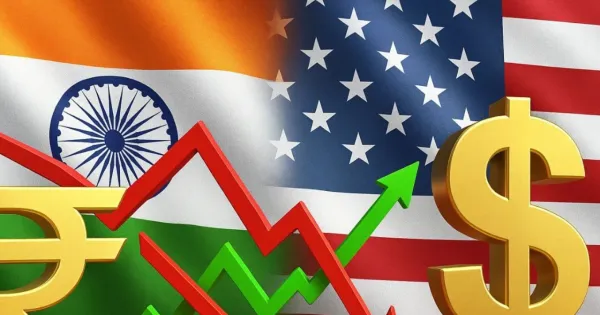
Continuous huge fluctuations in rupee in 2026, experts said – trade agreement with America is not a panacea.

New Delhi. The Indian rupee appears unlikely to arrest its decline amid a number of headwinds, including global trade disruptions and strong domestic macroeconomic supportive factors amid massive outflows of foreign capital, as uncertainty over the impact of the tariffs remains.
The Reserve Bank of India (RBI) sees the rupee’s fall as a measure to offset the impact of the tariffs and expects the currency to return to stability once India reaches a trade deal with its largest trading partner, the US.
The Indian currency has weakened by about five percent so far from the level of 85 per dollar in January and has also crossed the historic low of 91 against the dollar. During the year the exchange rate of the rupee has weakened by more than 19 per cent against the euro, by almost 14 per cent against the British pound and by more than five per cent against the Japanese yen. The rupee was the worst performer among Asian peers despite a more than 10 per cent fall in the US dollar index and weak international crude oil prices.
The currency’s sharp slide, which began with US President Donald Trump’s announcement of sweeping retaliatory tariffs in April, prompted foreign investors to increasingly pull money out in search of better profits in other emerging markets. The effect of this trend was also visible in the foreign capital coming through Foreign Direct Investment (FDI). On a net basis, FDI turned negative between January and October this year.
“FDI acts as a key pillar for the balance of payments,” said Anindya Banerjee, head of currency and commodity research at Kotak Securities. When it weakens, the currency becomes more dependent on portfolio flows. “Foreign exchange markets become more sensitive to global risk sentiment and the need for central bank intervention increases.”
Due to this, the fall of rupee seemed to be accelerating further. It fell more than one percent to 89.66 against the dollar in a single session on November 21. Within 13 sessions, it crossed the level of 90 per dollar on December 2 and went below the historical low of 91 against the dollar on December 16. The government blamed the rupee’s decline on the lack of progress in talks on a trade deal with the US amid a widening trade deficit and a weak capital account. Minister of State for Finance Pankaj Choudhary had said in the Rajya Sabha on December 16, “…the decline in the Indian rupee is due to the widening trade deficit and progress related to India’s trade agreement with the US, while relatively weak support from the capital account.”
RBI Governor Sanjay Malhotra, however, said that the central bank does not target any fixed range for the rupee in the foreign exchange market. Dilip Parmar, research analyst at HDFC Securities, attributes the rupee’s decline to the “capital account crisis” as the main reason. “Unlike previous crises that were trade-driven, the current decline is due to reduced capital inflows,” he said, adding that the RBI’s interest rate cuts to support domestic growth made the rupee less attractive.
“Uncertainty over the India-US trade agreement and the imposition of 50 per cent duty by the US on exports from India hit Indian exports, widening the trade deficit and negatively impacting the rupee,” said Anuj Chaudhary, research analyst at Mirae Asset Sharekhan.
He forecasts the rupee to fall towards 91 and 92.50 levels in the near term. Jatin Trivedi, vice-president (research) for commodities and currencies at LKP Securities, said the sharp decline in FDI “has reduced long-term dollar inflows making the rupee more dependent on volatile portfolio flows.”
“High commodity prices and increased risk over trade agreements with the US kept FDI away and lack of investment inflows hurt the rupee as investments shifted to our competitor countries,” he said. According to RBI data, total investment inflows declined to a net worth of (-) $0.010 billion between January and October this year.
In contrast, during January-December 2024, an investment inflow of $23 billion was recorded in the country. Net foreign direct investment (FDI) during January-December 2025 stood at $6.567 billion while net portfolio investment stood at (-) $6.575 billion. According to balance of payments data for the July-September quarter of FY26, foreign exchange reserves recorded a deficit of $10.9 billion, compared to an increase of $18.6 billion in the same period a year ago. Dilip Parmar of HDFC Securities said the current rupee crisis is almost entirely driven by capital account imbalances. Record outflows of $17.5 billion by foreign institutional investors (FIIs) in 2025 generated huge demand for the dollar, putting the rupee under pressure.
“The trade deal with the US will be helpful but it is not a panacea,” said Anindya Banerjee of Kotak Securities. He said it is equally important to speed up and simplify FDI approvals, deepen domestic bond and foreign exchange markets and reduce dependence on short-term portfolio flows. Banerjee said despite the challenges, the rupee is expected to continue to trade amid extreme volatility underpinned by strong macroeconomic infrastructure.

Comments are closed.