
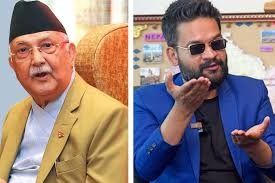
Counting of votes continues in Nepal: Balen Shah or KP Oli… know who is in the lead for the post of Prime Minister?

Kathmandu, March 6. After the parliamentary elections held on March 5 in Nepal, counting of votes is now going on. According to Nepali media, in the initial count of 43 seats, Rashtriya Swatantra Party is leading on 35 seats. Rashtriya Swatantra Party’s Prime Ministerial candidate Balendra Shah will contest against former Prime Minister K.P. in Jhapa-5 of Eastern Nepal. Sharma is leading over Oli, while RSP has taken an early lead in the country’s parliamentary elections. Balen Shah, a former mayor of Kathmandu Metropolitan City, is in a contest between the two prime ministerial candidates in Oli’s traditional political stronghold.
According to initial vote counting on online portal Ekantipur, Shah has got 1,478 votes, while Oli has got 385 votes. Apart from Shah’s lead, his party, RSP, is also making a big lead in the initial vote count. RSP wants to end the decades-old dominance of traditional political parties in the country’s politics. As per the latest updates, RCP is leading in 39 constituencies, followed by Nepali Congress, which is leading in three constituencies.
Nepali Communist Party (NCP) is leading in two areas, while former Prime Minister Oli’s party Communist Party of Nepal (Unified Marxist-Leninist) has no lead in any area. The counting of votes is going on under the first-past-the-post (FPTP) system, through which 165 members of the lower house of Parliament will be elected. Another 110 members will be elected through the proportional representation system to create a 275-member lower house.
According to early results, the decades-long dominance of the three major political parties, Nepali Congress, CPN-UML and Nepal Communist Party, which were formed after the merger of the Communist Party of Nepal (Maoist Centre) and the Communist Party of Nepal (Unified Socialist), may end. Elections are being held in the country for the first time since the Gen-Z protests in September last year, which led to the fall of the coalition government led by then Prime Minister KP Oli.
There was a growing feeling among the people of Nepal that the country was going backward because of the traditional parties and their leadership. This is the reason why strong opposition to Gen-ji started in Nepal. General elections have been held in Nepal almost six months after the Gen-Ji Protest. For this reason also, the performance of old traditional political parties appears to be poor in the initial results. Whereas the political party, RSP, is performing well. RSP is led by former media personality Rabi Lamichhane.

Comments are closed.