
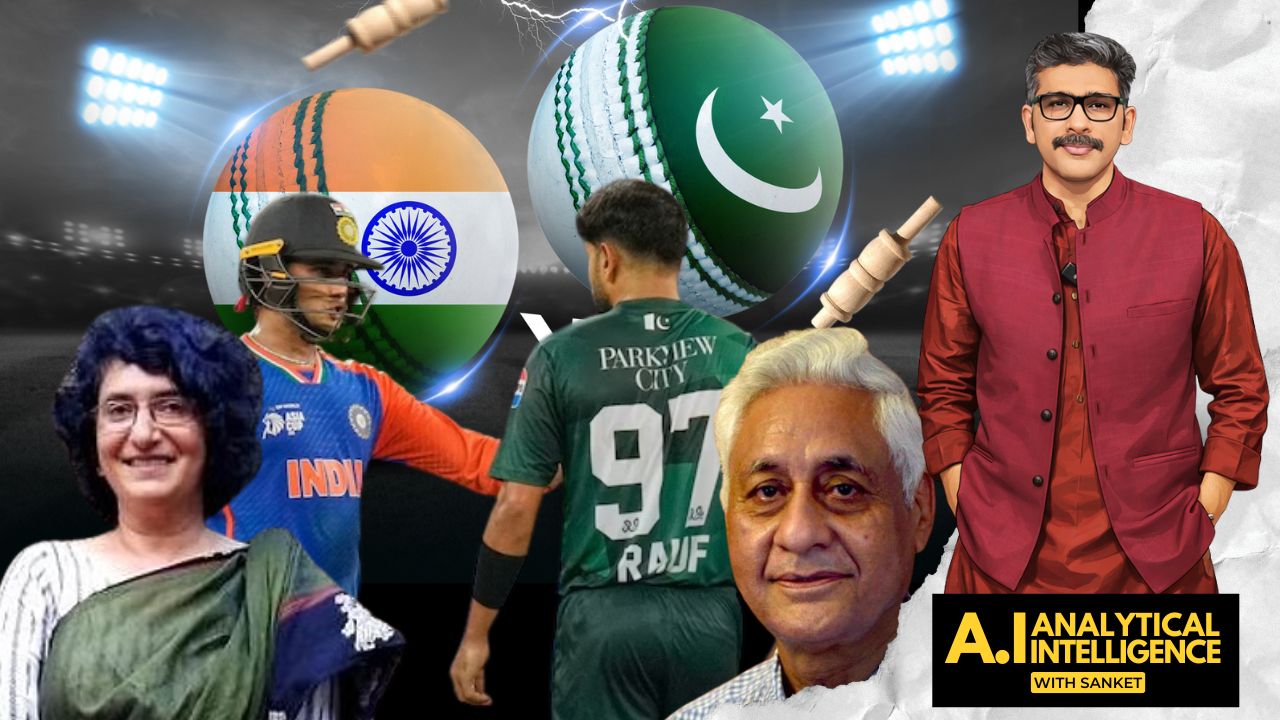

Pakistan’s decision to pull out of the India fixture in the ICC T20 World Cup 2026 and its abrupt U-turn have exposed how political symbolism and economic imperatives now outweigh sporting logic in South Asian cricket. On the latest episode of AI With Sanket, The Federal spoke to senior sports journalists Pradeep Magazine and Sharda Ugra on how the nine-day drama unfolded, why Pakistan eventually agreed to play, and what this reveals about the game’s governance, the influence of politics, and the commercial forces shaping modern cricket.
The controversy was sparked by Pakistan’s announcement that it would not play India — a move widely framed as solidarity with Bangladesh and a protest at perceived political interference. Behind the scenes, however, economic stakes and cricketing realities gradually forced a reversal that neither side is willing to frame in purely sporting terms.
Nine days of drama
For nine days, the cricketing world was gripped not by performances on the field but by negotiations and brinkmanship off it. Pakistan’s initial stance reverberated far beyond Lahore and Colombo because India-Pakistan fixtures generate unparalleled viewership and revenue in global cricket. The prospect of missing that clash sent ripples through broadcasters, sponsors, and cricket boards alike.
Also Read: India vs Pakistan T20 WC: Colombo flight fares touch Rs 74,000; no boycott saves ICC USD 174 million
Magazine called the episode “drama”, but stressed it had tangible outcomes. Pakistan succeeded in making itself indispensable.
“Without Pakistan, you can’t host the World Cup,” he said, pointing to the economic and tourism impact on host Sri Lanka when fixtures involving Pakistan were disrupted. Sri Lanka’s president reportedly appealed to Islamabad, urging it not to withdraw, stressing the significant financial loss that would result from cancellations in hotel bookings and match-day commerce.
For much of South Asia, the story was being framed in nationalistic terms — that India had “shown Pakistan its place” and forced a reversal. But both journalists emphasised that the narrative of victory masks deeper structural truths about the sport’s political economy.
Politics at the crease
Ugra said the controversy was political from the start.
“This started as a political event,” she said, citing the exclusion of a Bangladeshi player from the Indian Premier League (IPL) as an early flashpoint. That decision was widely interpreted as politically motivated, setting in motion a chain of events that culminated in Pakistan’s rebuff and eventual return.
Referencing commentary from analyst Sushant Singh, Ugra noted that Pakistan had effectively turned a single fixture into a veto point with leverage over the event’s overall staging. That leverage was not cricketing but political — involving governments, nationalist constituencies, and social media campaigns pushing emotive narratives.
Also Read: India-Pakistan T20WC match on after Pak govt withdraws boycott call
“Once you get political people involved in cricket decisions, cricket people seldom win,” she said, underscoring how national governments now shape what were once purely sporting considerations.
Magazine echoed this view, pointing out that the political context post-Pahalgam and in the Asia Cup had already embedded national sentiment into scheduling and fixtures. What might once have been a straightforward sporting dispute had become inseparable from questions of national honour and political signalling.
The economic imperative
Both panellists agreed that economics played a decisive role in Pakistan’s return to the field.
“Money dictated things,” Ugra said, pointing to the influence of broadcast revenue, viewership figures, and advertising interests. India’s huge cricket market — the largest in the world — creates commercial imperatives that no major cricket board can ignore.
This commercial calculus also applied to Sri Lanka and Bangladesh. Bangladeshi involvement in the World Cup schedule was significant because Bangladesh is among the top three cricket-viewing nations globally, alongside India and Pakistan. Ugra pointed out that cricket’s commercial geographies — audience size, advertising dollars, and broadcasting deals — often overshadow sentiments about political principle.
Magazine highlighted that the real test would be the reception of the match itself. With the fixture played in Colombo, the composition of the crowd — especially neutral Sri Lankan spectators — would indicate whether political narratives truly shape public sentiment or whether cricket’s allure prevails.
“India-Pakistan is never watched like a normal game,” he said of India-Pakistan clashes, noting that even in normal circumstances, these matches carry extraordinary interest. In the current context, that intensity has only been magnified by the political overtones of the lead-up.
Cricket’s governance crisis
A recurring theme in the discussion was the role of cricket’s governing bodies. Ugra called into question the International Cricket Council’s (ICC) ability to enforce the spirit of the game or provide coherent leadership. Decisions that once might have been left to sporting bodies are now caught up in geopolitics and commercial interests.
“In theory, the ICC is the governor of cricket,” she said, “but when politics enters, and the sport’s stewards don’t assert authority, the game loses coherence.”
Also Read: T20 World Cup row: BCB chief in Lahore as ICC, PCB hold talks over India game boycott
Decisions about fixtures, player participation, and match protocols get filtered through political lenses — undermining the autonomy of sporting institutions.
Magazine agreed that cricket’s leadership has struggled to manage the game’s expansion beyond the pitch. With national boards operating like corporate entities — prioritising revenue and influence — there is a growing disconnect between cricket’s governance and its traditions.
Importance of symbolism
One of the most symbolic questions surrounding the match was whether the Indian and Pakistani captains would shake hands at the toss. Ugra suggested that such gestures could help recalibrate the narrative toward cricketing solidarity rather than political contestation. She noted that even recent under-19 matches had seen such gestures normalised without spectators making a fuss.
Yet both journalists acknowledged that symbolism alone could not disentangle sport from politics. The broader narrative wars — on social media and in national discourse — would likely continue regardless of on-field gestures.
Legacy of the standoff
Pakistan’s return to play has not silenced debates over principle versus pragmatism. In India, questions linger about why the government chose participation over protest, especially given earlier rhetoric about apartheid-style sporting boycotts. Across the subcontinent, fans and commentators remain divided on whether cricket should be insulated from geopolitics or whether it inevitably reflects wider national tensions.
Also Read: Will Pakistan play India in T20 WC? There could be a U-turn
What is clear, according to both panellists, is that modern cricket can no longer be viewed purely as sport. It is a nexus of politics, economics, national identity, and global media — and episodes like the delayed India-Pakistan World Cup fixture illustrate this fusion vividly.
(The content above has been transcribed from video using a fine-tuned AI model. To ensure accuracy, quality, and editorial integrity, we employ a Human-In-The-Loop (HITL) process. While AI assists in creating the initial draft, our experienced editorial team carefully reviews, edits, and refines the content before publication. At The Federal, we combine the efficiency of AI with the expertise of human editors to deliver reliable and insightful journalism.)

Comments are closed.