
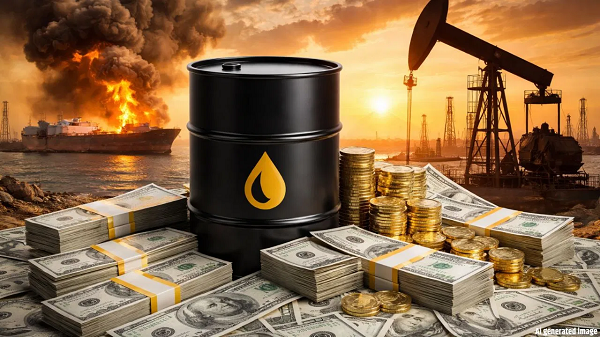
‘Crude oil’ changed the fortunes of Gulf countries, how did America capture the oil empire?

New Delhi: When crude oil reserves were first discovered in the desert regions of the Middle East, the lifestyle of the people living there underwent unprecedented changes. This oil became not only an economic asset but also the energy backbone of the entire world. The recent attacks on Iran by the US and Israel have created turmoil in the Middle East. Following the news of the death of Iran’s Supreme Leader Ali Khamenei in the attack on February 28, Iran launched a counter-attack against the US and Israel. The impact of this conflict is gradually being felt on global energy supplies and shipping routes.
When oil reserves were discovered, life in the Gulf countries was extremely difficult. However, the discovery of oil brought economic prosperity. The United States and other Western countries quickly eyed this wealth. During the 1973 October War, British government documents reveal that the United States planned to seize control of the Middle East’s oil reserves. Arab countries had imposed a moratorium on oil sales after the war against Israel. This prompted the United States to develop a strategy to gain control of oil resources in Saudi Arabia, Kuwait, and Abu Dhabi through air force support.
British intelligence agencies were aware of the US strategy. Then-US Defense Secretary James Schlesinger warned the British ambassador that the US would not hesitate to use force to seize the oil. The British Joint Investigation Committee estimated that the US operation would require two brigades—one for Saudi Arabia, one for Kuwait, and one for Abu Dhabi. The objective was to maintain control of the oil reserves for the next 10 years.
Although the US did not fully implement the option of force, and due to pressure and agreements from Western countries, the Gulf countries lifted the oil embargo. By then, the US had already set its sights on the Gulf countries’ oil reserves.
The importance of oil was first recognized in history during World War I (1914-1918). The war made the need for oil to power tanks, trucks, warships, and the navy clear. Countries that used oil wisely emerged victorious. This experience was incorporated into Western strategy, and the United States later began intervening in the Middle East to protect its strategic and economic interests.
Crude oil remains the Middle East’s greatest asset today, and US strategy has made clear that oil reserves are not only a source of economic power but also a center of global and strategic strength. This wealth has transformed the fortunes of Gulf states and made them key players in global energy politics.

Comments are closed.