

Virendra Pandit
New Delhi: With its reserve stock of 100 million barrels of crude, India can sustain normal economic activities for 40 to 45 days even if the supplies through the Strait of Hormuz get disrupted due to the ongoing multinational war in the Middle East, the media reported on Tuesday.
India imports about 88 percent of the crude oil it needs for refinement as petrol and diesel, of which more than 50 percent comes from the Middle Eastern countries through the narrow Strait of Hormuz that links the Persian Gulf with the Arabian Sea.
India’s crude reserves
As of now, India holds about 100 million barrels of commercial crude oil stocks in storage tanks, underground strategic reserves, and on ships voyaging towards the country, which could cover around 40 to 45 days of its requirement if flows through the 33-km-long Strait of Hormuz are disrupted, researchers said.
If Middle Eastern crude supply halts completely for a temporary period, the immediate impact would be logistical and price-driven, with supply risks intensifying if movement through the Strait of Hormuz is disrupted for longer, according to Sumit Ritolia, Lead Research Analyst, Refining & Modeling at Kpler.
Any potential closure of the Strait would at first impact prompt cargo liftings.
“However, refiners typically maintain commercial inventories, and cargoes already on water would continue to arrive, providing some short-term cushioning to the system,” he said. In the event of a prolonged disruption, medium-term pressures would build through higher import costs, freight exposure, and the need to reroute supplies over longer distances.
“India maintains strategic petroleum reserves alongside commercial inventories held by refiners and oil marketing companies. These buffers are intended to manage temporary supply shocks rather than sustained outages,” Ritolia said.
“Based on Kpler inventory data, commercial crude stocks are around 100 million barrels, including volumes in the strategic petroleum reserve (SPR) facilities at Mangalore, Padur and Visakhapatnam.”
With imports via the Strait of Hormuz averaging nearly 2.5 million barrels per day (bpd) — about half of India’s 5 million bpd total crude imports — these combined reserves could cover around 40-45 days of imports in a crude disruption scenario, he said.
Additional refined product inventories would extend effective coverage further.
However, the immediate impact will be on prices. Brent, the global benchmark, crossed USD 80 per barrel, some 10 percent more since the current Iran crisis surfaced four days ago. For India, higher prices mean higher import bill.
India spent USD 137 billion on crude oil imports in 2024-25. In the first ten months of this fiscal, April 2025 to January 2026, it spent USD 100.4 billion on importing 206.3 million tonnes of crude oil.
The Israel-US-Iran war
The United States and Israel launched fierce military strikes on select targets in Iran over the last weekend. Tehran retaliated with missiles and drones aimed at Israel and Mideast countries hosting US forces, including Saudi Arabia, the United Arab Emirates, Qatar, Kuwait, Bahrain, Iraq and Jordan, besides Cyprus in the Mediterranean Sea.
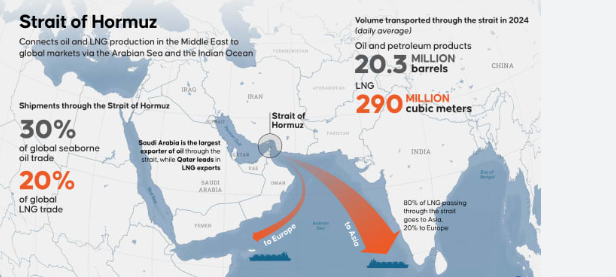
According to media reports, the ongoing conflict has effectively closed the Strait of Hormuz, a key conduit for the flow of nearly 25 percent of global energy, mainly to China and India. Nearly one-third of the world’s seaborne crude oil exports and about 20 percent of liquefied natural gas (LNG) shipments transit the narrow waterway.
India, the world’s third largest oil importer, imports nearly half of its crude needs through the Strait. Its mainstay LNG supplier in Qatar also uses this waterway to ship the fuel to India.
Russian oil
In case of the Strait’s closure, India can tap suppliers in West Africa, Latin America and the US to make up for the shortfall from the Middle East. India could also restart enough imports from Russia.
In recent months, New Delhi had agreed to wind down purchases of Russian oil as part of a potential trade deal with the US–which is now uncertain after the US Supreme Court struck down President Donald Trump’s country-based tariffs.
“Russian cargoes currently floating in the Arabian Sea and wider Asian region without firm buyers could also be absorbed relatively quickly if required,” Ritolia said.
If the Strait of Hormuz were disrupted or shipping were forced onto longer routes, India’s crude import bill would rise.
Even without a full blockade, higher freight, war-risk insurance, and geopolitical premiums would lift landed costs.
“In a more severe scenario, policy intervention would likely become a key stabilizing tool. The government could prioritize domestic energy security by asking refiners to moderate or temporarily curb refined product exports to ensure adequate domestic supply,” he said.
India is among the world’s largest exporters of refined products, particularly diesel and jet fuel. Redirecting export volumes to the domestic market would provide an additional buffer.
India exported 23.7 million tonnes (474,000 bpd) of petroleum products or 10 percent of the country’s fuel consumption, in 2024-25. During April-January, exports stood at 53.3 mts.
“If the Hormuz situation were to deteriorate further, safeguarding domestic fuel availability and price stability would likely take precedence over export optimization, reinforcing internal supply resilience even at the cost of lower export revenues,” he said.
The worst-case scenario would involve a prolonged and severe disruption to Hormuz flows combined with sustained geopolitical escalation. In that case, crude prices would spike sharply, freight markets would tighten, and refiners could eventually be forced to trim runs if replacement barrels are delayed.
“However, such a scenario would have major global economic consequences, making it a low-probability but high-impact risk, Ritolia said, adding, the near-term risk is primarily price volatility and higher import costs rather than immediate physical shortage, for now.
India has diversification options and inventory buffers, but sustained disruption would materially increase the import bill and create macroeconomic pressures.

Comments are closed.