


According to Yanolja Research, South Koreans spent an average of $971 per overseas trip in 2025. Within this budget, travel to higher-cost destinations like Singapore or Hawaii often requires careful planning, while long-haul trips to Europe are less accessible.
This has contributed to a shift in destination choices, with Vietnam emerging as a notable option. Of the nearly 29.6 million outbound South Korean travelers last year, more than 4.3 million visited Vietnam, making it the second most popular destination and the top choice in Southeast Asia, ahead of Thailand, the Philippines and Singapore. Within Vietnam, Da Nang and Phu Quoc have attracted growing interest.
South Korean travelers are generally considered quality-conscious and increasingly focused on cost efficiency. A report by Outbox found that 41% of Korean tourists rank value for money as the most important factor when selecting a destination.
At traditional tourism hubs, hotel rates during peak seasons can range from $250 to $700 per night, in addition to higher airfare costs. In comparison, destinations such as Da Nang and Phu Quoc are often perceived as offering a broader range of services within similar budgets.
Korean travelers pose for photos on Golden Bridge, Ba Na Hills, Da Nang. Photo courtesy of Sun Group |
In Da Nang, visitors can access a mix of beach resorts, entertainment complexes and dining options within a relatively compact area. Attractions such as My Khe Beach and Sun World Ba Na Hills are commonly included in travel itineraries, along with local seafood experiences and urban nightlife.
Further south, Phu Quoc offers a range of resort accommodations, including beachfront properties and private villas, contributing to its appeal among travelers seeking leisure-oriented stays such as JW Marriott Phu Quoc Emerald Bay Resort, Premier Village Phu Quoc Resort, La Festa Phu Quoc, Curio Collection by Hilton…
Beyond cost considerations, travel time has become an increasingly important factor. Short international trips are gaining popularity, particularly among younger travelers who prefer trips lasting three to five days over longer vacations.
Vietnam’s proximity supports this trend. Direct flights from Seoul or Busan to Da Nang or Phu Quoc take approximately five hours, allowing travelers to reach their destination and begin activities on the same day.
 |
Korean runners stop for photos along a running route at Kiss Bridge in Phu Quoc. Photo courtesy of Sun Group |
Connectivity between South Korea and Vietnam has also expanded.
South Korea is currently the largest source market for Da Nang, accounting for more than 35% of international flights. Currently, there are around 11 airlines operating routes and is going to increase more routes by Sun PhuQuoc Airways.
In Phu Quoc, data from Booking.com shows that searches from South Korea increased by 71% between October 2025 and mid-January 2026, placing the island among the top five most searched destinations for the Lunar New Year holiday.
Air connectivity is expected to improve further, with additional direct routes planned between Phu Quoc and major regional cities, including Seoul and Busan.
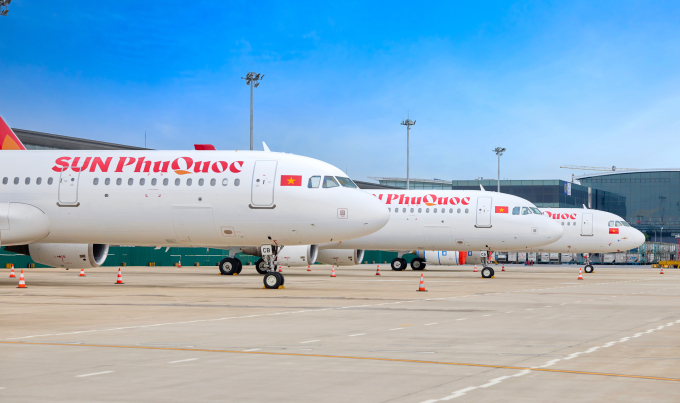 |
Sun PhuQuoc Airways aircraft at Phu Quoc Airport. Photo courtesy of Sun Group |
Visa policies also support travel demand. Phu Quoc offers visa exemptions of up to 30 days for international visitors, reducing administrative requirements and enabling more flexible travel planning.
However, beyond cost and convenience, destination appeal is increasingly linked to experience and visual engagement. For many younger travelers, trips are associated with personal experiences and social media sharing.
In Da Nang, a combination of natural landscapes and landmarks/tourist attractions provides a range of settings within a short travel distance. Locations such as the Golden Bridge at Sun World Ba Na Hills, mountain gardens and pagodas are frequently featured in travel content.
In Phu Quoc, tourism development has incorporated diverse architectural and entertainment elements. Travelers can encounter Santorini-inspired white at Santo Port, Mediterranean-style buildings in Sunset Town, the image of a Roman amphitheater at the Hon Thom cable car departure station, or the iconic Kiss Bridge.
 |
Nightly fireworks light up the skies at Sunset Town, Phu Quoc. Photo courtesy of Sun Group |
Entertainment offerings also contribute to the visitor experience. Phu Quoc hosts regular performances and events, including multimedia shows such as Kiss of the Sea and Symphony of the Sea and nightly fireworks displays. This is also one of the few islands that has two fireworks performances each night for 365 days.
The destination’s service ecosystem has also evolved to cater to international visitors, including Korean travelers, with the availability of language support and cuisine options.
Overall, Da Nang and Phu Quoc are positioning themselves as accessible regional destinations that combine relatively short travel times, a range of accommodation options and diversified tourism experiences.

Comments are closed.