
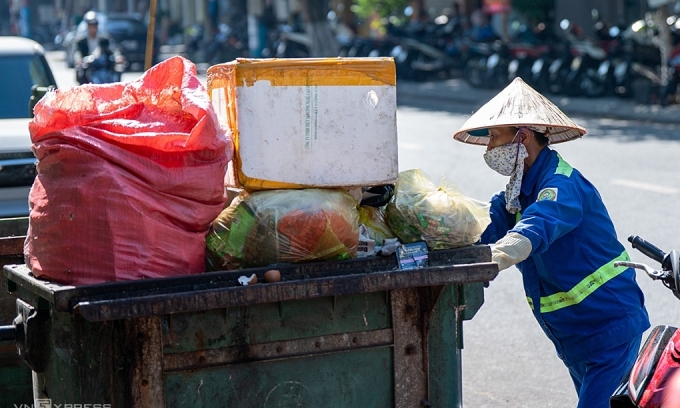
Da Nang sanitation workers burdened with 1,700 tons of garbage daily amid staffing shortage

Slowly pushing a garbage cart stacked higher than her head along Hai Phong Street one day in May, Ong Thi My Linh, 48, a worker with the Thanh Khe Environmental Team, says her daily shift begins at 5 a.m. and lasts until late afternoon, yet “the garbage never seems to end.”
At many places, people dispose of trash indiscriminately, taking her more time to collect, but then any delay in collection triggers complaints on social media and the city’s public feedback channels, she laments.
Sanitation worker Ong Thi My Linh during her shift in Da Nang City, May 2026. Photo by Read/Nguyen Dong. |
The 20-year veteran at the job says she handles around 11 large 660-kg garbage bins a day, with the number sometimes rising to 15.
Lately, the volume she collects has reached eight tons a day, including domestic waste, construction debris, and abandoned furniture such as old mattresses and beds.
During holidays, the volumes increase even further, placing additional pressure on sanitation workers.
But her monthly income remains just above VND6 million (US$230) comprising of a daily wage of VND225,000 and a meal allowance of VND25,000.
Workers of her age group account for a majority of the workforce at the company, and receive the same salary.
Pham Thanh Phuc, chairman of Da Nang Urban Environment JSC, which employs them, says with workers aged over 45 accounting for more than half of all its employees, the company is facing an aging labor crisis.
The hazardous nature of the work combined with low pay has made recruitment increasingly difficult, leaving the company unable to replace departing workers, he says.
Sanitation workers are supposed to work 26 days a month, but due to a severe staff shortage, many work 28-29 days.
“The root problem behind the inability to ensure workers’ benefits lies in outdated procurement mechanisms and insufficient funding norms,” Phuc admits.
He explains that many wards still apply old price frameworks for garbage collection, causing losses to sanitation companies.
The household waste collection fees in Da Nang remain unchanged since 2017, ranging from VND15,000 for apartments and boarding houses, VND25,000 for homes located in alleys, and VND30,000 for houses facing main roads.
Ngo Le Quang, director of the central region’s branch of Hanoi Urban Environment One Member Co Ltd’s Central Region branch, says Da Nang’s garbage collection fees are “far too low.”
 |
Waste is illegally dumped in Alley 149 Le Dinh Ly Street, Hoa Cuong Ward, Da Nang, at 8:30 p.m. on May 25, 2026. Photo by Read/Nguyen Dong |
“With service prices this low, it is impossible to expect better sanitation quality.”
Quang urged Da Nang authorities to quickly amend fees to improve worker incomes, and called for a crackdown on illegal dumping of construction debris and bulky waste at night by deploying street surveillance cameras.
At a meeting held last week to discuss improving waste collection and treatment in Da Nang, city vice chairman Tran Nam Hung said public bidding would be the long-term solution to standardize urban sanitation quality.
He said wards and communes have been given two months to complete bidding procedures, and need to finalize contracts by early August.
To retain sanitation workers during the transition period, the city has decided to immediately raise sanitation workers’ incomes.
Hung instructed the city Department of Agriculture and Environment to immediately end the practice of local authorities arbitrarily reducing street-cleaning standards because of financial shortages.
“The city must adopt a unified pricing framework. Any funding gaps must be covered by relevant agencies to avoid inconsistent … sanitation quality.”
Workers like Linh hope not just for higher wages but also for the public to help keep the city clean by disposing of garbage properly so that they no longer have to clean streets repeatedly.
Comments are closed.