
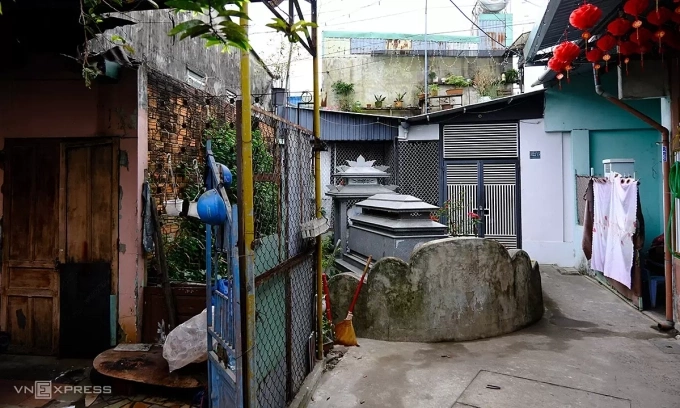

A grave in a residential area in Da Nang in central Vietnam. Photo by Read/Nguyen Dong
Da Nang wants to relocate nearly 400,000 graves scattered among homes and businesses in one of Vietnam’s most ambitious urban clearance campaigns, as the coastal city races to free land for a high-speed railway and a chain of modern seaside zones.
The Da Nang Department of Construction submitted the proposal to the city People’s Committee after a survey found 394,470 graves requiring relocation as of late February.
More than 67,000 were already part of a relocation plan launched in August 2025, while the remaining 327,000-plus were identified in a new survey covering the strip between National Highway 1 and the coastline.
The problem extends far beyond the graves earmarked for relocation. The survey found that Da Nang’s eastern corridor, from the expressway to the sea, contains around 256 cemeteries holding more than 1.4 million graves across roughly 1,420 hectares. Most are scattered through residential neighborhoods and zones designated for industrial and commercial development, a legacy of decades of rapid urbanization that built homes around old burial grounds rather than relocating them.
The department said the concentration of graves among houses violates environmental buffer standards, posing risks of groundwater contamination and public health hazards while hampering urban planning and deterring investment.
Clearing the graves is considered urgent partly because of the North-South high-speed railway, Vietnam’s largest-ever infrastructure project. The 350-kph line will run more than 116 km through Da Nang’s territory, requiring the city to acquire over 866 hectares of land.
The government aims to break ground on the railway by December 2026.
Beyond the railway, Da Nang envisions the freed land enabling a chain of green, smart coastal urban zones along its eastern seaboard.
To accommodate the reinterred remains, authorities have proposed five new centralized cemeteries totaling 437 hectares in the city’s western interior.
Under the proposed timeline, localities will progressively shut down small scattered cemeteries and relocate graves from east to west, completing planning by the second quarter of 2026 and substantially finishing the relocation by 2030.
Authorities have also ordered stricter enforcement to prevent new unauthorized burials outside designated areas.
Comments are closed.