
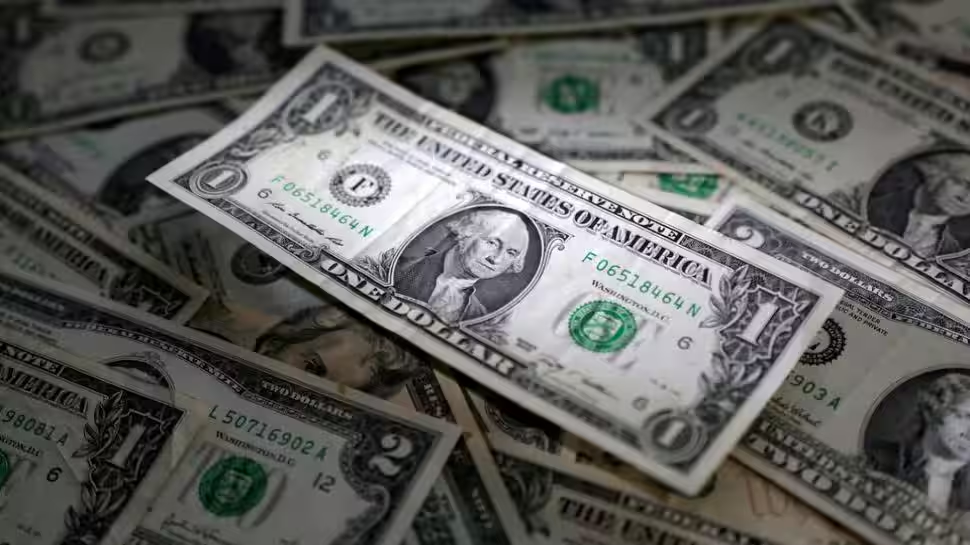
De-Dollarisation Campaign: India, Russia, China Tighten Grip Against USD – Will The Currency Survive? , world news

De-Dollarisation: Russian President Vladimir Putin arrived in the city on December 4 for a two-day visit to India, his first since the Ukraine war began. The trip highlights Moscow’s efforts to strengthen ties beyond China and explore strategic economic and financial cooperation with India, particularly in promoting trade in local currencies and reducing reliance on the US dollar.
All three countries, India, Russia and China, are key BRICS members, and each has long promoted trade in local currencies rather than the US dollar.
Analysts suggest that during Putin’s visit, discussions could deepen cooperation in using local currencies for bilateral trade, and even explore the potential of a common BRICS currency, a plan that has already garnered support from China.
Add Zee News as a Preferred Source
The push for a common alternative became evident during the November 2024 BRICS Summit in Kazan, Russia. On stage, Putin showcased a prototype of a potential shared currency and emphasized that the goal is not to abandon the US dollar entirely, but to create alternative financial systems for transactions among member nations and their global partners.
“We are not denying the dollar, nor fighting it. But if it does not allow us to operate freely, we must explore other options,” he had said.
The proposed BRICS currency aims to enhance economic independence while competing with the existing global financial system, which is overwhelmingly dominated by the US dollar.
At present, nearly 89% of international currency trades involve the dollar, and historically, almost all oil transactions were conducted in USD. In 2023, however, roughly one-fifth of oil trade occurred in non-dollar currencies.
Understanding De-Dollarisation
De-dollarisation involves reducing dependence on the US dollar by conducting international trade in local currencies, lowering demand for dollars globally, strengthening financial autonomy among BRICS countries and mitigating the impact of US policies and global market volatility.
Next year, India will host the BRICS summit. Financial experts predict that the event could solidify India, Russia and China’s alliance against the dollar.
Prime Minister Narendra Modi, President Putin and Premier Xi Jinping recently shared a platform at the SCO Summit in Tianjin, a gathering that reportedly unsettled former US President Donald Trump.
India-Russia Trade Already Leading The Way
Russian Deputy Prime Minister Denis Manturov had said in November 2024 that approximately 90% of India-Russia trade now occurs in local or alternative currencies. Addressing the 25th session of the India-Russia Intergovernmental Commission on trade, economic, scientific, technology and cultural cooperation, he had said, “The share of local and alternative currencies in bilateral trade is increasing, now approaching 90%. Expanding correspondent banking relations between Russian and Indian banks remains a priority.”
India had taken its first concrete step in July 2022, when the Reserve Bank of India permitted international trade invoicing and settlements in rupees. Around 20 authorized dealer banks in India were allowed to open 92 special rupee vostro accounts with partner banks in over 22 countries to facilitate these transactions.
Countries that have opened rupee accounts in India include Bangladesh, Belarus, Botswana, Fiji, Guyana, Israel, Kazakhstan, Kenya, Malaysia, Maldives, Mauritius, Myanmar, New Zealand, Oman, Seychelles, Sri Lanka, Tanzania and Uganda.
Why BRICS Wants A Common Currency
BRICS countries face growing financial challenges and aggressive US foreign policies; and therefore, they want to safeguard their economic interests.
A new BRICS currency could reduce reliance on the US dollar and euro, minimize the impact of unilateral sanctions, facilitate smoother cross-border transactions, encourage regional currency alliances and strengthen economic integration among member nations.
Dr. Brahmchelani, a well-known geopolitical expert, said in a social media post, “Putin’s India visit from December 4-5 is more than a diplomatic stopover. It sends a powerful geopolitical signal. We could see agreements on bypassing the SWIFT system and establishing alternative payment channels designed to challenge the US dollar’s dominance.”
Global Context And US Response
While the US dollar remains the dominant reserve currency, its share has gradually decreased with the rise of the euro, yen, pound and yuan. President Donald Trump’s tariff policies, initially aimed at China and later impacting India, highlight Washington’s protectionist approach.
And therefore, BRICS nations are increasingly exploring currency alternatives to reduce dependence on the dollar.
India-Russia Trade Prospects
External Affairs Minister Dr. S. Jaishankar estimated that bilateral trade between India and Russia could surpass $100 billion by 2030. Addressing the India-Russia Business Forum in Mumbai recently, he said, “Our current bilateral trade stands at $66 billion, making the $100 billion target by 2030 both realistic and achievable.”
As Putin lands in New Delhi, the world watches closely. The discussions on local currency trade, BRICS integration and alternatives to the dollar could influence global financial dynamics in the years ahead.

Comments are closed.