
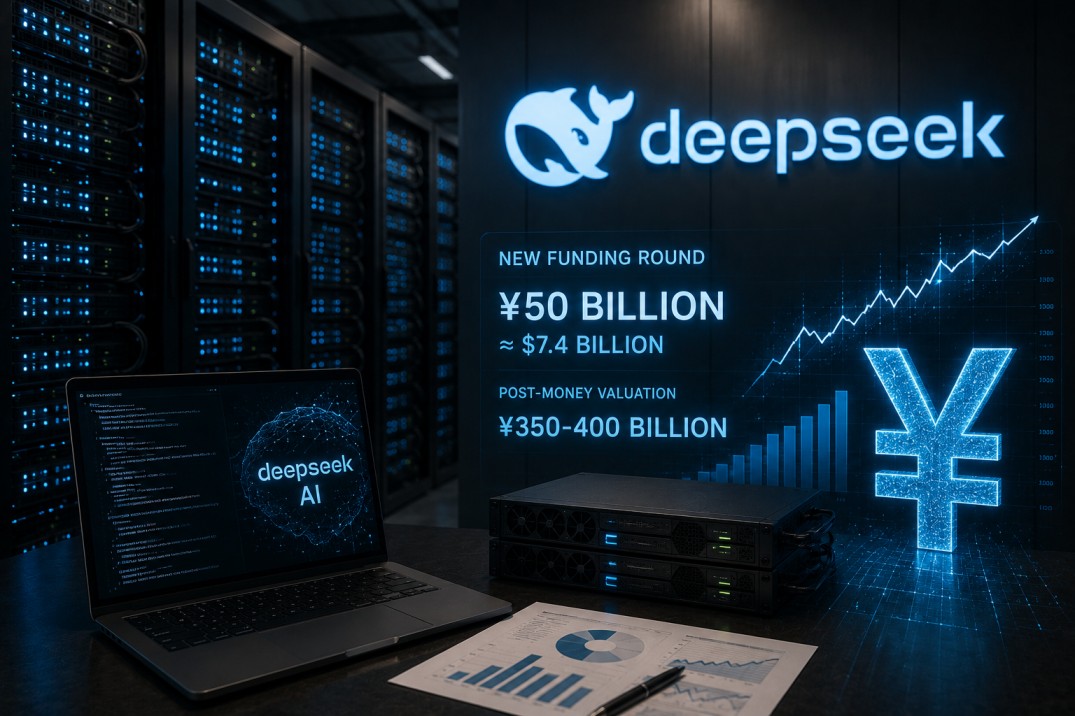

DeepSeek, the Chinese artificial intelligence company that surprised much of the technology world with the rapid rise of its open-source models, is now on the verge of securing one of the largest private funding rounds ever seen in China’s technology industry. According to people familiar with the discussions, the company is close to raising about 50 billion yuan, or roughly $7.4 billion, in a deal that could place its valuation between 350 billion yuan and 400 billion yuan after the investment.
The proposed fundraising marks a turning point for a company that until now has largely avoided outside capital. For years, DeepSeek’s development was financed by its founder Liang Wenfeng through profits generated by his quantitative hedge fund, High-Flyer. That approach allowed the company to pursue research with little outside pressure and helped it build a reputation for focusing on technical capability rather than commercial expansion.
The latest financing effort suggests the economics of artificial intelligence are changing rapidly. Building advanced AI systems now demands increasing amounts of computing power, specialist chips, data processing capacity and energy supply. Those requirements have raised costs across the industry and prompted even well-funded firms to seek larger pools of capital.
The investor list being discussed also offers a glimpse into how China is organising resources around AI at a time when competition with the United States remains intense and access to advanced semiconductor technology continues to be restricted by export controls.
Tencent and CATL back DeepSeek as AI spending rises
People familiar with the matter say founder Liang Wenfeng plans to contribute about 20 billion yuan of his own money to the funding round. If completed on those terms, it would represent one of the largest founder commitments seen in a Chinese technology company.
Among outside investors, Tencent Holdings is expected to emerge as the largest participant, with discussions centred on an investment of around 10 billion yuan. Battery manufacturer Contemporary Amperex Technology Co. Ltd., better known as CATL, is considering a commitment of approximately 5 billion yuan. Both companies have declined to comment publicly on the reported discussions.
The presence of Tencent carries particular interest because China’s largest internet groups are increasingly competing to secure positions in artificial intelligence. Tencent has invested heavily in its own Hunyuan model but faces competition from a crowded field of domestic rivals. DeepSeek’s rise has altered that competitive balance, with many analysts viewing the company as one of the strongest challengers in China’s AI race.
For Tencent, a stake in DeepSeek would provide access to a company whose models have attracted attention from researchers and developers inside and outside China. The relationship could also create opportunities for cooperation across cloud services, software products and consumer applications, although neither side has outlined any plans.
CATL’s involvement highlights another reality of the AI industry. Computing power requires vast amounts of electricity, and energy supply has become an increasingly important part of discussions surrounding artificial intelligence. CATL has expanded its interest in data centre power systems and energy storage in recent years, seeking opportunities tied to rising demand from AI computing facilities.
The participation of China’s National Artificial Intelligence Industry Investment Fund is equally noteworthy. The state-backed fund was created to support AI development and its inclusion in the fundraising would represent a strong signal of official support. Beijing has repeatedly identified artificial intelligence as an area of national importance, particularly as competition with American firms intensifies.
Sources familiar with the negotiations say fewer than ten investors are likely to participate in the round. Among those reported to be in discussions are gaming company NetEase, e-commerce giant JD.com, Hong Kong-based investment firm IDG Capital and Monolith Capital. Final agreements have not yet been completed and details could still change before the fundraising closes.
A changing AI race reshapes DeepSeek’s strategy
The funding discussions come after a period of rapid growth for DeepSeek’s profile. The company attracted international attention when its V3 and R1 models earned praise from technology researchers and developers who viewed them as proof that Chinese firms could produce advanced AI systems despite restrictions on access to some of the most powerful American chips.
Those releases challenged assumptions held by many investors and analysts about the pace of Chinese AI development. DeepSeek’s approach, which focused heavily on efficiency and open-source distribution, won support among developers looking for alternatives to proprietary systems.
Yet the market has moved quickly. While chatbot technology remains important, attention has increasingly turned towards AI agents capable of handling more complicated tasks with reduced human input. Such systems often require larger computing resources, more advanced hardware and greater spending on training and deployment.
DeepSeek said earlier this year that its next-generation V4 model represented a major step forward for open-source AI. Independent evaluations, however, have produced mixed conclusions. Some tests placed the model among the strongest open-source systems available, while others suggested it still trails the most advanced offerings from leading Chinese and American competitors.
That changing environment helps explain why DeepSeek is now seeking outside funding despite years of self-financing. The cost of remaining competitive has risen sharply across the industry. OpenAI, Anthropic and other firms have secured enormous financial commitments as investors race to back companies viewed as leaders in artificial intelligence.
Even if DeepSeek completes its planned $7.4 billion round, the amount remains smaller than the sums raised recently by several American rivals. OpenAI and Anthropic have attracted funding commitments measured in tens of billions of dollars, supported by deeper capital markets and wider access to international investors.
DeepSeek also operates under conditions different from those faced by many US companies. Export restrictions limit access to some of the most advanced American semiconductors, influencing how Chinese AI companies plan their computing requirements and research priorities. Analysts say those limits have encouraged Chinese firms to place greater focus on efficiency and alternative technical approaches.

Comments are closed.