

Virendra Pandit
New Delhi: Ahead of German Chancellor Friedrich Merz’s visit to India next week with a business delegation, the two countries are negotiating a crucial USD 8 billion defense deal for submarine manufacturing in the country, the media reported on Thursday.
The two countries are working on the details of a submarine manufacturing deal worth at least USD 8 billion — the largest-ever defense agreement for New Delhi.
The agreement would, for the first time, include technology transfer for submarine production.
The Indian Navy operates about a dozen aging Russian submarines and six new French-made models. If the deal under discussion goes ahead, India would likely scrap plans to buy three more French submarines.
Germany’s Thyssenkrupp Marine Systems GmbH and Indian state-owned Mazagon Dock Shipbuilders Ltd. may work together to manufacture submarines.
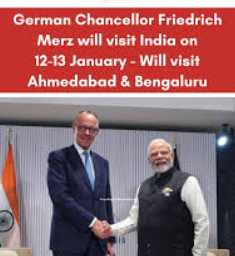
Chancellor Merz, on his maiden visit to India (January 12-13) with a delegation, will meet with Prime Minister Narendra Modi for talks in Gujarat on Monday before flying to India’s Information Technology hub of Bengaluru to see German companies there, a German government spokesperson was quoted as saying.
Besides defence, the two countries are also likely to increase cooperation in the pharmaceuticals sector. and discuss how to speed up broader negotiations between the European Union and India on a free-trade agreement (FTA).
European Commission President Ursula von der Leyen and European Council President Antonio Costa will attend India’s Republic Day on January 26 as chief guests, the media reported.
The new submarines will be equipped with air-independent propulsion systems, which increase the boats’ endurance and allows them to remain submerged longer than with diesel-electric propulsion. The vessels will add to India’s ability to police the vast waters of the Indian Ocean region as China asserts its presence there.
New Delhi has long been encouraging global defense manufacturers to partner and share technology with Indian entities to ramp up weapons manufacturing there. The Modi government blocked the import of most defense platforms, including fighter jets, helicopters, artillery and warships, to encourage foreign weapons makers to shift production lines to India in 2020.
Even so, India is the second-largest importer of military hardware globally, sourcing most of its equipment from Russia, according to the Stockholm International Peace Research Institute (SIPRI), an international think tank that tracks weapons purchases.
Germany’s defense industry kicked into high gear after the Russian invasion of Ukraine in February 2022. Berlin’s decision to share technology to make one of the most complex military platforms is also aimed at reducing India’s dependence on Russia for weapons.

Comments are closed.