
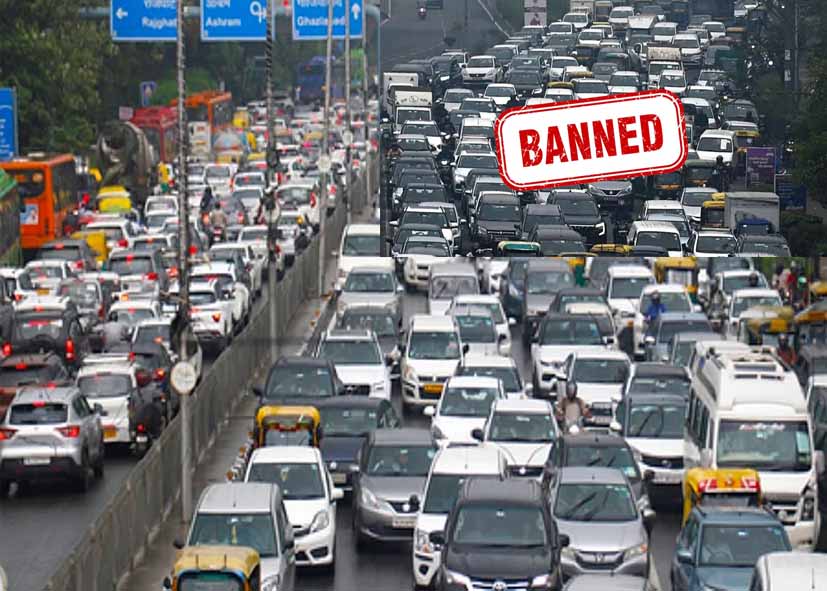
To control the serious level of pollution in Delhi, order to ban old vehicles, strict action including fine if rules are broken

Rekha Gupta government has started taking major steps to control the serious level of pollution in Delhi. From December 18, the entry of vehicles of less than BS-VI standard has been completely banned in the borders of the capital. This will have a direct impact on those BS-III and BS-IV vehicles that enter Delhi daily from Noida, Gurugram, Ghaziabad and other NCR cities. It is estimated that there are about 12 lakh private vehicles in NCR which come under this category. The Environment Minister has given a clear warning that the vehicles of those violating the rules will be seized on the spot.
The new order of Delhi government has affected lakhs of vehicles in NCR. After the ban, around 2 lakh vehicles from Gurugram, 4 lakh from Noida and 5.5 lakh from Ghaziabad have been stopped from entering Delhi. According to official data, around 2 lakh vehicles in Gurugram fall below the BS-VI standard, including 1.5 lakh BS-III petrol cars and over 36 thousand BS-IV diesel cars. Apart from this, about 47 thousand BS-IV diesel commercial vehicles and more than 2 thousand BS-III petrol vehicles are registered. More than 2,000 BS-III and BS-IV category buses are also running in the city. More than 90 thousand vehicles in Millennium City have crossed the age limit of 10 years, which come under the ambit of ban.
Around 4 lakh vehicles in Noida will be affected by the Delhi government’s BS-VI order. There are around 1.4 lakh BS-III vehicles registered in the city, which includes 96,210 petrol and more than 41 thousand diesel vehicles. Apart from this, about 2.8 lakh vehicles are of BS-IV category. At present only 4.2 lakh BS-VI standard vehicles will be able to enter Delhi. On the other hand, in Ghaziabad, the second biggest city of UP adjacent to Delhi, more than 5.5 lakh vehicles of less than BS-VI category have been banned. According to the data, 1.7 lakh private vehicles here are of BS-III standard, while 3.7 lakh vehicles are of BS-IV category.
Why did NCR’s old plan fail?
The National Capital Region Planning Board (NCRPB) was formed in 1985. Its main objective was to reduce the population pressure of Delhi and develop the surrounding cities in partnership. But even after four decades, most of these plans remained limited to files only. According to a TOI report, Omesh Saigal, former member secretary of the board, termed the concept of NCR as a failure and said that in the current situation this idea has completely derailed. He says that the new order of the Center is contrary to the basic spirit of NCR and this will affect the daily movement of people, be it office, school or home. Saigal also reminded that former Prime Minister Indira Gandhi had once given instructions to ban the construction of new central offices in Delhi. Despite this, today almost all the major government headquarters are located in Delhi.
Small steps in the name of pollution?
Another former Chief Secretary, on condition of anonymity, said that Delhi has been carrying the burden beyond its capacity for a long time. According to him, such immediate decisions are being taken in the name of pollution because it is much more difficult to find comprehensive and permanent solutions. He said that Delhi needs a model like the one adopted for Delhi Metro where political interference does not stop the work. NCR’s Draft Regional Plan 2041 clearly states that 40 to 50 percent of pollution in the region is caused by vehicles. The plan advocates seamless movement across state borders and suggests that nine major entry gates of Delhi be kept jam-free throughout the year.
Is it the right way to stop old vehicles?
Noor Mohammad, former member secretary of NCRPB, calls this decision a very crude way to control pollution. He says that the result of less attention being paid to public transport is that the number of private vehicles has increased rapidly. He raised the question, how many government vehicles in Delhi are still of BS-III or BS-IV standard? They argue that it may not be appropriate to ban private vehicles from neighboring areas but allow their own old government vehicles to ply on the road. They remind that Delhi’s expansion had become limited, hence NCR was formed. In such a situation, ignoring the concept of NCR and making a policy contrary to it cannot be a solution.
Follow the LALLURAM.COM MP channel on WhatsApp
Click to read big news of India and abroad
Click here to read Read.com news in English
Click here to read sports news
Click to read big entertainment news

Comments are closed.