
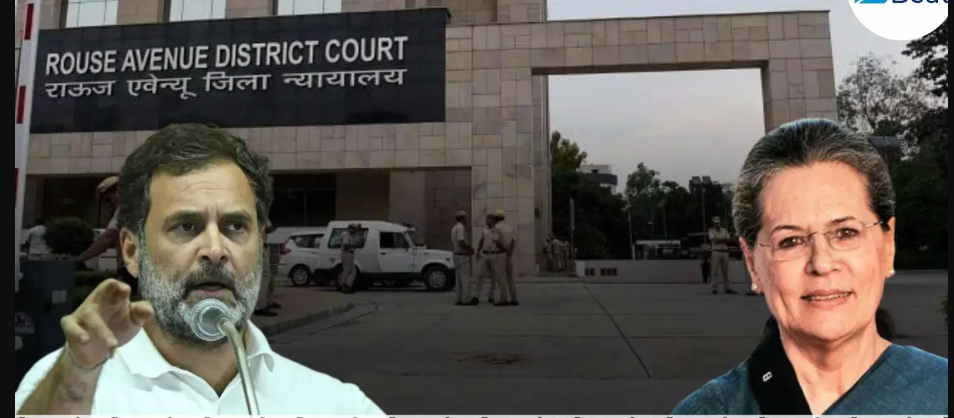
Delhi Court Rejects ED’s Money Laundering Complaints against Gandhis in National Herald Case

Rohit Kumar
NEW DELHI, Dec 17: A Delhi has refused to take cognizance of the Enforcement Directorate’s money laundering complaint against Congress leaders Sonia Gandhi and Rahul Gandhi, in connection with the National Herald newspaper case.
Special judge Vishal Gogne of the Rouse Avenue Court noted that the complaint filed by the Central agency, under the Prevention of Money Laundering Act (PMLA), was not maintainable because the case was based on a special complaint filed by BJP leader Subramanian Swamy before a magistrate under Section 200 of the Code of Criminal Procedure, not on a first information report (FIR) as usual in such cases.
“An investigation and the consequent prosecution complaint pertaining to the offense of money laundering, defined under Section 3 and punishable under Section 4 of the PMLA is not maintainable in the absence of an FIR for the offense mentioned in the Schedule to the Act,” the court said.
The National Herald case stems from a ₹90 crore loan advanced by the Congress party to Associated Journals Limited (AJL), the publisher of the National Herald, which was then assigned to Young Indian for a consideration of ₹50 lakh. Young Indian is a not-for-profit company in which the Gandhis hold a majority stake. It has been alleged that there was misappropriation of assets worth over ₹2,000 crore in an equity transaction.
The complaint in the case was filed by senior BJP leader Subramanian Swamy, who highlighted an alleged criminal conspiracy by several prominent political figures, including the late Motilal Vohra, the late Oscar Fernandes, Suman Dubey, and Sam Pitroda, apart from the Gandhis and Young Indian.
While dismissing the agency’s complaint against the Congress leaders, the court pointed out that the Delhi police’s economic wing has already lodged an FIR in the matter. Hence, it would be premature to decide the submissions made by the ED in relation to the merits of the allegations against the accused, the court said.
In a 117-page detailed order, the court said it was a challenge to recognize the complaint, given that the investigation itself commenced without jurisdiction, the consequent prosecution complaint was also without jurisdiction, and the court was equally deprived of the jurisdiction to take cognizance due to these lapses in law.
On Monday the court had ruled that the accused in the present case were not entitled to be given a copy of the FIR registered against them by the Delhi police in connection with the case, though the judge said the accused may be informed that the FIR has been registered.
On October 3 this year, the Delhi police’s Economic Offenses Wing had filed an FIR naming Ms and Mr Gandhi, Mr Pitroda, and other accused, on charges of cheating, dishonest misappropriation of property, and criminal breach of trust, along with criminal conspiracy.
The ED charge-sheet against Sonia and Rahul Gandhi was filed 8 months ago alleging that they had fraudulently taken over The Associated Journals Limited, publisher of the National Herald newspaper, which was dismissed by the Rouse Avenue court on Tuesday, shedding light on one of India’s premier investigative agencies as well as the political weaponisation of the Prevention of Money Laundering Act.
The Congress party’s legal advisors have long complained that the ED’s National Herald probe was one of a kind pointing out that the ED can only step in after another investigating agency has initiated a case against an accused, and that too in one of the offenses listed in the Prevention of Money Laundering Act, 2002. National Herald case, not only did the Enforcement Directorate initiate a money-laundering investigation without a pre-existing FIR, but it also took sweeping action. In April, the agency had sought possession of the newspaper’s assets in Delhi, Mumbai and Lucknow that were valued at Rs 661 crores. Back then, the Congress party had organized nationwide protests against what it saw as the wrongful targeting of the Gandhis.
After the Rouse Abenue court order, the Congress claimed victory. “Truth has prevailed, and truth will always prevail,” it said in a press release. “The BJP government has relentlessly targeted the Gandhi family… but the Gandhi family will never bow down, because they stand firmly with the truth.”
At a news conference in Delhi, Pawan Khera, chairman of media and publicity for the party, also chided the Enforcement Directorate and other government agencies for functioning as the “private army” of the BJP. The Enforcement Directorate has yet to release an official statement about the court ruling. Congress President Mallikarjun Kharge welcomed the court order.
The National Heraldsaga is traced back to a February 2013 complaint that the BJP leader Subramanian Swamy made before a Delhi court. Swamy alleged that the Gandhis had wrongly acquired control of National Herald’s assets, which he claimed were worth thousands of crores. In doing so, he contended, the Gandhis had cheated shareholders of The Associated Journals Limited, the company that owns National Herald., as well as the Congress party.
The Associated Journals Limited was incorporated in Lucknow in 1937 to help Jawaharlal Nehru and other Congress leaders publish newspapers that could carry their point of view to readers. It began by publishing the National Herald in English and eventually started publishing “Qaumi Awaaz” in Urdu and “Navjivan” in Hindi as well.
In the years after Independence, various governments across the country leased land to the company to facilitate its operations. But by the turn of the century, The Associated Journals Limited was struggling to stay afloat and pay its staff. That is when the Congress party came to its aid, extending loans of bout Rs 90 crores to keep it going.
Even so, the company had to stop publishing the National Herald in 2008 as its managing director Motilal Vora, a former treasurer of the Congress party, took up the task of restructuring it. A nonprofit company called Young Indian was floated in 2010 and the Gandhis became its directors.
This company bought out the Congress party’s loans worth Rs 90 crore for the measly sum of Rs 50 lakhs and converted the debt into shares with approval from The Associated Journals Limited in 2011. That is how Young Indian became the holding company with effective control over the properties of National Heraldand its sister publications.
In his complaint, Swamy alleged that Young Indian had defrauded both the publisher as well as the party by acquiring the debt and converting it into shares. While the complaint, like much of what Swamy used to say then, elicited media attention, it did not lead to any serious investigation against the Gandhis till 2021, when the Enforcement Directorate entered the picture.
In 2022, soon after it began its money-laundering probe, the Enforcement Directorate questioned Sonia Gandhi and Rahul Gandhi for days on end. A year later, it attached the National Herald’s assets worth Rs 751 crores, and finally in April, this year it filed a chargesheet in the case.
The Congress leaders have consistently argued that there was nothing out of the ordinary about how Young Indian acquired control of The Associated Journals Limited. The arrangement was necessitated, they explain, because of the publishing company’s inability to repay its debts. Furthermore, they point to how Motilal Vora’s efforts led to the revival of the National Herald and the other publications that had become defunct.
Crucially, nothing in the case seems to suggest that any money or properties changed hands. The Associated Journals Limited continues to use the money it generates from its assets to publish papers and pay its staff. Its assets remain its own and have not been transferred to Young Indians, let alone to the Gandhis. This, according to Congress leaders, shows that nothing was done with the intent of drawing any undue commercial benefit. The sole purpose of the restructuring, they say, was to revive a legacy institution of the party.

Comments are closed.