


Delhi’s newly notified Electric Vehicle Policy 2026 has lately been creating a lot of headlines. It has triggered mixed reactions from within the industry. The policy will boost EV adoption in Delhi. However, it can also be risky for automakers if other states also adopt similar policies, says a report by Morgan Stanley. In that case, the traditional internal combustion engine (ICE) vehicle market could get adversely affected.
Morgan Stanley is an investment bank and financial services company. It has its headquarters in Midtown Manhattan, New York City. It is a multinational company operating globally. According to the report, the impact of Delhi’s EV policy may be limited in the short term. This is because Delhi accounts for just a small portion of the total vehicle sales here. Automakers may not face immediate financial stress.
The report also suggests a practical workaround- owners could get their vehicles registered in neighbouring states. The restrictions put forward by the EV policy do not apply there.
“Delhi as a percentage of sales is small, and consumers can go to neighbouring states to buy vehicles, so the net adverse impact on OEMs will be modest, but the risk is that this policy is followed by other states,” it said.
Morgan Stanley expects strong resistance from automobile manufacturers and dealers particularly in the two-wheeler segment. In this segment, electric alternatives continue to remain limited. A similar push back was seen in Chandigarh previously.
The Union Territory (UT) had earlier proposed a ban on new ICE two-wheelers. But following concerns raised by the industry, the implementation was postponed to 2027. The governments may continue to push for faster electrification. However, industry readiness is still a challenge.
The report also says that companies with established EV portfolios can offset any major impact of the transition. Hero Motocorp, Bajaj and TVS are all examples. They have popular EV models on sale, which can help offset losses from falling ICE numbers.
Things can get a bit tricky for Royal Enfield and its parent Eicher. We know that Royal Enfield is an immensely popular brand in the two-wheeler space. However, most of its present lineup is ICE-powered. In fact, Royal Enfield launched its first electric motorcycle, the Flying Flea C6 in April this year. The success of this model is critical in defining its future in Delhi, under the new EV policy. Royal Enfield’s ability to scale EV sales will directly impact its future growth there.
The report suggests that instead of aggressively restricting new ICE models, faster scrappage of old and polluting ones need to be introduced. This will help in reducing air pollution faster. This is primarily because older vehicles contribute much to emissions.
Another key point raised in the report is the significance of local battery manufacturing in the long term growth of the EV ecosystem and in its adoption. India continues to rely heavily on China for batteries, EV technology, magnets and more. Localisation in these will enable manufacturers to price EVs more competitively.
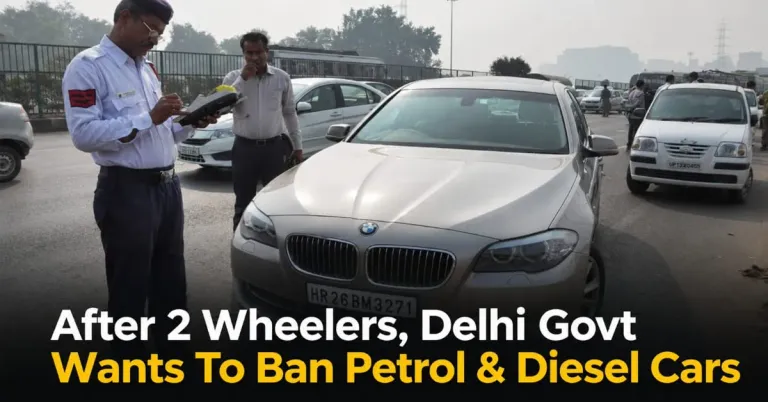
The policy lays down a clear plan to gradually phase out internal combustion vehicles. From January 1, 2027, only electric three-wheelers and sub-3.5-tonne commercial vehicles will be allowed for new registrations. From April 1, 2028, the registration of new petrol and CNG two-wheelers will stop. Only EVs will be allowed to register from there on. At least 30 percent of school buses must be electric by March 2030.
The policy has announced major subsidies and benefits for EV adopters. Electric cars priced up to Rs 30 lakh, ex-showroom will get full exemption from road tax and registration fees. This will reduce their upfront costs significantly.
Electric two-wheeler buyers will receive subsidies in the first three years- Rs 30,000 in the first year, Rs 20,000 in the second and Rs 10,000 in the third years. Electric three-wheeler buyers can get up to Rs 50,000 in the first year.
A scrappage bonus of Rs 1 lakh has also been announced for owners switching to electric vehicles from BS4 or older cars. The government also has plans to aggressively expand the charging infrastructure in the city over the next few years. Around 32,000 charging stations will be set up across Delhi. The policy will remain in force from July 1, 2026, to March 31, 2030.
Source
Comments are closed.