

Editorial Note
This article examines the circumstances surrounding a recent killing in Delhi and the broader concerns expressed by residents, officials and observers about maintaining communal harmony ahead of Eid. The report does not attribute motives to any community and is based on publicly available information, witness accounts and ongoing developments. Authorities have not indicated that the incident represents a wider communal conspiracy and investigations remain ongoing.
On the evening of 4 March in the crowded lanes of JJ Colony in Uttam Nagar in west Delhi, a young man rode his motorcycle toward home, unaware that the narrow street he had travelled through for years had become the site of a violent confrontation that would end his life within hours. His name was Tarun Butolia. He was twenty six years old. By the following morning he was dead in a hospital bed after what police say was a brutal mob assault triggered by a dispute so trivial that it would normally disappear within minutes during the chaos of a Holi celebration.
Nine days later Delhi remains caught between grief, anger, political mobilisation and legal complexity. Arrests have been made, security forces have been deployed, civic authorities have bulldozed portions of property linked to the accused, and courts have intervened to halt further demolitions. At the same time competing narratives about what actually happened that night continue to circulate, raising questions not only about the truth of the incident but about how fragile social order can become when neighbourhood tensions collide with politics, religion and the viral force of digital misinformation. JJ Colony in Uttam Nagar represents a familiar urban reality in India’s capital. It is a neighbourhood built on proximity rather than privacy. Buildings stand close together. Lanes are narrow. Families live beside one another for decades, sharing festivals, disputes and the accumulated irritations that come from living too close for too long. The families now at the centre of the Holi night killing had reportedly been neighbours for roughly fifty years. Over such a long period relationships develop layers of familiarity and resentment that remain manageable until something small suddenly pushes them beyond control.
According to the account presented by Tarun Butolia’s family, the incident began with an act that would ordinarily pass without consequence during Holi festivities. A child from Tarun’s household allegedly threw a water balloon from the balcony. The balloon struck a woman from a neighbouring family walking through the lane. Tarun’s father Memraj later told reporters that the family immediately stepped outside, apologised and explained that a child had thrown the balloon without thinking. In most situations that apology might have ended the matter. Instead the situation escalated quickly. The woman reportedly returned accompanied by relatives and neighbours. The gathering outside Tarun’s house grew rapidly. Within a short time the number of people present reportedly rose to between fifty and sixty individuals. By the time the confrontation reached this point Tarun himself was not yet at the location. He was elsewhere and began returning home on his motorcycle after receiving information that his family members were facing trouble in the lane. What happened when he arrived forms the core of the criminal case now unfolding in Delhi. According to the victim’s family and several early reports, Tarun was immediately attacked by members of the crowd using sticks, iron rods and metal pipes. Even after he collapsed unconscious the assault allegedly continued. His family managed to transport him to hospital but the injuries proved fatal and he died the following morning. Delhi Police responded during the same night and launched an investigation that has since led to a series of arrests. Fourteen individuals including two minors have been detained or arrested so far in connection with the case. Authorities have also confirmed that the investigation has invoked provisions relating to murder under the Bharatiya Nyaya Sanhita 2023, India’s new criminal code that replaced the colonial era Indian Penal Code in July 2024.
The significance of the legal framework governing the case cannot be overstated. Under the Bharatiya Nyaya Sanhita, Section 103(2) addresses situations where murder is committed by a group of five or more individuals acting together, effectively recognising mob violence as a distinct form of criminal liability within India’s new criminal justice structure. Alongside the provisions of the Bharatiya Nyaya Sanhita, investigators have also invoked sections of the Scheduled Castes and Scheduled Tribes Prevention of Atrocities Act, a law designed to address crimes motivated by caste based hostility. The inclusion of this legislation significantly alters the legal landscape of the case because it imposes stricter conditions on bail and carries serious sentencing consequences if proven during trial. The Butolia family has demanded a Central Bureau of Investigation inquiry and has repeatedly expressed concerns regarding the transparency of the investigation. According to relatives, communication with police improved only after sustained public pressure. The family has also requested that the case be heard in a fast track court so that the trial process does not stretch indefinitely.
While the investigation advanced through arrests, the political environment surrounding the case intensified dramatically when the Municipal Corporation of Delhi conducted a demolition operation on 8 March targeting what officials described as illegal construction connected to one of the accused. The demolition occurred amid heavy police deployment and was widely interpreted as a symbolic assertion of state authority following the killing. Officially the municipal corporation stated that the demolition was part of routine action against encroachments obstructing drainage infrastructure ahead of the monsoon season. However political statements suggested a different message. Public comments from government representatives emphasised that individuals involved in violent crimes would face strict consequences including action against illegal properties. The symbolism was unmistakable and echoed a pattern seen in several high profile criminal cases across northern India where bulldozer actions have become politically charged responses to violent incidents.
The legality of such demolitions quickly became the subject of judicial scrutiny. Families of the accused approached the Delhi High Court which ordered an immediate halt to further demolition activities until the matter could be examined in detail. The court’s intervention reflects an ongoing debate within India’s legal system regarding whether executive authorities can use property demolition as a punitive instrument before a criminal conviction has been secured.
While Tarun Butolia’s family maintains that he was the victim of a brutal mob assault, members of the accused family have presented an entirely different narrative. Shahin Rangrez Chouhan, whose relatives are among those arrested, has publicly denied that her family killed Tarun and claims they are being falsely implicated.
According to her account the confrontation began when a young man named Prince allegedly threw a balloon filled with dirty water at her aunt who was walking through the lane while preparing arrangements for the pre dawn meal during the fasting period. She claims the situation escalated when several young men present at the spot appeared intoxicated and behaved inappropriately toward her aunt. When her brother intervened she alleges he was attacked first. Shahin further claims that Tarun arrived later accompanied by a group of twenty to twenty five individuals carrying sticks and rods. In her version of events the fatal injury occurred during the chaos of the fight and may have been caused accidentally by someone from Tarun’s own group who struck him after mistaking him for another person in the crowd. She also alleged that Tarun had threatened members of her family weeks before the incident and claimed he had connections with the organisation Bajrang Dal. These claims have not been independently verified. The existence of two sharply conflicting narratives is not unusual in criminal cases involving large groups and chaotic street violence. However the stakes in this case extend far beyond determining which version is correct. The incident has rapidly acquired political and communal overtones that threaten to destabilise the fragile social equilibrium of the locality.
Chief Minister Rekha Gupta met Tarun’s family and publicly described the killing as reprehensible while assuring them that justice would be delivered. Protests have taken place in several locations including near Uttam Nagar East metro station. Student activists associated with the Akhil Bharatiya Vidyarthi Parishad have also demonstrated in Delhi demanding swift punishment for the accused.
Security forces including the Rapid Action Force and Central Reserve Police Force have been deployed across JJ Colony in order to prevent further escalation. The locality has been divided into police sub sectors with designated officers responsible for monitoring each zone.
The situation has been further complicated by the emergence of manipulated videos and incendiary messages circulating across social media platforms. Delhi Police have issued warnings that individuals spreading misinformation related to the case will face criminal action. Authorities say that artificial intelligence generated videos falsely depicting retaliatory violence have already appeared online, raising concerns that digital propaganda could provoke real world confrontation.
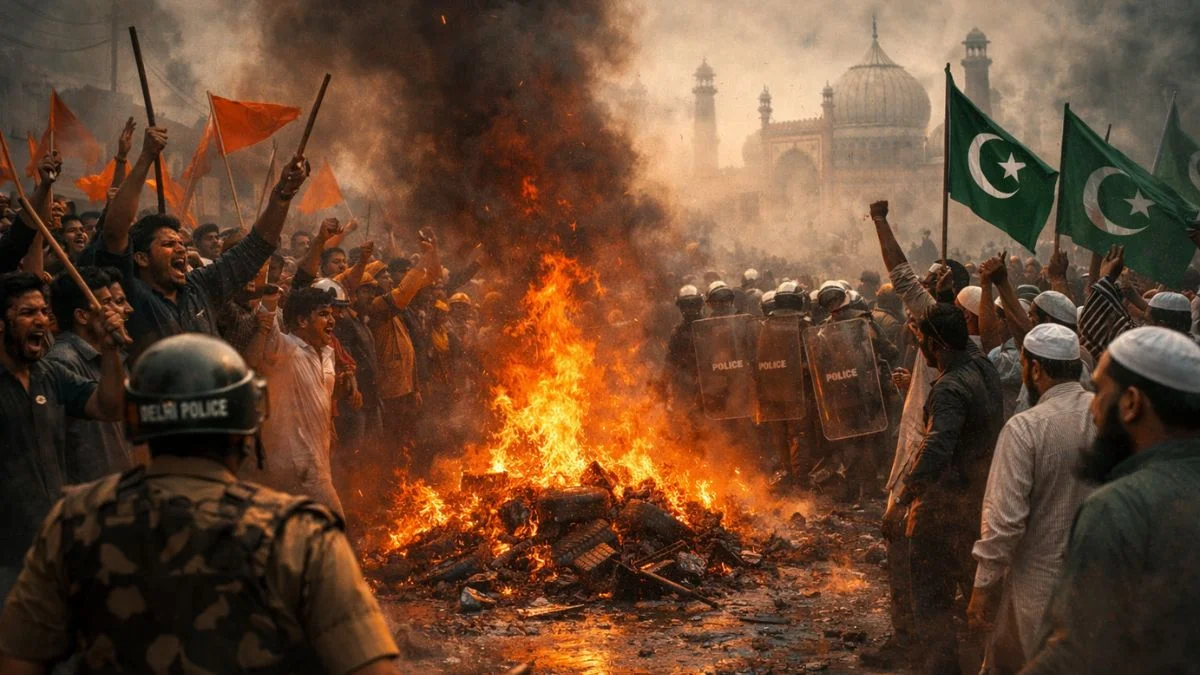
According to videos and reports in open domain, some protest groups have gone even further by issuing public statements suggesting that if authorities fail to deliver justice they may take matters into their own hands during upcoming religious festivals. Such rhetoric carries enormous risk in a city that has previously experienced devastating communal riots. When mob violence becomes linked to religious identity narratives the potential for escalation extends far beyond the neighbourhood where the original incident occurred.
Video of one of such statements being rapidly shared across social media:
For now the investigation continues. Police are preparing the formal charge sheet while legal teams representing the victim’s family push for a fast track trial. Courts will also determine whether the municipal demolition actions were lawful and whether the evidence supports the severe criminal charges filed under the Bharatiya Nyaya Sanhita and the Scheduled Castes and Scheduled Tribes Prevention of Atrocities Act. Amid all these legal and political developments the fundamental fact remains painfully simple. A twenty six year old man went out during a festival meant to celebrate colour, laughter and forgiveness. He returned to a lane where violence had already begun and within hours he was dead.
What the courts eventually establish as the precise sequence of events on that night will determine the legal fate of those accused. What Delhi must confront, however, is a broader and more uncomfortable reality. In the space of a few minutes a neighbourhood dispute transformed into mob violence, political theatre and communal tension capable of destabilising an entire city. The death of Tarun Butolia now sits at the intersection of those forces and the outcome of this case may test not only India’s new criminal laws but the ability of society itself to prevent tragedy from becoming the spark for something far more dangerous.
Disclaimer
This article is an analytical journalistic examination of a developing incident and its possible social and administrative implications. All information has been drawn from publicly available reports, eyewitness accounts and statements made by officials at the time of writing. The publication does not assert or conclude that the incident constitutes communal violence or reflects the actions of any religious community. Investigations by law enforcement authorities remain ongoing and readers are advised to treat the situation as evolving. The purpose of this article is to examine public concerns regarding law, order and communal harmony and not to promote hostility, misinformation or prejudice against any group.

Comments are closed.