

8
Rising electric vehicle adoption faces charging challenges beyond Delhi’s urban boundaries.
New Delhi:
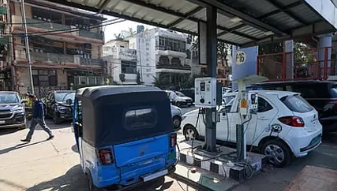
Electric vehicles (EVs) are increasingly becoming part of Delhi’s urban transport landscape, but their limitations on long-distance travel are raising concerns among users and experts, who say charging infrastructure is still uneven and unreliable outside city limits.
While EV adoption has picked up sharply in the capital, particularly among two-wheelers and compact cars used for daily commuting, users say the experience changes significantly on highways, where charging availability, downtime and interoperability issues continue to disrupt travel plans.
Within city limits, EV owners report smooth usage supported by home charging and short-distance travel cycles. However, intercity travel remains inconsistent, with users citing non-functional charging stations, long queues and fragmented payment systems as key challenges.
Delhi resident Rohan Mehta, who frequently travels between Delhi and nearby cities in an EV, said reliability remains the biggest concern.
“Inside the city, EVs are perfect. But once you go outside Delhi, you cannot depend on charging stations. One broken charger can ruin the entire trip,” Mehta said.
Another EV user, Shreya Kapoor, said planning long journeys still involves uncertainty despite improvements in infrastructure.
“Even if you plan everything, you never know if the charger will work or if there will be a queue. It is still not as predictable as petrol refuelling,” she said.
Users also point to inconsistent charging networks, where different apps, payment systems and connector types create friction during travel.
Experts say the core issue is not adoption but infrastructure readiness. While Delhi has expanded its EV charging network in recent years, demand growth has outpaced the availability of fast-charging stations required for highway mobility.
A transport analyst said the ecosystem is still in transition.
“Delhi has made strong progress in EV adoption, but long-distance reliability depends on charger uptime, density and standardisation. These are still evolving and not yet uniform,” Sharma said.
Frequent downtime at charging stations, caused by maintenance issues or power disruptions, adds to the uncertainty. Even when stations are functional, waiting times can increase significantly during peak hours, especially on intercity routes.
Despite infrastructure gaps, EV adoption in Delhi continues to grow steadily, driven by lower running costs, environmental awareness and government incentives. However, experts say the current phase reflects a partial transition rather than complete system readiness.
Policy researcher Neha Gupta said the next phase of EV growth will depend on reliability, not just expansion.
“The shift to EVs in cities like Delhi is real, but the challenge now is ensuring seamless travel across regions. Without that, users will continue to treat EVs as secondary vehicles for long-distance travel,” Gupta said.
Authorities are working to expand fast-charging corridors and improve standardisation across networks. However, experts caution that until issues of interoperability, uptime and network density are resolved, confidence in long-distance EV travel is likely to remain limited.
For now, Delhi’s EV story reflects a clear divide: strong adoption within the city, but an incomplete ecosystem beyond it.

Comments are closed.