
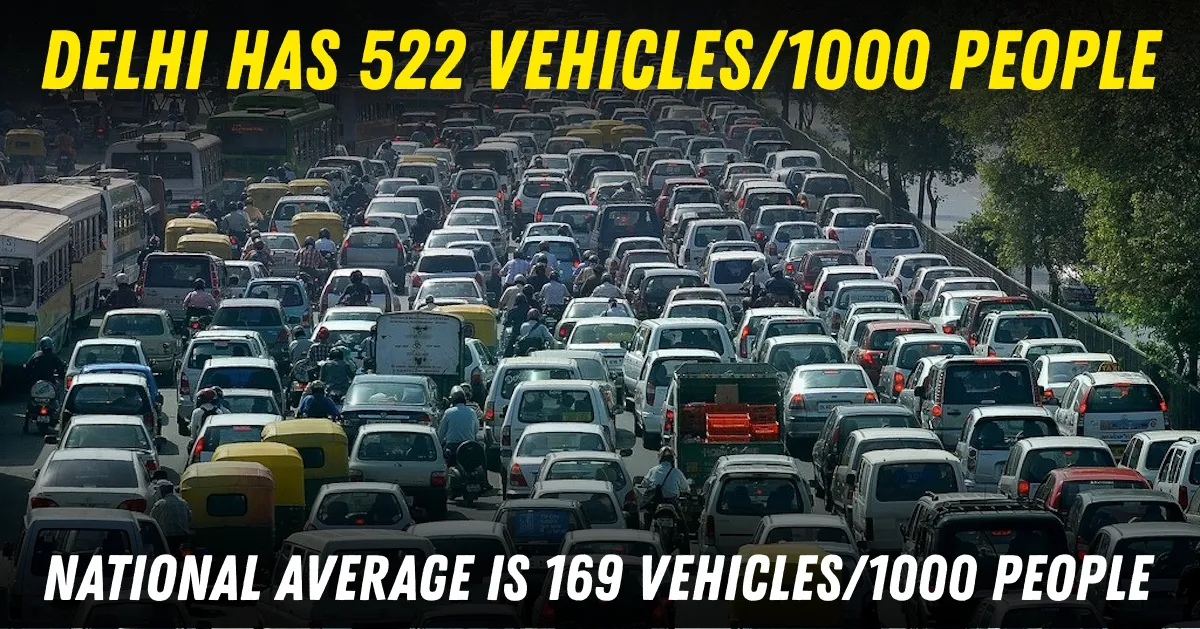

Numbers from the Economic Survey 2025-26 have made official what anyone who has driven through the capital already knows intuitively. Delhi’s roads are carrying a vehicle load that is 3.2 times higher than the national average. The specific figure is 522 motor vehicles per 1,000 people, against a national average of 169.
The total vehicle count in the National Capital Territory as of March 19 stands at 87.61 lakh, a jump of 7.93 percent compared to 2024-25. For a city with a population of 16.78 million according to the 2011 Census, those numbers describe a city where the ratio of people to vehicles is narrowing at a significant pace.
To put it plainly, Delhi is adding vehicles faster than it is adding road space, public transport capacity, or parking infrastructure. And the data suggests this trend is accelerating, not stabilising.
The city’s response to this density crisis is centred on its public transport backbone. The Delhi Metro currently operates a 352-km network, which includes 58.49 km in the NCR, 22.90 km of the Airport Line, and a 2-km extension to Yashobhoomi. Under Phase IV expansion, the total metro network including NCR lines is expected to grow to approximately 463 km, adding meaningful capacity to one of the most used metro systems in the country.
On the bus side, the Delhi Transport Corporation fleet as of March 2026 stands at 6,100 vehicles. That fleet includes 1,002 non-AC CNG buses, 760 AC CNG buses, 2,750 AC low-floor 12-metre electric buses, and 1,588 AC low-floor 9-metre electric buses. The DTC moves approximately 29 lakh passengers daily and covers 5.01 lakh km per day. The scale of the electric bus transition here is significant. A large share of the current DTC fleet is already electric, which directly reduces per-kilometre emissions from public transport even as private vehicle numbers climb.
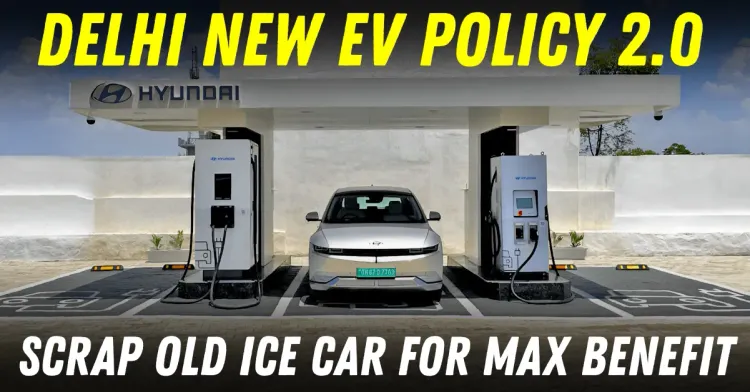
On the private vehicle side, the city’s EV policy aims to accelerate electric adoption through purchase incentives, road tax waivers, registration fee exemptions, and a growing charging and battery swap network. As of March 31, 2025, Delhi had 3,100 charging stations and 893 battery swapping stations operational within its boundaries.
These are meaningful numbers for a city of this size, but they need to keep pace with the growth in both total vehicles and EV registrations. The challenge is that EVs currently represent a small fraction of the 87.61 lakh vehicles on the road. The bulk of that fleet is still petrol and CNG powered. Even with 3,100 charging points, the infrastructure is serving a relatively small slice of the overall vehicle population.
The survey also notes that women travelling in DTC and cluster buses continue to do so for free. During 2025-26 up to February, 56.21 crore women used this free travel provision, with the subsidy amounting to Rs 562.17 crore. This program matters for the overall congestion argument because every commuter who shifts from a private vehicle to public transport is one fewer car on a road already operating beyond comfortable capacity.
The data from the Economic Survey does not read like a problem on the horizon. At 522 vehicles per 1,000 people, and growing at nearly 8 percent year on year, it is a problem that is already here.

Comments are closed.