
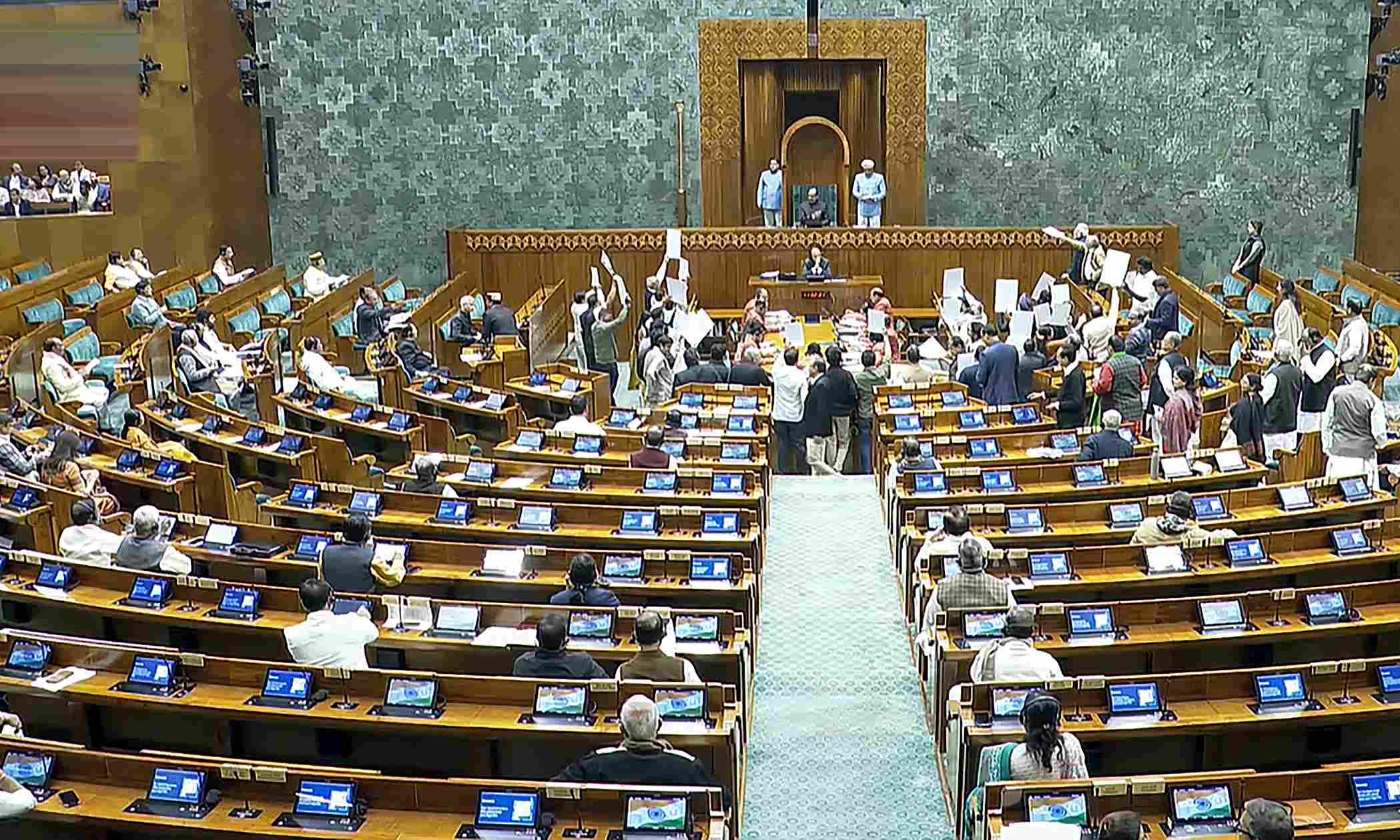

The Centre’s proposal to amend the Naari Shakti Vandan Adhiniyam for hastening the rollout of women’s reservation while simultaneously increasing the number of Lok Sabha seats of all states by 50 per cent has put the Opposition in a bind. The Opposition can’t be seen stalling any effort that accelerates implementation of the one-third ‘women quota’ in Lok Sabha and State Assemblies but supporting the Centre’s move would concomitantly pave the way for a skewed delimitation exercise designed to put the ruling BJP’s rivals at a clear electoral disadvantage.
Also read: Amit Shah blames Congress for Naxalism: ‘What kind of govt were you running?’
The Centre had reached out to some Opposition leaders last month with a plan to expedite implementation of the women’s reservation law passed by Parliament in September 2023. According to sources on both the ruling and Opposition sides, Union Home Minister Amit Shah had informed Opposition leaders, including AIMIM chief Asaduddin Owaisi and senior NCP-SP MP Supriya Sule that the government planned to do away with the 2023 law’s provision that made delimitation following the first Census conducted after 2026 a mandatory precursor to reserving one-third seats in Lok Sabha and State Assemblies for women.
Increasing Lok Sabha’s strength from 543 to 816 MPs
Shah is learnt to have told the Opposition leaders that the government is willing to increase the Lok Sabha’s strength from 543 to 816 MPs and proceed with delimitation of constituencies on the basis of the 2011 Census to ensure that women’s reservation can be rolled out with the 2029 Lok Sabha polls.
Also read: FCRA amendment Bill: Congress claims it favours RSS; Centre says ‘false’
The government’s offer to uniformly increase the number of seats each state (with the likely exception of states and Union Territories that have only a single MP) currently has in the Lok Sabha by 50 per cent was meant to pacify Opposition outfits who feared that delimitation on the basis of population would penalise southern states for taming population and reward Hindi heartland states like Uttar Pradesh and Bihar for performing poorly on this score.
Southern states will be marginalised, claims Telangana CM
Shah’s formula, however, has only agitated the BJP’s rivals further. On Monday (March 30), Telangana chief minister Revanth Reddy expressed strong reservations against the proposal to uniformly increase the share of seats for all states by 50 per cent, claiming that this would marginalise southern states while disproportionately benefitting states in the north.
Reddy explained that while the ‘uniform increase’ formula would see the collective strength of Telangana, Andhra Pradesh, Karnataka, Kerala and Tamil Nadu go up from the current 129 seats to 195 seats – an increase of 66 seats – the seat share of just Uttar Pradesh and Bihar, both NDA strongholds, would increase by 60 seats (from their current collective strength of 120 seats to 180 seats).
Also read: What’s behind Trump’s flip-flops on Iran war?
If the prospective increase in seats across Delhi, Chhattisgarh, Madhya Pradesh, Rajasthan, Maharashtra, Haryana, Uttarakhand, Himachal Pradesh, Gujarat, Punjab and Jharkhand – most of which are currently seen as BJP bastions – is added to the tally of UP and Bihar, it would form a block of 471 seats, well above the majority mark of 408 seats in an 816-member Lok Sabha. In contrast, the five southern states will together account for a mere 195 seats.
Reddy said that if the Centre is adamant about delimitation, it should ensure that “the current difference in representation between States must be maintained”. Telangana currently has 17 Lok Sabha seats while UP has 80 seats, which pegs the current gap between the two states at 63 seats. With a uniform 50 per cent increase, Telangana would get an additional nine seats while UP will get a bounty of 40 seats, widening the gap between the two states to 94 seats.
On Tuesday, Manickam Tagore, MP from Tamil Nadu’s Virudhunagar, who is also the Congress’s whip in Lok Sabha, echoed Reddy’s views. Asserting that the 50 per cent formula would “push the southern states to the political margins”, Tagore said Shah’s proposal is meant to shift the balance of power “heavily towards the Hindi-belt”.
Opposition’s ‘legitimate concern’
Sources in the INDIA bloc told The Federal that there was a “broad consensus” among the alliance’s constituents on the argument put forth by Reddy and Tagore. “This is a very valid concern and it is not the first time that it has been articulated. A year ago, Tamil Nadu chief minister MK Stalin had taken the initiative of reaching out to his counterparts from all southern states to unitedly raise the same issue. Of course, at the time we did not know of this 50 per cent formula but now that the Union Home Minister has himself disclosed this to some of our Opposition colleagues, there is a greater urgency to raise these concerns vociferously so that injustice is not done to people from the southern states,” a senior DMK MP told The Federal.
However, while the Opposition believe it has a “legitimate concern” over the Centre’s proposal, what complicates matters for the INDIA bloc is the government’s wily move of “weaving delimitation by stealth” into the proposal for early implementation of women’s reservation.
“This is a political ploy to give the BJP a clear and long-term electoral advantage. The BJP has not been able to expand in the southern states like they have in the rest of the country. Despite their best efforts, they have only had success in Karnataka and some limited but easily reversible gains in Telangana and Andhra Pradesh. Tamil Nadu and Kerala have repeatedly rejected them. This is why they want to implement delimitation by stealth,” a CPM Rajya Sabha MP said.
“They know that if they try to push a standalone Delimitation Act after the 2027 Census to increase the number of seats, they can’t get it passed in Parliament because it would require a two-thirds majority, which the NDA doesn’t have. They are cleverly weaving this into the women’s reservation issue by saying they will implement women’s quota through delimitation based on 2011 Census. The BJP, perhaps, thinks that if they bring in delimitation this way, they will be able to do it because no political party today would risk being seen as the one creating hurdles for implementing women’s reservation. This is why the original law was also passed by consensus in 2023 even though all Opposition parties had serious reservations to the way the law was drafted without any clear timeline for the (reservation) rollout,” the CPM MP explained further.
Opposition wants all-party meeting
While a united Opposition’s resistance to the Centre’s bid of pushing the proposed amendments to the 2023 Act in the ongoing session of Parliament, which is set to conclude on April 2, seem to have forced the government to hold off for now. Congress communications in-charge and chief whip in the Rajya Sabha, Jairam Ramesh said that the Opposition has jointly urged the government to convene an all-party meeting any day after April 29, by when Assembly elections in Assam, Tamil Nadu, Kerala, Pondicherry and West Bengal will conclude, and discuss the amendments it seeks to move.
Sources in the BJP, however, told The Federal that the government’s decision to not go ahead with moving the amendments in the ongoing Budget session was merely a “tactical retreat”. There is already speculation in Raisina Hill that the Centre may yet convene a special session of Parliament, possibly in April itself, to push the amendments as the BJP believes the Opposition “cannot risk alienating half the electorate (women voters) by blocking early implementation of women’s reservation”.
For the Opposition, the challenge now is to articulate its concerns against delimitation while not being seen as blocking the women’s reservation rollout – a tough task considering that the government is determined to keep the two intertwined. Some in the Opposition believe they could still argue about the “constitutional tenability” of amendments that would need to be made to the Constitution’s Article 81 and Article 8 to enable a change in the composition of the Lok Sabha and delimitation, respectively, and would require to be passed by a two-thirds majority.
“We need to see the full text of the amendments that the Centre plans to bring. So far, these haven’t been shared with anyone and we are all going primarily by what Shah told some Opposition MPs and what has appeared in the media but as far as I understand, they will have to make two separate amendments, one to the 2023 Act and another to Articles 81 and 82. The Opposition can endorse the early rollout of women’s reservation but block the amendments required to change the composition of Lok Sabha, for which we have legitimate grounds. To my mind and based on the limited information we have right now about the Centre’s plans, this is the only way forward for the Opposition,” said a Congress MP, who is also a distinguished lawyer.

Comments are closed.