
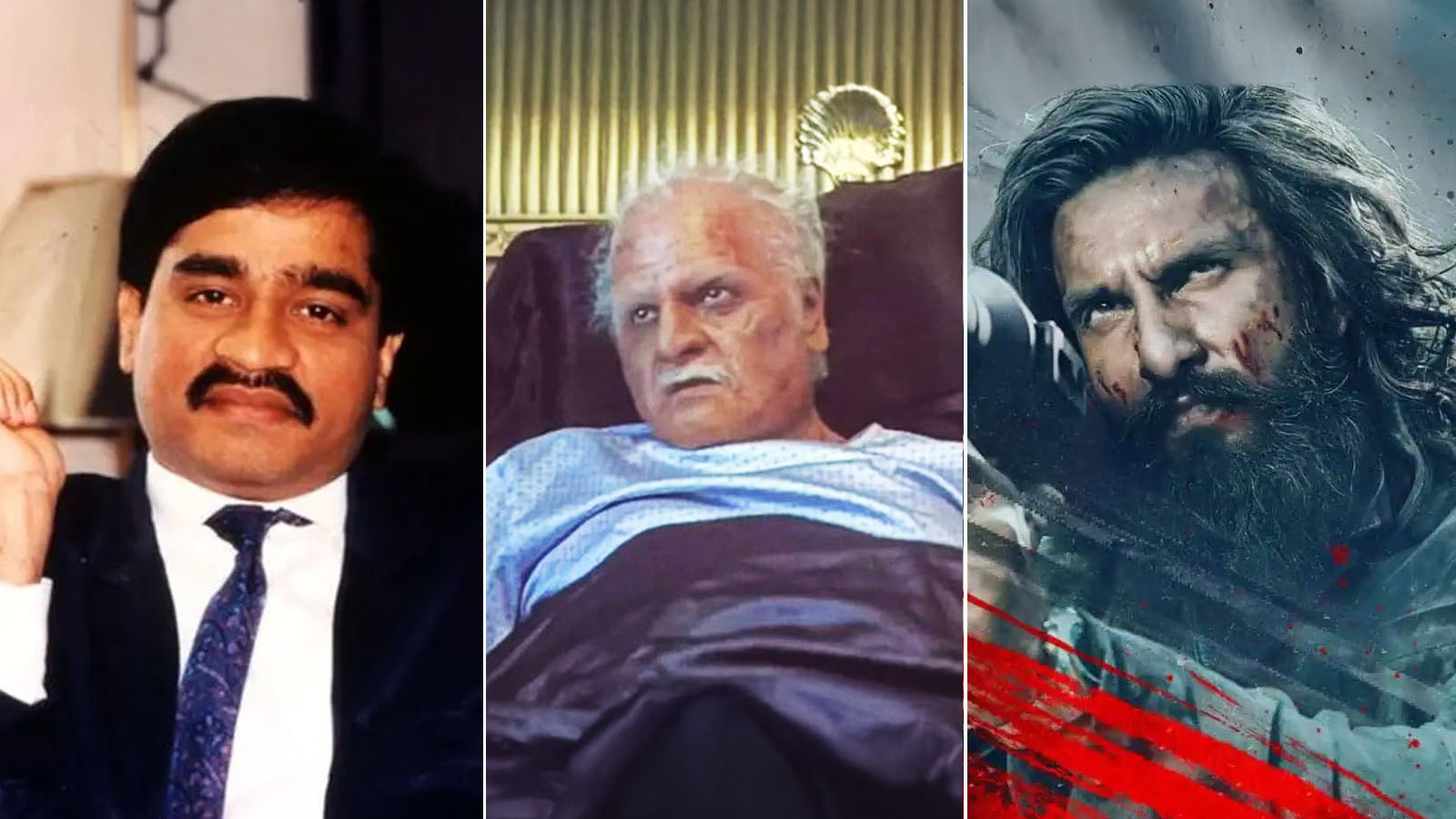

In Dhurandhar: The Revenge, we meet Dawood Ibrahim as the shadowy, mysterious antagonist ‘Bade Sahab’. His identity remains hidden throughout the first film, but is revealed in the sequel as the real-life fugitive gangster living in Karachi. Portrayed by actor Danish Iqbal, with heavy prosthetic makeup that required up to 12 hours of application, Dawood appears as a frail, older man confined to his sickbed, who still continues to exert remote control over criminal networks in Lyari, a neighbourhood in Karachi, ISI-linked handlers, and narcotics operations meant to fund militancy. In the film, which is being pilloried to push the Centre’s agenda to justify demonetisation, Dawood is the mastermind who assigns tasks to Indian spy Jaskirat Singh Rangi/ Hamza Ali Mazari (Ranveer Singh) after the latter rises in the underworld hierarchy, issuing directives for large-scale attacks on India while operating from a position of physical vulnerability.
Watching Dawood’s character in that state might make you wonder about the 70-year-old man from Mumbai who became India’s ‘most wanted’ criminal, and is rumoured to have been poisoned. You’d do well to check out crime journalist-turned-author S. Hussain Zaidi’s Dongri to Dubai: Six Decades of the Mumbai Mafia (2012), which provides an account of organised crime in Mumbai from the post-Independence period onward. Zaidi, who covered crime reporting and conducted one of Dawood Ibrahim’s final direct interviews in 1997, begins with earlier dons like Haji Mastan and Varadarajan Mudaliar before addressing Dawood Ibrahim Kaskar. Born in 1955 in Dongri to a police constable father, Dawood left school and engaged in initial theft and other activities before forming a group with his brother Sabir Kaskar.
The D-company
The book records conflicts with Pathan gangs, whose hegemony Dawood set out to break, that resulted in Sabir’s death, subsequent arrangements, contract killings, gold smuggling operations, and influence over film industry financing through demands for payments. It notes Dawood’s reported statements in a rare 1988 interview with journalist Sheela Bhatt: “I was never engaged in any gang activity… I have never extorted money from anybody… I was never into the drug business.” Zaidi records that Dawood left for Dubai in 1986 and later relocated to Karachi before the 1993 Mumbai (then Bombay) riots. During the interview with Bhatt, Dawood described his businesses in Dubai as “legitimate” and claimed he was financially comfortable enough to avoid “nefarious activities”. He explicitly stated that he hated the drug business and did not associate with those in it.
Despite his denials, Indian and international intelligence agencies have since linked his “D-Company” syndicate to extensive extortion, drug trafficking, and orchestrating the 1993 Mumbai riots following the demolition of the Babri Masjid. The story of the eventual rise of Dawood Ibrahim is inextricably linked to his bond with his mentor, Khalid Khan, popularly known as Khalid Pehalwan or Khalid Khan Bachcha. A former wrestler (wrestler)-turned-smuggler, Khalid was a towering, brawny figure who took a young, scrawny Dawood under his wing in the seedy underworld of 1970s Bombay. Khalid, a strategic thinker with an economics background, introduced corporate-style management to the smuggling syndicate, moving operations from petty street crime to sophisticated logistics. Under Khalid’s guidance, Dawood, son of Mumbai Police head constable Sheikh Ibrahim Kaskar, learned how to build a relationship with law-enforcement and restructure his gang into the dreaded ‘D-Gang’.
Also read: Why Aditya Dhar’s Dhurandhar films are India’s very own wish-fulfilment military drama
Khalid’s loyalty to Dawood was proven in life-or-death situations. Most notably, in October 1980, Khalid saved Dawood’s life outside the Nagpada police station by pushing him out of the path of a bullet intended for his heart. His attackers were Pathan cousins Amirzada and Alamzeb, who were hiding inside Memnani Mansion, an old V-shaped building located near Nagpada Junction, known for the popular Irani hotel Sarvi; located on the ground floor, Sarvi serves arguably the best seekh-kebab and rotis in Mumbai. Zaidi writes in Dawood’s Mentor: The Man Who Made India’s Biggest Don (2018) how Khalid sustained a gunshot wound in the process, which led to a “blood bond” between the two and made Khalid indispensable to the young don’s survival and ascent.
It was Khalid who had advised Dawood: “You will remain the king of mischief till the time you do not drink alcohol and do not have sex.” (You will remain the king of the Mumbai underworld as long as you avoid alcohol and involvement with prostitution). Their partnership eventually came to an amicable end, which was highly unusual in the volatile Mumbai mafia world. As the nature of their smuggling business evolved — and as Dawood’s ambitions outgrew local constraints — the two realised their paths were diverging. Khalid left for Dubai in the early 1990s, retiring from the underworld life, and remained inaccessible to most.
Zaidi’s previous book, Black Friday: The True Story of the Bombay Bomb Blasts (2002), which was adapted into a film by Anurag Kashyap, focuses on the March 12, 1993, bombings in Bombay that resulted in 257 deaths and over 1,400 injuries. Based on four years of examining records, interrogations of figures including Tiger Memon, and statements from those in Dawood Ibrahim’s network, it outlines the preparation involving RDX transport through Dubai routes, assembly of devices, and strikes on locations such as the Bombay Stock Exchange and other sites. Dawood Ibrahim is identified in the account as having provided financial and planning support in response to the Babri Masjid events and subsequent riots. The book incorporates official FIRs, and trial proceedings to describe the shift in the syndicate’s operations toward these coordinated actions.
Byculla to Bangkok (2014), also by Zaidi, details the activities of Chhota Rajan and Abu Salem from bases in Dubai and Karachi, covering extensions into film financing, property-related demands, and financial transfer systems. The book references the displacement of mill workers into related criminal structures and the syndicate’s reported connections to external entities for operational support. It records how these networks maintained operations despite Dawood Ibrahim’s location outside India. B.V. Kumar’s DRI & the Dons: The Untold Stories (2019) presents the perspective of a former Director General of the Directorate of Revenue Intelligence. Kumar personally conducted an interrogation of Dawood Ibrahim in July 1983 under the Conservation of Foreign Exchange and Prevention of Smuggling Activities (COFEPOSA) Act, 1974, in connection with gold smuggling cases.
A new life in Karachi
Kumar describes Dawood as “an ordinary-looking coward person” who admitted participation in organised criminal activities during questioning. The account covers the Directorate of Revenue Intelligence’s operations against smuggling networks, including those linked to Haji Mastan, Dawood’s reported injury from an accidental discharge during travel from Porbandar, his detention, an unsuccessful bail application involving Ram Jethmalani, and his subsequent departure from India after release on bail. Kumar states the book’s aim is to highlight the DRI’s role in addressing these syndicates.
Also read: Dhurandhar: The Revenge has a screenplay mired in clichés, but plays to the gallery
American writer Gilbert King’s The Most Dangerous Man in the World: Dawood Ibrahim (2004) is slim at only 120 pages, but it addresses Dawood’s billionaire gangster status, alleged protection of Osama bin Laden, nuclear-related dealings, and his alleged support to terrorism. King connects D-Company operations to al-Qaeda support, events preceding 9/11, and Pakistan’s nuclear ambitions. He talks about his residence in Karachi, conflicts with Chhota Rajan and alleged ISI associations. The book, however, has faced criticism for relying on claims that lack full independent verification.
Black Scorpion: To Hell and Back (2025), based on the account of Shyam Kishore Garikapati (known in operations as Black Scorpion, a former associate and shooter for Dawood Ibrahim), was compiled by journalists Vijay Shekhar, Raju Santhanam, and Calvin Joshua. It covers gang conflicts in the 1980s and 1990s, including attempts on Chhota Rajan, recorded communications revealing divisions, and an incident at JJ Hospital tied to a relative’s death. The book describes internal group meetings to address disputes, changes in alignments, and operational methods under Dawood Ibrahim’s direction from outside India.
Over time, Dawood became one of the ‘most wanted’ men in the world. When the United States declared him a global terrorist in 2004, his associates treated it as a badge of honour. He named several of his residences ‘The White House,’ including homes in Dubai, Karachi, and London. While living in Dubai and Sharjah, he tried to recreate a version of India abroad, bringing Bollywood celebrities to perform and influencing cricketers. At the same time, he repeatedly sent messages through political contacts expressing his desire to return to India. Each attempt was rejected, but he continued trying until the 1993 blasts made it clear that a return was no longer possible.
In Karachi, he was offered protection, a new identity, and a fresh start, though at the cost of becoming dependent on the Pakistani establishment. Confident in his financial power, he believed he could maintain control of his own position. Dawood’s presence in Pakistan has deepened mistrust between the two countries. India has consistently demanded his extradition, while Pakistan has denied that he is on its soil, even as he is widely believed to serve as a strategic asset. Dawood first lived in a bungalow in the Clifton area in Karachi before building a grand residence called Moin Palace after the birth of his son, Moin, following three daughters: Mahrooq, Mahreen, and Mazia. The mansion is heavily guarded and considered one of the most secure properties in the area, with constant surveillance by paramilitary forces. The don we see in Dhurandhar: The Revenge, however, is a pale shadow of his former self, effete, weathered by years, on the verge of becoming history.

Comments are closed.